U.S. Gov't To Shock Gold Investors On April 15 
As Recession Odds Climb, Defensive Sectors Continue to Outperform Written by Jessica Mitacek on April 1, 2026 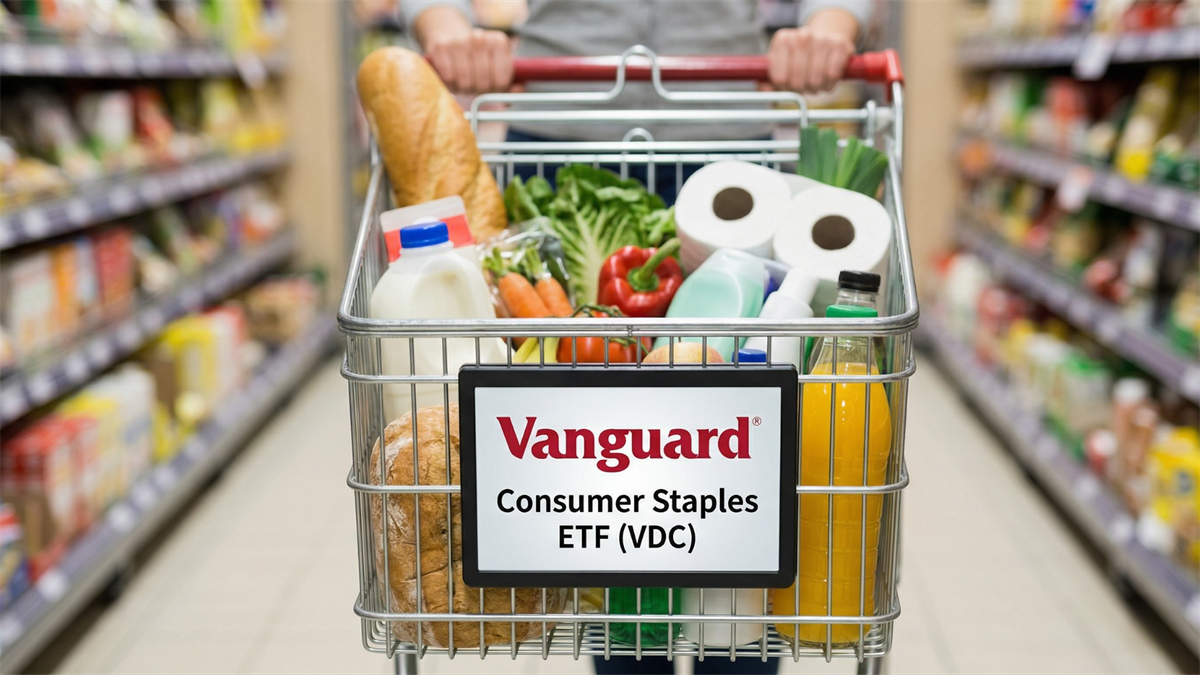
Key Points - Persistent inflation, market corrections, and the conflict in Iran have severely dampened consumer confidence, with key measures falling to levels associated with an impending recession.
- As growth-focused tech stocks stumble and Main Street budgets tighten, investors are flocking to the consumer staples sector, which is currently outperforming the broader S&P 500 as a hedge against volatility.
- The Vanguard Consumer Staples ETF offers a low-volatility hedge, providing exposure to Dividend Kings with inelastic demand that offer steady income and reliable performance during economic downturns.
- Special Report: $50 billion. One stock offering. June.
 This year’s exodus from tech stocks and other growth-focused corners of the market has been well-documented. But after the NASDAQ and Dow Jones Industrial Average both entered a correction last week, it is increasingly evident that Main Street is feeling the pinch just as much as Wall Street. Consumer discretionary, for example, is 2026’s second-worst performer of the S&P 500’s 11 sectors through the first quarter of the year, which underscores how Americans are dealing with sticky inflation and subsequently tighter budgets. Outside of the stock market, the Conference Board’s Expectations Index has fallen below the 80-point threshold, a level historically associated with an impending recession. The drag has been exacerbated by the war in Iran and expectations of higher inflation. But while consumers are tightening their purse strings, it presents an opportunity for defensive-minded investors, specifically consumer staples. The fourth-best performer in the S&P 500 this year, consumer staples will continue to act as a hedge against additional downward price action in growth and cyclical sectors as Americans continue to prioritize needs over wants. For broad exposure, the Vanguard Consumer Staples ETF (NYSEARCA: VDC) offers a basket of stocks that showcases the largest companies operating in that sector, alongside a dividend that pays shareholders to wait out any potential economic downturn. Your electric bill is up 42% since 2019, and utilities requested $31 billion in rate hikes last year alone. The culprit: AI data centers consuming power at a scale the grid was never designed to handle. The last time a bottleneck like this formed, three overlooked infrastructure stocks surged 1,700%, 1,900%, and 900% before Wall Street caught on. One analyst has identified the next candidate - earlier in the cycle, smaller, and positioned at a chokepoint that even the largest players cannot build around. See the one infrastructure stock Wall Street is about to chase As Consumer Confidence Wanes, Consumer Staples Benefit From the American Association of Individual Investors’ sentiment survey and CNN’s Fear & Greed Index to the University of Michigan’s Surveys of Consumers, bearishness, fear, and insecurity are dominating investor and consumer mindsets. According to Surveys of Consumers Director Joanne Hsu, over the past month, “declines were seen across age and political party. Consumers with middle and higher incomes and stock wealth, buffeted by both escalating gas prices and volatile financial markets in the wake of the Iran conflict, exhibited particularly large drops in sentiment.” Hsu added that the near-term economic outlook fell by 14%, and expectations for personal finances over the next year dropped by 10%. That waning consumer confidence is good news for stocks operating in the consumer staples sector—a corner of the market that has been overlooked in recent years as growth stocks maintained the narrative. But after finishing 2025 second-to-last among all sectors with an uninspiring 3.9% gain, consumer staples is back in the spotlight as it is outperforming the broad S&P 500 for the first time since 2022 during the last bear market. Inside VDC: A Staples Basket Built Around Inelastic Demand The VDC caters to investors who are aiming to insulate their portfolios with companies offering goods that are inelastic in demand. The fund seeks to track the investment performance of the MSCI US Investable Market Consumer Staples 25/50 Index, a benchmark of large-, mid-, and small-cap U.S. consumer staples stocks. Like the index it tracks, the VDC is composed of companies whose businesses are less sensitive to economic cycles and includes manufacturers and distributors of food, beverages, tobacco, nondurable household goods, and personal products. It also includes food and drug retailing companies as well as hypermarkets and consumer supercenters. The result is a basket of stocks that, among its roughly 109 holdings, range from its largest constituent having a market cap of nearly $985 billion to its smallest constituent having a market cap of under $105 billion. Showcasing its diverse portfolio of companies that provide essential consumer goods, Walmart (NYSE: WMT), Costco (NASDAQ: COST), Procter & Gamble (NYSE: PG), Coca-Cola (NYSE: KO), and PepsiCo (NASDAQ: PEP) make up the top-five holdings with a collective weighting of more than 49%. The ETF is also a reliable source of income, highlighted by four of the fund’s top-five holdings being members of the exclusive Dividend Kings club (Costco being the sole exception, though after 22 consecutive years of increases, the warehouse club is nearing membership in the Dividend Aristocrats club). The VDC currently yields 2.15%, or $4.82 per share annually, paid in quarterly distributions. Stocks crashed in 2008, 2020, and 2022 - and recovered every time. The dollar hasn't bounced back once in 50 years. Over the past five years alone, it has lost nearly 20% of its purchasing power, quietly and without alarm bells. Louis Navellier, a 47-year market veteran who recommended Apple at $1.49 and Amazon at $46, has put together a free briefing on why the wealthiest investors fear holding dollars - and the steps he believes you should take now. Watch Louis Navellier's free briefing and learn how to protect your wealth Year-to-Date Performance Hints at Exactly What Investors Should Expect So far in 2026, the VDC has posted a nearly 6% gain. While that may not catch the eye of growth investors who have enjoyed the triple-digit gains posted by some of the top semiconductor and AI stocks over the past few years, that gain demonstrates exactly why conservative-minded investors turn to the fund: low volatility, steady gains, and market outperformance during downturns. For context, the S&P 500 has lost nearly 8% this year. Meanwhile, the VDC’s beta of 0.56 demonstrates that the fund is nearly half as volatile as the overall market—something that should be alluring to investors looking to safeguard their portfolios during a time of uncertainty, global conflict, and regulatory pressure. Read this article online › Featured Articles 
Did you enjoy this article?  
|