|

It's 'Round To It' Time ~
Wednesday, October 14, 2026
September CPI Prints at 8:30. Four Defensive Sectors Were Already Positioned.


Tuesday, October 13, 2026
USAU Could Be Entering its Most Important Stretch Yet!
| Unsubscribe |
This has been disseminated on behalf of U.S. Gold Corp.

USAU Has Something Important to Watch: A Fully Permitted U.S. Gold-Copper Project Moving Toward Construction!
U.S. Gold Corp. (NASDAQ: USAU) is entering a potentially important stretch with its flagship CK Gold Project in Wyoming now fully permitted, shovel-ready and backed by a completed 2026 feasibility study.
The project carries approximately 1.6 million ounces of proven and probable gold-equivalent reserves, with the study outlining an estimated 11-year mine life and average production of roughly 85,000 gold-equivalent ounces per year. At the feasibility study's $3,250 gold base case, CK Gold generated an estimated after-tax NPV5 of approximately $632 million, while a modeled scenario using roughly $4,500 gold increased that figure to approximately $1.37 billion!
Eric Sprott, Terra Capital, Franklin Templeton, and Mackenzie Investments are also among the notable investment names positioned in USAU.
Now USAU is moving toward the next phase: financing and construction. The company is targeting a construction decision as soon as the second half of 2026 while evaluating debt, equity, streaming and offtake opportunities designed to limit shareholder dilution. At the same time, USAU is exploring additional resource growth at CK Gold, evaluating strategic M&A interest and considering a potential spin-out of its Keystone Project in Nevada.
With financing, construction, exploration and strategic developments all potentially ahead, put USAU on your radar and keep watching as this U.S. gold story moves closer to development.
This Month's Exclusive Story
Saddle Up: Texas Stock Exchange Ropes In $80 Billion in Listings
Submitted by Jeffrey Neal Johnson. First Published: 10/2/2026.

Key Points
- The Texas Stock Exchange begins its corporate listings rollout in October, challenging the New York Stock Exchange and Nasdaq's longtime dominance.
- Energy Transfer, Dillard's, and Texas Capital Bancshares are moving roughly $84 billion in combined market capitalization to the TXSE, citing lower fees and reduced friction.
- Backed by Citadel Securities and BlackRock with about $430 million in capital, the TXSE's real test will be attracting large-caps without Texas ties.
- Special Report: Trump goes "all-in" on Grand Canyon energy breakthrought.
For decades, the New York Stock Exchange and Nasdaq (NASDAQ: NDAQ) have dominated U.S. corporate listings. That dynamic faces a structural test this October as the Texas Stock Exchange (TXSE) begins rolling out corporate listings. TXSE already launched live trading in July, followed by its first exchange-traded product (ETP) listings in September.
Backed by institutional heavyweights, the Dallas-based upstart is actively courting established companies away from legacy platforms. Securing multi-billion-dollar primary listings from Energy Transfer (NYSE: ET), Dillard's (NYSE: DDS), and Texas Capital Bancshares (NASDAQ: TCBI) gives investors a real opportunity to assess whether lower issuer costs and regional loyalties can permanently disrupt U.S. capital markets. This migration signals a potential shift in how public corporations manage their capital-market footprints.
Building the New Frontier: The Mechanics of the TXSE
The Rumors About Elon’s Next Move Are Spreading Fast (Ad)
Rumors are circulating that Elon Musk is preparing to acquire three publicly traded companies.
Dr. Mark Skousen, who met Musk in person and called the SpaceX listing months early, says he has identified all three targets in what he calls Elon's $2.1 Trillion Hit List.
See the three companies before the rumors become headlines.
Get the details on all three companies nowThe TXSE closed a funding round in September 2026, pushing its total capitalization to approximately $430 million. This capital pool is critical because it helps secure the high-frequency market-making infrastructure required to handle large-cap trading volume. With Citadel Securities and BlackRock (NYSE: BLK) providing market infrastructure, TXSE is addressing historic concerns that regional exchanges lack the liquidity to support major corporate equities.
What the exchange offers issuers centers largely on economics. Corporate boards constantly evaluate compliance costs and exchange fees, which can erode cash flow over time. TXSE promises a technology-driven framework designed to reduce operational friction and lower the cost of maintaining a public listing. By creating a transparent, dedicated third alternative, the exchange's leadership aims to encourage more competitive pricing across national listings.
Pioneers of the Plains: Energy and Retail Head South
The October migration of Energy Transfer and Dillard's establishes an approximately $80 billion beachhead for the Dallas platform. Both companies maintain deep geographic ties to Texas, but the underlying reasons for their moves tell a more nuanced story about capital efficiency and margin protection.
Energy Transfer Pipelines Lower Overhead Costs
Energy Transfer targets a leverage ratio of 4x to 4.5x EBITDA and has a market capitalization of about $68 billion. Managing that balance sheet requires highly efficient capital markets to roll maturities forward and fund ongoing infrastructure projects without penalizing equity holders. Energy Transfer currently supports a forward distribution yield of about 6.8%, and any reduction in corporate overhead directly helps support that high-yield payout structure.
Energy Transfer is transitioning its common units alongside its Series I preferred units. Moving a complex, multi-tiered capital structure demonstrates the TXSE's technological parity with legacy exchanges.
Insider activity suggests management sees clear value in the transition. Corporate directors accumulated more than one million shares in recent months, deploying about $21.5 million in capital. While founder Kelcy Warren is an early investor in TXSE, the broader strategic value lies in accessing a secondary capital avenue as Energy Transfer navigates fluctuating commodity cycles. Shares declined about 5.5% over the trailing 30 days amid broader energy volatility, making cost-saving structural moves timely.
Dillard's Hedges Retail Margins in the Lone Star State
Retail operates on tight margins, and Dillard's faces sustained macroeconomic pressures. Rising global tariffs have directly affected the cost of goods sold across the department-store sector, squeezing profitability from the top down. With a trailing price-to-earnings ratio near 15x, above the peer average, Dillard's management is actively searching for ways to defend bottom-line profitability against these structural headwinds.
Dillard's reincorporated in Texas in 2025 and operates its largest retail footprint in the state. Leveraging TXSE's promised reduction in listing fees could help offset broader margin compression. By transitioning its Class A shares and capital trust securities, Dillard's effectively turns administrative cost savings into a direct defense of its operating margins. Price action has remained choppy and range-bound recently, with shares peaking near $688 before retracing. Locking in lower structural costs provides a tangible financial benefit while consumer discretionary spending remains under pressure.
Banking on the Home Turf: A Regional Player Scales Up
The financial sector is represented by Texas Capital Bancshares. The regional bank is shifting its primary corporate listing and exchange-traded funds away from Nasdaq. Texas Capital Bancshares effectively stress-tested TXSE's clearing and routing mechanics in mid-September by transferring two ETFs to the platform as part of the exchange's broader ETP listing launch.
This strategy aligns with the fundamental restructuring underway at Texas Capital Bancshares. Trading at a trailing price-to-earnings ratio of 12.4x, the bank is rapidly scaling its investment banking and advisory unit. Management is deliberately pivoting away from traditional net interest income toward capital-efficient, fee-based revenue streams. Transitioning to TXSE positions Texas Capital Bancshares to underwrite, advise and provide treasury services for future corporate clients looking to migrate to the new exchange.
Institutional investors appear to support the strategy. Filings show BlackRock taking a new equity stake of around 12.8%, valued at about $578 million, alongside fresh long positions from Deutsche Bank and CIBC. Insider activity reflects strategic liquidity events, notably a liquidation of about $5 million by the CEO earlier in the summer, which institutional demand readily absorbed.
High Noon for Legacy Exchanges: The Real Test Ahead
Securing approximately $84 billion in combined market capitalization across these three entities validates TXSE as a viable liquidity hub. The institutional backing and successful transfer of complex financial instruments suggest the exchange possesses the technical capacity to host large-cap equities from day one.
Early adoption currently relies heavily on geographic and advisory alignment. Energy Transfer, Dillard's and Texas Capital Bancshares all share strategic ties to Texas. The true measure of TXSE's competitive viability against the New York Stock Exchange and Nasdaq will depend on its ability to secure primary listings from corporate boards without geographic ties to Dallas. If the platform can attract non-affiliated large-cap companies in upcoming quarters by relying strictly on superior issuer economics and reduced regulatory friction, the U.S. capital markets may face a genuine paradigm shift.
Investors may want to monitor the bid-ask spreads and daily trading volumes of these three early adopters throughout October. A seamless transition with sustained liquidity could pave the way for a broader corporate exodus, signaling an opportune time to evaluate the competitive positioning of legacy exchange operators.
This Month's Exclusive Story
Why onsemi’s Synaptics Pivot Could Be a Game Changer
Submitted by Thomas Hughes. First Published: 10/6/2026.

Key Points
- onsemi revised its bid for Synaptics from an all-stock deal worth more to a $5.7 billion all-cash offer, eliminating shareholder dilution.
- The new cash structure makes the deal immediately accretive to earnings at closing, lets onsemi retain full ownership, and offers Synaptics investors $123 per share.
- Synaptics adds wireless connectivity, NPUs, and its Astra AI platform, complementing onsemi's power and sensing portfolio to support physical AI and robotics alongside NVIDIA.
- Special Report: Trump goes "all-in" on Grand Canyon energy breakthrought.
onsemi’s (NASDAQ: ON) all-stock bid to acquire Synaptics (NASDAQ: SYNA) initially depressed its share price, but circumstances have since changed. The sharp decline undercut the value of onsemi’s all-stock offer, enabling a competing suitor to enter the mix.
Faced with a superior offer, onsemi made a nimble pivot to an all-cash deal, securing its bid and accelerating a major transformation from component provider to end-to-end physical AI systems original equipment manufacturer (OEM), and on better terms.
This AI fund sends investors payouts every Thursday (Ad)
CrowdStrike, Palantir, Nvidia none of them pay a real dividend. But one fund holding the biggest AI names distributes income every single Thursday, with payouts reported as high as $1,051 a month.
Chief Income Strategist Tim Plaehn breaks down the fund's real Thursday distribution history, how the income is generated, and how to buy it in any brokerage account.
Watch the free presentation before this Thursday's payoutWhy is the move so brilliant? Four key reasons stand out: dilution, price tag, accretion and ownership. The original deal was all stock, meaning onsemi would dilute its shares, which was the primary cause of its share price plunge. The new deal is all cash, eliminating dilution and the associated overhang while improving the equation on price, accretion and ownership.
The price tag is now $5.7 billion, down 18.57% from the initial offer, with the share count unchanged. More importantly, the revised structure is expected to be immediately accretive to earnings upon closing, compared with accretion within 18 months under the original agreement. Finally, there is ownership: onsemi shareholders will retain 100% ownership, sharing no part of the business with Synaptics’ investors, who will receive $123 per share—a nearly 35% premium to the 150-week exponential moving average price.
onsemi’s Metamorphosis Is Nearly Complete
onsemi’s transition is significant, and its metamorphosis is nearly complete. While hurdles remain, they appear manageable, given the Federal Trade Commission’s Early Termination Notice. The notice effectively indicates that the deal does not raise significant competition concerns and can close more quickly than usual. As it stands, the deal is set to close by mid-next year, setting the stage for onsemi’s next phase.
What Synaptics brings to onsemi complements its already robust portfolio of power-control and sensing devices, adding wireless connectivity, neural processing units (NPUs) and the Astra AI platform. Product highlights include ultra-low power consumption, edge AI without cloud backup and an easy-to-use open-source framework.
Wireless connectivity spans the range, enabling autonomous machines to access local networks and Wi-Fi. More importantly, Synaptics’ industry-leading NPUs address a critical hurdle—obsolescence—through a dual-brain approach developed in close partnership with Alphabet (NASDAQ: GOOGL).
Synaptics’ contribution handles on-site tasks such as sensing, while Alphabet’s contribution is programmable, allowing it to adapt to inevitable code changes and upgrades. Together, onsemi and Synaptics cover the four pillars of physical AI—power, sensing, connected compute and control—in a single package, creating a foundation on which developers can build.
onsemi: Critical to NVIDIA’s Long-Term Plans
onsemi is already central to NVIDIA’s (NASDAQ: NVDA) near-term AI plans, providing essential power-delivery technology capable of handling the loads required by data centers, particularly next-generation 800VDC architectures. It is also pivoting alongside NVIDIA’s shift toward physical AI and robotics, positioning itself as the muscles and nervous system supporting NVIDIA’s AI brains. Executives estimate the opportunity at $6 billion by 2030, with onsemi capturing $900 in value per humanoid robot.
Analyst trends reflect confidence in the shift, but analysts moderated their price targets following the initial acquisition announcement. The announcement introduced dilution and execution risks, only one of which has now been mitigated. Other key details include the consensus analyst rating and price-target range, which show a 50% buy-side bias within the Moderate Buy rating and room for a robust price recovery. The consensus price target offers minimal upside but could be sufficient to trigger a technical reversal, while the high-end target suggests the potential to reach fresh all-time highs.
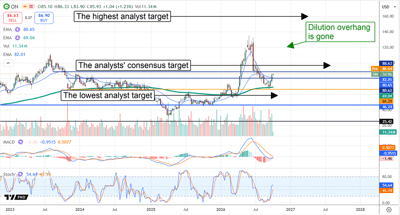
Institutions will be the deciding factor. The group owns nearly 98% of the stock, reflecting strong confidence and underpinning all major sustainable price movements. That includes the early 2026 price plunge, which helped set up today’s opportunity. While selling may continue, the market no longer has an overhang. Instead, it has a catalyst that only needs to be executed to deliver immediate value gains. In this scenario, institutions might not immediately resume accumulation, but they are likely to stop selling, freeing up price action.
The only bad news is that buybacks will pause. However, the new structure and onsemi’s balance sheet mean the company can finance the deal mostly with cash on hand. Morgan Stanley (NYSE: MS) has agreed to finance the remainder, up to $2.5 billion—an amount onsemi should be able to pay off easily. Executives target a 25% to 30% free cash flow margin, sufficient to pay off the new debt within 18 to 24 months. What will remain is a larger, better-positioned company with greater revenue, cash-generating and capital-returning capacity.
Thank you for subscribing to DividendStocks.com's daily newsletter for dividend and income investors that covers ex-dividend stocks, new dividend declarations, dividend stock ideas, and the latest market news.
This email message is a paid sponsorship sent on behalf of Trading Wire, a third-party advertiser of DividendStocks.com and MarketBeat.
This message is a paid advertisement for US Gold Corp. (NASDAQ: USAU) from Trading Wire and Sideways Frequency. MarketBeat Media, LLC receives a fixed fee for each subscriber that clicks on a link in this email, totaling up to $4,500. Other than the compensation received for this advertisement sent to subscribers, MarketBeat and its principals are not affiliated with either Trading Wire or Sideways Frequency. MarketBeat and its principals do not own any of the stocks mentioned in this email or in the article that this email links to. Neither MarketBeat nor its principals are FINRA-registered broker-dealers or investment advisers. The content of this email should not be taken as advice, an endorsement, or a recommendation from MarketBeat to buy or sell any security. MarketBeat has not evaluated the accuracy of any claims made in this advertisement. MarketBeat recommends that investors do their own independent research and consult with a qualified investment professional before buying or selling any security. Investing is inherently risky. Past-performance is not indicative of future results. Please see the disclaimer regarding US Gold Corp. (NASDAQ: USAU) on Sideways Frequency' website for additional information about the relationship between Sideways Frequency and US Gold Corp. (NASDAQ: USAU).
If you need assistance with your newsletter, feel free to email MarketBeat's U.S. based support team at contact@marketbeat.com.
If you no longer wish to receive email from DividendStocks.com, you can unsubscribe.
© 2006-2026 MarketBeat Media, LLC. All rights protected.
345 N Reid Pl., Suite 620, Sioux Falls, S.D. 57103. United States..
Daily Bonus Content: Boring, cheap, and paying 6% (Click to Opt-In)
This email message is a paid sponsorship sent on behalf of Trading Wire, a third-party advertiser of DividendStocks.com and MarketBeat.
This message is a paid advertisement for US Gold Corp. (NASDAQ: USAU) from Trading Wire and Sideways Frequency. MarketBeat Media, LLC receives a fixed fee for each subscriber that clicks on a link in this email, totaling up to $4,500. Other than the compensation received for this advertisement sent to subscribers, MarketBeat and its principals are not affiliated with either Trading Wire or Sideways Frequency. MarketBeat and its principals do not own any of the stocks mentioned in this email or in the article that this email links to. Neither MarketBeat nor its principals are FINRA-registered broker-dealers or investment advisers. The content of this email should not be taken as advice, an endorsement, or a recommendation from MarketBeat to buy or sell any security. MarketBeat has not evaluated the accuracy of any claims made in this advertisement. MarketBeat recommends that investors do their own independent research and consult with a qualified investment professional before buying or selling any security. Investing is inherently risky. Past-performance is not indicative of future results. Please see the disclaimer regarding US Gold Corp. (NASDAQ: USAU) on Sideways Frequency' website for additional information about the relationship between Sideways Frequency and US Gold Corp. (NASDAQ: USAU).
If you need assistance with your newsletter, feel free to email MarketBeat's U.S. based support team at contact@marketbeat.com.
If you no longer wish to receive email from DividendStocks.com, you can unsubscribe.
© 2006-2026 MarketBeat Media, LLC. All rights protected.
345 N Reid Pl., Suite 620, Sioux Falls, S.D. 57103. United States..
Subscribe to:
Posts (Atom)