
911,000 Phantom Jobs. $90B Gov't Spending. Billionaires Exit.

Something doesn't add up. Jobs that "existed"... didn't in reality. The government deploying record AI spending. Yet Buffett holds $344B cash—his largest position EVER. Louis Navellier's grading system (46 years tracking money flows) reveals what the Wall Street elite see but won't tell you.
Click here to see where the money is going. Not AI stocks.
Microsoft Is Lagging the Market—But Its Moat May Matter More in 2026
By Chris Markoch. First Published: 12/31/2025.
Quick Look
- Microsoft’s entrenched ecosystem and high switching costs make replacing MSFT more expensive than holding, even with a premium valuation.
- Azure, Microsoft 365, and Dynamics create a unified platform that reinforces recurring revenue and widens Microsoft’s competitive moat.
- Despite moderating growth expectations, Microsoft’s subscription model and free cash flow strength support a long-term hold case for MSFT stock.
It’s not often that investors have heard the words Microsoft (NASDAQ: MSFT) and “market laggard” in the same sentence. But that’s the situation with MSFT stock with only a few trading sessions left in 2025. To be clear, Microsoft is up more than 15% this year; that’s hardly a poor performance. Still, it is trailing the S&P 500, which is up roughly 16% for the year.
Through its ownership stake in OpenAI, Microsoft has emerged as a leader in generative AI. That’s one reason some analysts are bullish on MSFT heading into 2026.
Bitcoin is down but your income is about to explode (Ad)
Bitcoin just dipped, and while most people are staring at the price, they're missing the real opportunity — this pullback could be the best setup all year for a simple, low-cost strategy that generates steady weekly income without buying crypto, opening an exchange account, or trading options. It uses a small position available in most brokerage accounts, and it's designed to deliver reliable Thursday payouts, even in volatile markets, making this moment especially important for income-focused investors.
Watch my Bitcoin Income Briefing hereBut is there enough growth to keep investors interested? In the first quarter of its 2026 fiscal year, Microsoft reported revenue of $77.67 billion, up 18% year over year (YOY). The current forecast for Q1 2027 is $88.64 billion—about a 14% YOY increase—suggesting growth may be slowing from recent highs.
Double-digit revenue growth isn’t bad. But does it justify holding a stock trading at a price-to-earnings (P/E) ratio of roughly 34x, which sits near its historical average?
One way to answer that is to examine the company’s moat. By several measures, MSFT’s competitive advantages make the stock easier to hold during market downturns.
The Cost of Switching: Deep Enterprise Integration
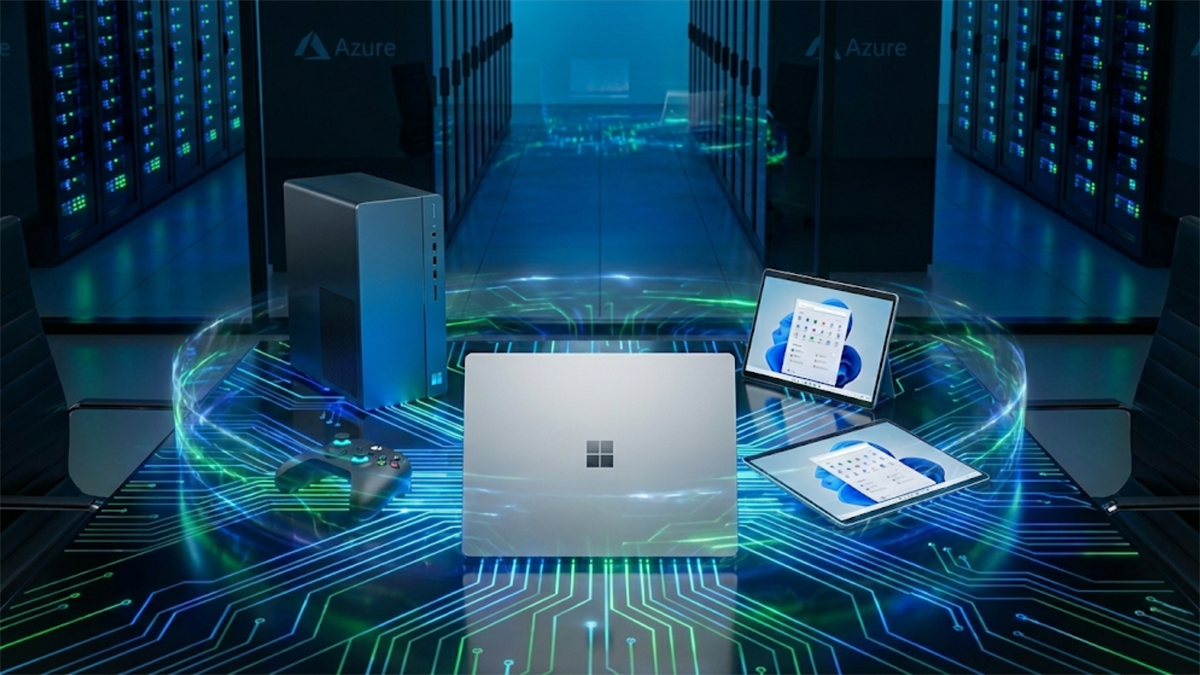
Investors may worry about slowing top-line growth. But Microsoft starts from a deeply entrenched user base: more than 400 million paid Microsoft 365 seats and 1.6 billion active Windows devices anchor the company in global IT operations.
The embedded nature of these tools makes switching both operationally risky and economically inefficient. Businesses have built processes, data systems, and communication norms around Microsoft’s infrastructure, and the longer an organization operates within this ecosystem, the more complex those dependencies become.
Migration costs often exceed any licensing savings from a rival. Beyond software fees, organizations face retraining, productivity loss, and security reconfiguration. Large enterprises rarely deem such disruption justifiable, which stabilizes renewal rates and makes recurring revenue from Microsoft 365 behave like an annuity.
A Unified Platform Creates Ecosystem Dominance
Microsoft has refined a platform strategy that connects productivity software, cloud infrastructure, developer tools, and security under one roof. Azure has become the backbone of digital transformation for many enterprises, often complementing or replacing on-premises systems.
Microsoft’s products aren’t just for large companies. Seamless integration among Microsoft 365, Dynamics, and GitHub has made the company a one-stop technology provider for businesses of every size.
This ecosystem creates a feedback loop: every new product strengthens the others, reducing the need for customers to look elsewhere. Azure workloads feed Power Platform analytics, which tie into Teams collaboration and Outlook data layers. That cohesion gives Microsoft a commanding advantage across both horizontal (productivity) and vertical (industry-specific) solutions.
Network effects amplify this dominance. Developers build on Azure because enterprises run on Azure; enterprises adopt Dynamics because their partners already do. It’s a self-reinforcing cycle that has helped transform Microsoft from a software vendor into a digital operating system for global business.
The 2026 Swing Factor: Can Copilot Turn Into Clear Monetization?
Here is where 2026 looks different from a pure “moat” story. The market already accepts that Microsoft is embedded; the bigger question is whether Copilot becomes a measurable growth driver at scale.
If Copilot drives seat upgrades, raises average revenue per user, or prompts broader deployments inside large accounts, investors will have an easier time defending a mid-30s multiple. If adoption is slower, the stock can still hold up because of the moat—but the upside may be harder to sustain.
MSFT’s 2026 narrative is likely to hinge on evidence that AI is becoming a durable revenue layer, not just a strategic positioning win.
Subscription-Driven Compounding Provides Recurring Revenue Durability
Microsoft’s revenue model has evolved into a high-visibility subscription engine. In fiscal 2025, more than 70% of total revenue came from recurring (user-based) sources. Constant seat expansion, higher-tier conversions, and cross-cloud adoption have driven mid‑teens compound annual growth in commercial cloud revenue, which now exceeds $160 billion annually and carries gross margins near 72%.
That mix of stable software margins and cloud consumption growth gives Microsoft one of the highest cash-conversion rates among large-cap technology stocks. Free cash flow topping $90 billion supports sustained reinvestment into AI infrastructure and customer retention without pressuring the bottom line.
Structural Compounding
Microsoft’s moat compounds: high switching costs protect installed bases; ecosystem breadth increases share of wallet; recurring revenue converts loyalty into high-margin cash flows. Together, these dynamics form a self-reinforcing cycle that sustains growth, funds innovation, and steadily boosts economic returns—creating one of the most predictable compounding engines in global technology.
For investors entering 2026, that is why MSFT can be easier to hold during drawdowns. The real question is whether the next leg higher will be driven by multiple expansion again—or by visible AI monetization that keeps growth closer to the high end of double digits.
This message is a paid advertisement for InvestorPlace, a third-party advertiser of MarketBeat. Why did I receive this email?.
If you have questions or concerns about your subscription, please contact MarketBeat's U.S. based support team at contact@marketbeat.com.
If you would no longer like to receive promotional emails from MarketBeat advertisers, you can unsubscribe or manage your mailing preferences here.
© 2006-2026 MarketBeat Media, LLC.
345 N Reid Pl., Sixth Floor, Sioux Falls, S.D. 57103-7078. United States..
