
Dear Reader,
What's the #1 investment today?
It's not a stock. Not crypto. Not gold.
It's a tiny device weighing less than 3 ounces.
Why? Because its software doesn't tell you what to buy. But it could help you transform how your existing portfolio performs.
We back tested it on the worst stocks in history. They would've turned from losers into winners.

Even Buffett's legendary results could have improved.
Click here now to watch the full presentation.
Sincerely,
Keith Kaplan
CEO, TradeSmith
P.S. I call this the fifth great money revolution. Don't miss your chance to see it.
Small Names, Big Impact: The Stocks Behind NVIDIA's Rubin
Reported by Jeffrey Neal Johnson. Published: 1/13/2026.
Key Points
- Strategic investors are shifting focus toward essential supply chain partners that enable the deployment of advanced computing architectures and massive data centers.
- Specialized firms providing critical power management and optical connectivity solutions are seeing increased demand as they solve physical limitations in server racks.
- Advanced manufacturing and thermal management technologies have become vital components enabling the semiconductor industry to meet soaring global computing demand.
NVIDIA (NASDAQ: NVDA) has achieved a level of dominance in the stock market that defies historical comparison. The chip giant's market capitalization briefly peaked above $4.76 trillion following its dominant presentation at CES 2026, which featured the debut of its new consumer-focused RTX 60-Series. That surge proved temporary, and the value has since settled into a $4.5–$4.6 trillion range. NVIDIA is the undisputed king of artificial intelligence (AI), but for investors seeking exponential returns in 2026, the company's sheer size presents a classic law-of-large-numbers problem.
To double its stock price from here, NVIDIA would need to add roughly another $4.76 trillion in value — about the equivalent of creating another Apple (NASDAQ: AAPL) or Microsoft (NASDAQ: MSFT). While not impossible, the law of large numbers implies the easy gains have largely been realized, and retail investors often rotate out when that happens.
Wall Street 'Sleeper Stock' Could Become #1 Stock of 2026 (Ad)
Wall Street veteran reveals #1 investment trend of 2026 (not AI)
Will you potentially make money or lose money in the U.S. stock market in 2026? According to the 50-year Wall Street legend who invented one of Wall Street's most popular buying and selling indicators – the answer has nothing to do with AI, quantum computing, or cryptos. Instead, it all comes down to the #1 stock he recommends you BUY now…
The smarter approach for many investors is to climb further up the supply chain and hunt for specialized mid-cap and small-cap suppliers that will help bring NVIDIA's upcoming Rubin architecture to market. NVIDIA designs the chips, but these suppliers solve the physics — managing heat, speed, and manufacturing limits so the system can operate as intended. Because they are smaller, new orders from NVIDIA tend to move their share prices far more than they move NVIDIA's.
Flex Ltd: The Grid Builder for AI
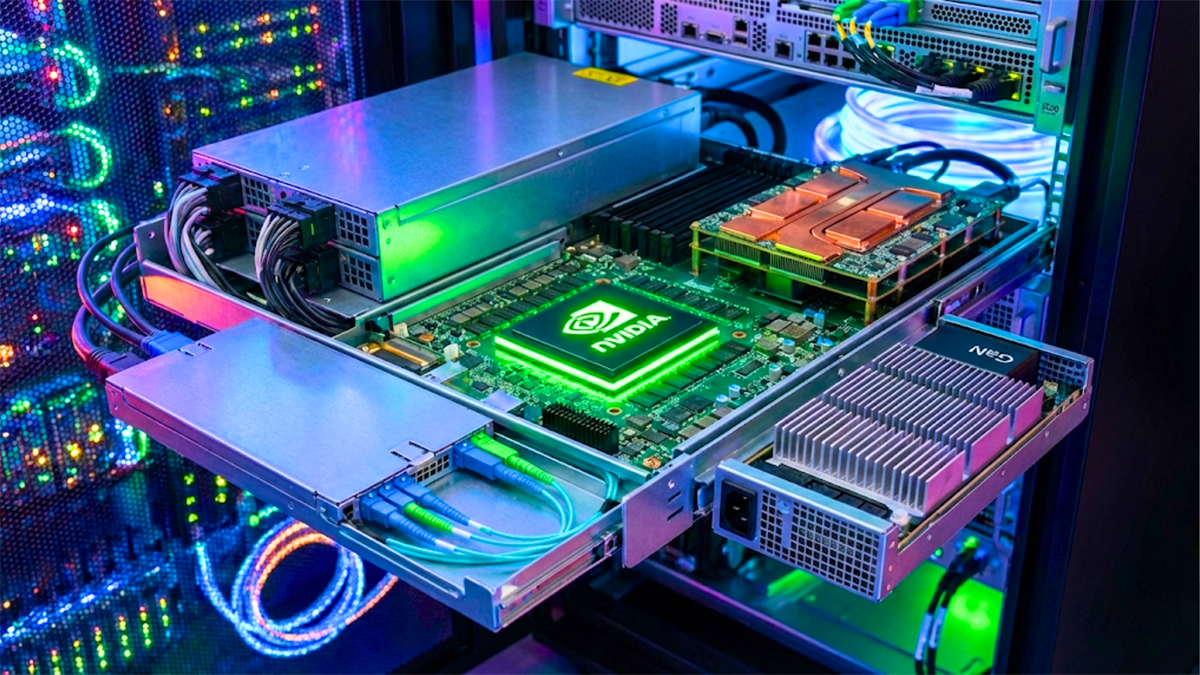
The first bottleneck in the AI supply chain isn't just making the chip; it's powering it. NVIDIA's Rubin architecture is so dense it can't rely on standard server power supplies. It requires large, centralized units known as power shelves to distribute energy evenly across a rack.
Flex Ltd. (NASDAQ: FLEX) has quietly shifted from a broad contract manufacturer into a primary architect of this power infrastructure. While the company still builds a wide variety of electronics, its Data Center division has become the growth engine. In its latest quarterly update, Flex reported that Data Center revenue grew 35% year-over-year, driven largely by demand for these complex power systems.
Wall Street has noticed the pivot. Early in December 2025, analysts at Goldman Sachs raised the stock's price target to $74 — roughly 17% above its trading price at that time. The analysts cited strong performance and growth across AI data centers, utilities, and automotive technology as reasons for the higher target.
Coherent Corp: Solving the Speed-of-Light Crisis
As AI clusters scale from thousands to tens of thousands of chips, the next bottleneck is speed. Traditional copper cabling is too slow and bulky to connect the massive server racks Rubin requires. Data must move using light — a switch to photonics.
Coherent Corp (NYSE: COHR) is a leader in that transition. The industry is moving to 1.6 Terabit (1.6T) optical transceivers, devices that convert electrical signals into light to match NVIDIA's processing speeds. Coherent controls the supply of indium phosphide, a critical material for manufacturing the lasers used at scale.
Think of Coherent as a toll operator on the information superhighway: the more data NVIDIA chips process, the more lasers Coherent sells.
- Key Catalyst: The shift from 800G to 1.6T speeds is creating supply strain.
- Why It Matters: Shortages give suppliers pricing power. The stock is trading near 52-week highs around $185, driven by projections of roughly 17% quarter-over-quarter revenue growth.
Amkor Technology: The Manufacturing Release Valve
The third bottleneck is packaging capacity. NVIDIA's primary manufacturing partner, Taiwan Semiconductor Manufacturing Company (NYSE: TSM), cannot package every AI chip it produces. Its advanced packaging lines, known as CoWoS, typically run at full capacity.
Amkor Technology (NASDAQ: AMKR) has become a critical release valve. As one of the few companies with advanced U.S.-headquartered packaging capabilities for AI chips, Amkor is taking on volume that TSMC cannot accommodate.
That role has turned Amkor from a sleepy value play into a momentum leader, with shares rallying roughly 100% since January 2025.
Navitas Semiconductor: The High-Voltage Gamble
The final bottleneck is heat and power density. Rubin consumes enormous amounts of electricity, and traditional silicon power supplies struggle to handle that density without overheating or occupying too much space.
Navitas Semiconductor (NASDAQ: NVTS) offers a solution with gallium nitride (GaN) technology. GaN chips handle higher power loads more efficiently than silicon alternatives. At CES 2026, Navitas unveiled the world's first 8.5 kW AI data-center power supply, delivering about 98% energy efficiency and designed specifically for next-generation racks. The market reacted quickly: Navitas' stock jumped roughly 30% in the days after the announcement.
Drafting Behind the Titan: A Picks-and-Shovels Strategy
NVIDIA provides the roadmap for the future of AI, but these four companies provide much of the vehicle to get there. For investors, looking inside the server rack offers a way to sidestep the law-of-large-numbers constraint.
By investing in the specific bottlenecks that must be solved for AI to advance, portfolios can gain exposure to the same explosive growth trends that helped power NVIDIA — while also tapping into companies with fresh runways for 2026.
This email message is a paid sponsorship from TradeSmith, a third-party advertiser of MarketBeat. Why did I receive this email message?.
If you have questions or concerns about your account, please don't hesitate to contact our South Dakota based support team at contact@marketbeat.com.
If you would no longer like to receive promotional emails from MarketBeat advertisers, you can unsubscribe or manage your mailing preferences here.
© 2006-2026 MarketBeat Media, LLC. All rights protected.
345 N Reid Place #620, Sioux Falls, South Dakota 57103-7078. U.S.A..
