ZIM shareholders secured a cash exit when Hapag-Lloyd agreed to acquire the shipping company at a premium valuation, reshaping the logistics... ͏ ͏ ͏ ͏ ͏ ͏ ͏ ͏ ͏ ͏ ͏ ͏ ͏ ͏ ͏ ͏ ͏ ͏ ͏ ͏ ͏ ͏ ͏ ͏ ͏ ͏ ͏ ͏ ͏ ͏ ͏ ͏ ͏ ͏ ͏ ͏ ͏ ͏ ͏ ͏ ͏ ͏ ͏ ͏ ͏ ͏ ͏ ͏ ͏ ͏ ͏ ͏ ͏ ͏ ͏ ͏ ͏ ͏ ͏ ͏ ͏ ͏ ͏ ͏ ͏ ͏ ͏ ͏ ͏ ͏ ͏ ͏ ͏ ͏ ͏ ͏ ͏ ͏ ͏ ͏ ͏ ͏ ͏ ͏ ͏ ͏ ͏ ͏ ͏ ͏ ͏ ͏ ͏ ͏ ͏ ͏ ͏ ͏ ͏ ͏ |
| | Written by Jeffrey Neal Johnson 
Shareholders of ZIM Integrated Shipping Services (NYSE: ZIM) woke up to a transformed investment landscape on Feb. 17, 2026. After months of speculation and a volatile year for the shipping sector, the company announced a definitive agreement to be acquired by German shipping giant Hapag-Lloyd (OTCMKTS: HPGLY). The all-cash transaction is valued at approximately $4.2 billion, a figure that instantly reshapes the valuation models for the entire logistics industry. The market reaction was swift and decisive. ZIM shares climbed over 30% to around $29.94, with trading volume nearly ten times the daily average. The headline figure driving this frenzy is the offer price: $35 per share. For long-term holders, this acquisition represents a sizeable victory. The $35 offer delivers a 58% premium over the stock’s closing price on Feb. 13, 2026. Perhaps more notably, it represents a staggering 126% premium over the unaffected share price recorded in August 2025. This metric is crucial because it highlights how much value management has unlocked relative to where the market valued the company on its own merits just six months ago. However, investors should see this deal as more than a merger; it is a strategic exit. The shipping industry is notoriously cyclical, prone to boom-and-bust periods that can decimate shareholder equity. By securing a high-value cash buyout now, management has effectively shielded investors from future volatility, converting a fluctuating stock ticker into a definitive cash payout. Consolidate or Die: The Strategy Behind the Spend The magnitude of Hapag-Lloyd’s premium serves as a warning shot to the broader logistics sector. Major carriers are rushing to consolidate capacity and acquire quality assets before the industry faces a potential cyclical downturn. ZIM’s recent financial reports illustrate this cooling environment: revenue dropped 36% year-over-year in the third quarter of 2025. Yet, despite shrinking revenues, the company commanded a massive buyout premium. This disconnect suggests that strategic buyers like Hapag-Lloyd are looking past short-term income fluctuations. They are hunting for asset quality and balance sheet strength. Hapag-Lloyd is buying revenue streams and acquiring a modernized, highly efficient fleet. Over the last few years, ZIM has accepted delivery of 46 new vessels, many of which use Liquefied Natural Gas (LNG) propulsion. In a regulatory environment increasingly focused on carbon emissions, ZIM’s fleet represents a plug-and-play upgrade for Hapag-Lloyd’s global network. Building these ships from scratch would take years; buying ZIM secures them instantly. Furthermore, ZIM’s balance sheet provided immense leverage in negotiations. As of Sept. 30, 2025, the company reported a total cash position of approximately $3.01 billion. With a net leverage ratio of just 0.9x, ZIM is financially pristine. For Hapag-Lloyd, this cash pile effectively lowers the acquisition's net price. When you subtract the $3 billion in cash ZIM holds from the $4.2 billion purchase price, Hapag-Lloyd is acquiring the shipping operations for a bargain price. Diplomacy and Dealmaking: The 16-Vessel Solution The primary hurdle in acquiring ZIM has always been political rather than financial. The State of Israel holds a Special State Share, commonly known as a Golden Share. This mechanism allows the government to veto transactions to ensure the country’s essential food and security supply lines remain secure during times of conflict. For a German acquirer, this posed a significant risk. To bypass this regulatory roadblock, the companies engineered a sophisticated solution involving a spin-off entity. A new, separate corporate entity, dubbed New ZIM, will be created. This entity will not be owned by Hapag-Lloyd. Instead, it will be acquired by FIMI Opportunity Funds, Israel's largest and most influential private equity firm. New ZIM will take ownership of 16 specific vessels dedicated to serving Israeli trade routes. This ensures that a domestic owner meets national security interests, while Hapag-Lloyd absorbs the global commercial network. This structure is the key that unlocks the $35 payout. By partnering with a domestic powerhouse like FIMI, ZIM’s board has proactively addressed the government’s security concerns. Instead of a vague promise to maintain operations, they have created a concrete legal structure to guarantee it, significantly reducing regulatory risk. Mind the Gap: The Arbitrage Opportunity Despite the definitive agreement and the massive premium, ZIM stock is currently trading at about $27.75, while the cash offer stands at $35. This creates a spread of approximately $7.26 per share. In financial terms, this is known as a merger arbitrage spread. The market is currently discounting the stock by roughly 26% due to the time remaining before the deal closes (expected in late 2026) and the residual risk regarding regulatory approvals. However, for patient investors, this gap represents a clear opportunity. If the deal closes as planned, buying at today's price and holding until the payout yields a healthy return. Additionally, investors are being paid to wait. ZIM has continued its policy of returning capital to shareholders, recently declaring a 31-cent dividend based on Q3 earnings. This dividend demonstrates financial discipline and provides income while the regulatory clock ticks. For those willing to hold through the regulatory process, the spread offers an annualized return profile that may outperform the broader market. The risk is that the deal falls apart, but the New ZIM structure serves as a solid hedge against the most likely cause of failure. Cash Is King: Locking in the Win The acquisition of ZIM by Hapag-Lloyd transforms the investment narrative from one of operating volatility to one of calculated execution. Management has secured a premium exit valuation that many analysts did not foresee, effectively monetizing the company's fleet modernization and cash reserves at the top of the strategic cycle. While the closing timeline requires patience, the strategic spin-off of New ZIM demonstrates a clear, executable path through the complex geopolitical landscape. For shareholders, the story has shifted from tracking weekly freight rates to monitoring the closing of a lucrative transaction. The $35 cash offer provides a definitive endpoint, locking in massive value in a sector often defined by uncertainty.  Read This Story Online Read This Story Online |  After signing more than 220 Executive Orders… more than any president in American history… Donald Trump is preparing for one final move.
On February 24th — I have every reason to believe he will sign his Final Executive Order.
When I say that it's his FINAL executive order… Click here or below for this unbelievable story… |
| Written by Thomas Hughes 
Analog Devices’ (NASDAQ: ADI) share price could easily top $400 this year, driven by a rapidly swelling outlook that the fiscal Q1 2026 earnings report strengthened. End-market normalization is becoming a robust tailwind as AI drives datacenter and broader semiconductor demand. What this means for ADI investors is sustained, accelerating growth, wider margins, and improved cash flow to support its healthy capital return. Analog Devices Reports 4th Quarter of Accelerating Growth: Guidance Wows Analog Devices saw a strong quarter, with growth across all end markets. The company reported $3.16 billion in net revenue, a 30.6% year-over-year (YOY) increase that outpaced consensus by 130 basis points. Segmentally, Industrial and Communications, which houses the data center business, led with gains of 38% and 63%, respectively. Automotive was the weakest link, up only 8%, but it is expected to strengthen over time. The final segment, Consumer, grew by an impressive 27%. Margin news was hot. The company widened its GAAP margin by a quadruple-digit figure and its adjusted margin by a triple-digit figure. Adjusted gross margin improved by 240 basis points, and adjusted operating margin by 500 basis points, to drive a 52% increase in adjusted earnings and robust free cash flow. Operating cash flow improved by 43% on a trailing 12-month basis, while free cash flow improved by 39% to over $4.5 billion. The robustness of free cash flow is critical, as it enables reinvestment and capital returns alongside balance sheet maintenance. Guidance was robust, driving the market. The company’s forecast for Q2 revenue and earnings was significantly above consensus at the low end of the range, suggesting a minimum of 500 basis points outperformance in the upcoming quarter and more than 1000 basis points at the high end. Based on the results and the clear momentum, the company will likely perform at the high end of its range, if not outperform guidance. Analog Devices Capital Return Is Dialing in on Dividend Aristocrat Status Analog Devices' capital return is noteworthy for several reasons, including the history of dividend increases. The company issued its 22nd consecutive annual increase alongside its fiscal Q1 (FQ1) release, sustaining its low-double-digit distribution CAGR, putting it on track to become a Dividend Aristocrat by decade’s end. (Note that the company's fiscal reporting period does not align with the calendar year.) Inclusion in the Dividend Aristocrats index is key because it would increase ownership, specifically buy-and-hold ownership, which reduces market volatility. Until then, the payment is safe at less than 50% of the earnings outlook and yields a market-average 1.15% as of the pre-release close. Share repurchases are equally significant. The Q1 activity reduced the count by an average of 1.4% YOY in the quarter and is expected to continue at a similar pace throughout the year. The balance sheet highlights no red flags, including increased cash and current assets, reduced long-term debt, and steady equity. Leverage is also low, with cash up 16% year-to-date and long-term debt about 2.5X the cash balance and 0.2X the equity. 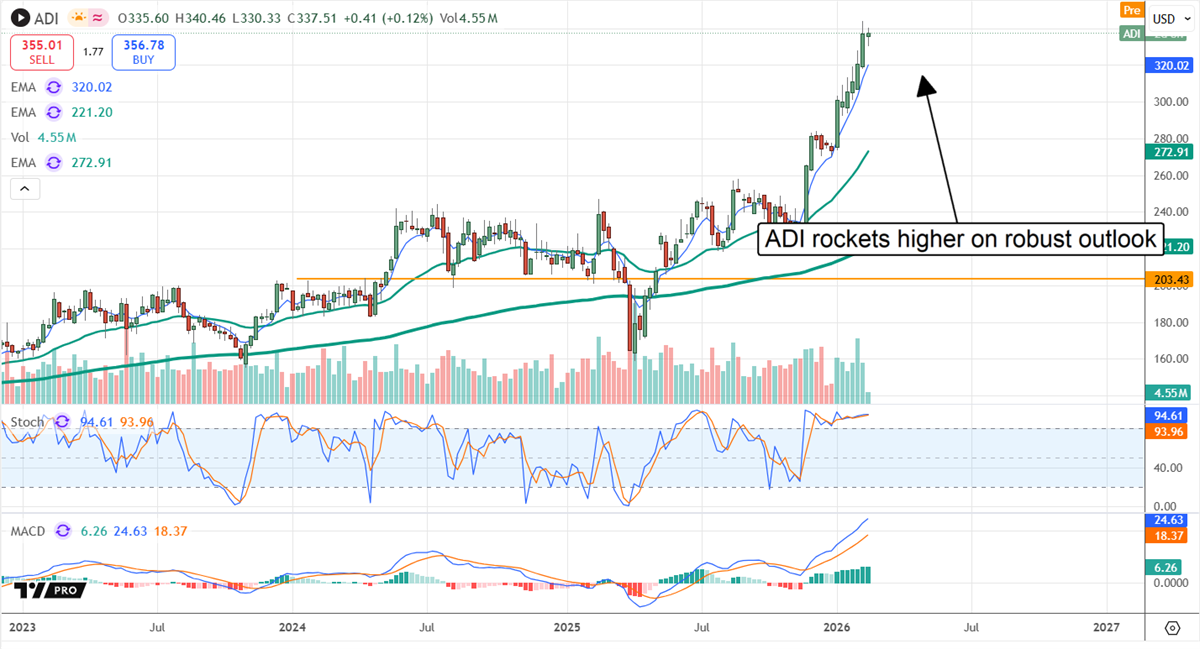
Analysts Trends Drive Analog Devices’ Market Sentiment The initial analysts’ response to Analog Devices’ FQ1 report is bullish, sustaining the trend. Price target increases from Stifel Nicolaus and Cantor Fitzgerald put this stock at the high end of the target range, with Cantor’s $400 target aligning with the current high. It assumes approximately 18% upside from the pre-release high, which may be reached before the second half. As it stands, MarketBeat data reveals strong coverage with 29 analysts tracked, up from the prior year, the Moderate Buy rating firming, and price targets trending higher. Institutional activity is also bullish for this market. While institutional selling increased over the past 12 months, the quarterly balance remained bullish throughout the year, with activity sustaining the trend in early 2026. The balance in the first six weeks is more than $1.50 in purchases for each $1 in sales, which is a tailwind for price action, given the 87% institutional ownership rate. Short sellers do not appear to be a risk for this market. Short interest is low, below 2%, and declining as of early February. Analog Devices Rockets Higher on Strong Results Analog Devices’ price action surged more than 5% in premarket trading following the release. The move reflects the market's surprise at the news, suggesting this rally will continue. The risk is that profit-taking begins and caps gains. In this scenario, ADI stock price may consolidate at the new highs or even correct before moving up to set fresh highs. Read This Story Online |  Do you own the worst stock of 2026? [Name + Ticker]
He issued warnings for RNG before it crashed 89%, BYND before it crashed 90%, TDOC before it crashed 84%, and FVRR before it crashed 86%. Now, he's stepping forward to name the popular stock that could go down as one of the worst-performing tickers of the year. It could be the most dangerous stock of 2026. Click here for its name and ticker, 100% free. |
| Written by Leo Miller 
Investment giant Berkshire Hathaway (NYSE: BRK.B) just released its Q4 2025 portfolio moves. The company’s 13F filing details the trades it made during the quarter ending Dec. 31, providing insight into its views on several notable names. The firm’s key portfolio changes include one of the world’s most well-known media companies and multiple Magnificent Seven stocks. This latest round of trades is particularly noteworthy. At the end of 2025, Berkshire founder Warren Buffett officially retired from his position as CEO. Greg Abel has since replaced him, but Buffett will continue to have a strong hand in the company, serving as the Chairman of the Board. Thus, these were Berkshire's last moves while Buffett held the firm’s top management role. As Buffett exits his role as CEO after an incredible 60 years, let’s dive into Berkshire’s most significant trades in Q4 2025. The New York Times: Berkshire’s Shiny New Holding In Q4, Berkshire initiated a fresh position in the media outlet New York Times (NYSE: NYT), buying nearly 5.1 million shares. While this move is interesting, it is relatively small compared to the size of Berkshire’s total portfolio. At the end of Q4, the position was worth approximately $352 million, or around 0.13% of Berkshire’s equity holdings. NYT shares performed well in Q4, rising around 21%, and the stock has continued climbing higher in 2026. NYT’s November earnings report was a key catalyst, helping to accelerate its rally. That quarter, the company added 460,000 net new digital subscribers, a 77% increase year-over-year. Digital advertising revenue also increased by 20%. That figure has accelerated every quarter since Q4 2023, and climbed to 25% in NYT’s latest earnings. Berkshire’s purchase demonstrates confidence in NYT’s digital transformation strategy, which has already made significant headway. Berkshire Reduces Apple Stake, Trims Several Key Names Notably, Berkshire reduced its stake in Apple (NASDAQ: AAPL) by 4% during Q4. This continues Berkshire’s recent trend of selling Apple. In Q2 2025, Berkshire lowered its shares held in Apple by around 7%, and reduced its position by 15% in Q3 2025. Despite this, Apple remains Berkshire’s largest position, valued at nearly $62 billion at the end of Q4. This amounts to almost 23% of Berkshire’s equity portfolio, signaling that it is still confident in the iPhone maker’s long-term future. Other notable reductions include Berkshire selling 48% of its Atlanta Braves (NASDAQ: BATRK) shares, a 9% reduction in Bank of America (NYSE: BAC), and a 3% reduction in Constellation Brands (NYSE: STZ). However, the biggest headline is Berkshire’s sale of hyperscaler and Magnificent Seven giant Amazon.com (NASDAQ: AMZN). AMZN vs GOOGL: Berkshire Dumps One, Holds the Other Steady During the quarter, Berkshire sold more than 7.7 million Amazon shares. This moved its Amazon holdings down from 10 million shares to around 2.3 million shares, a massive 77% decrease. In contrast to its sales of Magnificent Seven peer Apple, the drop in Berkshire’s Amazon holdings was sudden. This was Berkshire’s first AMZN sale since dropping its shares held from 11 million to 10 million in Q3 2023. The reasoning for such a drastic move is up for debate. However, it is worth noting that Amazon achieved its all-time high closing price of $254 in Q4. Since then, the stock is down around 20%. Achieving and hovering near this level was likely one of the key impetuses for Berkshire’s sale. It's possible that Berkshire anticipated Amazon’s lofty capital expenditure (CapEx) guidance and moved preemptively. The firm plans to spend $200 billion on CapEx in 2026. This is the highest among all hyperscalers and $50 billion above analyst expectations. Amazon’s CapEx guidance was one of the key factors that created downward pressure on its share price after the firm’s latest earnings report. Interestingly, Berkshire didn’t alter its position in Amazon’s cloud data center competitor, Google parent company Alphabet (NASDAQ: GOOGL). This comes even though Alphabet also hit many new all-time highs during Q4. This suggests that Berkshire is more confident in Google’s overall cloud and artificial intelligence (AI) strategy than Amazon’s. Analyst Forecasts Clash with Berkshire’s Long-Term Perspective Overall, the most interesting takeaway from Berkshire’s Q4 13F revolves around not only the actions it took, but those that it didn’t take. By selling Amazon and maintaining its position on Google, the firm is showing a clear preference for the latter. Price target data indicates that analysts disagree with this take. The consensus price target on AMZN implies approximately 43% upside in shares, and the consensus target on Google implies 20% upside. However, it is important to remember that price targets are 12-month forecasts. Meanwhile, Berkshire typically invests over many years, and the company is likely signaling where it sees value long-term. Read This Story Online |  For years, the American economy has been engineered to reward Wall Street institutional investors and Silicon Valley insiders first.
Everyday investors like you and me were left with the table scraps.
But this rigged game ends today! Click here now and I'll show you how to claim your stake… |
| More Stories |
| |
|
|