
When Elon's SpaceX IPO officially hits — which could be just days from now — two things will happen.
Elon's 40% stake will immediately earn him around $625 billion in new wealth. Then millions of small investors will buy SpaceX's stock, hoping to strike it rich.
Unfortunately, many of them will be disappointed.
That's why I'm urging you to take advantage of this pre-IPO SpaceX play while you still can.
Sincerely,
Tim Bohen
3 International Stocks Most U.S. Investors Have Never Heard Of
Reported by Bridget Bennett. Date Posted: 3/20/2026.

Key Points
- The gap between United States and European equity valuations has widened, pushing some global stock pickers to look overseas for “quality at a reasonable price.”
- Pieter Slegers highlighted Games Workshop, Investor AB, and LVMH-Moet Hennessy Louis Vuitton as examples of durable businesses he believes are priced more attractively than many U.S. peers.
- The argument rests on selective stock-picking rather than a blanket “Europe is better” call, with the main risk being that cheaper European valuations persist longer than expected.
- Special Report: Have $500? Invest in Elon's AI Masterplan
U.S. markets have dominated for the better part of two decades. But the cycle may be turning—and the valuation gap between American and European equities is getting harder to ignore.
Pieter Slegers of Compounding Quality searches for businesses with high margins, strong balance sheets, and durable competitive advantages. Increasingly, he says, the best risk-reward setups are appearing outside the United States.
Why the U.S.-Europe Valuation Gap Matters Now
Alpha School replaces teachers with AI across 35 cities (Ad)
A humanoid robot called Figure 03 escorted First Lady Melania Trump at a White House tech summit attended by CEOs and representatives from 45 countries. Alpha School, a private institution replacing teachers with AI, is now expanding to 35 cities with Department of Education support - and its students are scoring in the top 0.1% nationally.
Jamie Dimon, Larry Fink, and Senator Mark Warner are all warning about mass job displacement. One historian is predicting a permanent underclass as automation accelerates. History shows these shifts also create rare wealth-building opportunities for investors who act early.
See the investment blueprint for navigating the AI displacement nowSlegers doesn't argue that Europe is broadly superior to the United States. He acknowledges U.S. companies generally have higher margins and stronger fundamentals. But that contrast is exactly what makes selective European investing interesting: when you find a European company that matches U.S. quality, you are often paying 14 or 15 times earnings instead of roughly 25.
Markets move in cycles. Historically, the United States outperforms international markets for about eight years, then the pattern reverses. The current U.S. streak has lasted roughly 16 years—an unusually long run. Slegers recommends investors consider allocating 40% to 50% of investable assets outside U.S. stocks for genuine geographic diversification.
As he put it, quoting Warren Buffett: "Only when the tide goes out do you discover who's been swimming naked." That backdrop frames the stocks he brought to the table.
Games Workshop: The Compounder Hiding in Plain Sight
The first name is one almost no U.S. investor will recognize: Games Workshop (LON: GAW). This U.K.-based company produces miniatures for tabletop board games—a niche market, which is the point. Niche businesses with fanatical customer bases tend to generate the pricing power that shows up in long-term stock performance.
The GAW chart is remarkable. Games Workshop has compounded roughly 140x since 1994, making it one of the best-performing U.K. stocks over that stretch. The company raises prices about 5%–6% annually, and customers keep coming back.
Slegers compares the loyalty to addiction: "Once you are a Games Workshop player, you always stick to the game." One anecdote he shared involved a club leader who owned $125,000 worth of miniatures.
The same CEO has led the company for more than 20 years, and a pending deal with Amazon (NASDAQ: AMZN) could be the next major catalyst. At current levels, this isn't a company where the growth story is over—it's one where the moat appears to be widening.
Investor AB: Europe's Answer to Berkshire Hathaway
If you want broad European exposure through a single stock with a proven track record, Investor AB (OTCMKTS: IVSBF) is the name Slegers highlighted. This Swedish holding company has been around since 1916, and the Wallenberg family still owns about 20% of the business.
Investor AB operates across three segments: direct stakes in listed European companies like Atlas Copco (OTCMKTS: ATLKY) and ABB (NYSE: ABBNY), private equity activities, and growth investments.
Since 2001, the stock has roughly doubled every five years. Slegers says he has dined with the CFO and head of investor relations multiple times and believes management "walks the talk."
The case is straightforward: for first-time European exposure, Investor AB has outperformed the Stoxx Europe 600 over the medium and long term, and its management incentives are tightly aligned with shareholders.
LVMH Moët Hennessy Louis Vuitton: Luxury at a Discount to the S&P 500
LVMH Moët Hennessy Louis Vuitton (OTCMKTS: LVMUY) needs little introduction. The French luxury conglomerate behind Louis Vuitton, Dior, and dozens of other iconic brands is one of Europe's largest companies. Bernard Arnault, the richest person in Europe, owns roughly 50% and continues to add to his stake.
Two dynamics make LVMH compelling at current prices. First, luxury is extraordinarily difficult to replicate—brand equity built over decades does not get disrupted overnight. Second, the company's growth in China and broader Asia remains a powerful long-term tailwind.
Trading at roughly 20 to 21 times earnings, LVMH sits slightly below the S&P 500 average while offering fundamentals that are meaningfully stronger than the typical index constituent. Cheaper and better is a combination worth noting.
The Common Thread Across These Names
Every stock on this list shares a few traits: founder-led or long-tenured management, durable competitive advantages, and valuations that look attractive relative to U.S. peers. The risk is that European markets stay cheap longer than expected; the upside is a potential rerating as institutional capital rotates toward international equities.
You don't need to go all-in on Europe to benefit. But ignoring the opportunity entirely—especially when quality names trade at meaningful discounts—means leaving diversification and potential returns on the table. That's the setup heading into the rest of 2026.
Watch the full video above for a deeper look at these names (and more).
Why Williams-Sonoma Could Be One of Retail's Smartest Long-Term Buys
Reported by Thomas Hughes. Date Posted: 3/21/2026.

Key Points
- Williams-Sonoma stands out in retail for sustaining high operating margins and returning significant capital through dividends and buybacks.
- Q4 2025 results showed resilient profitability despite a small revenue decline, and fiscal 2026 guidance points to continued strength.
- With institutional ownership near 100%, the post-earnings dip may find support, but tariffs and margin pressure remain key risks.
- Special Report: Have $500? Invest in Elon's AI Masterplan
Williams-Sonoma (NYSE: WSM) will face hurdles in 2026, as most companies do, but it stands out from typical retail stocks. It consistently generates and sustains a high operating margin, benefits from a loyal customer base that helps insulate it from macroeconomic headwinds, and returns significant capital to shareholders.
Williams-Sonoma’s dividend yield is modestly above average, and the payout's reliability and growth outlook make it attractive. With a payout ratio below 30% of expected earnings, the company is well positioned to continue annual increases for the foreseeable future, supporting the strong compound growth in its dividend. The company has raised the dividend for 20 consecutive years, putting it on pace for possible inclusion in the Dividend Aristocrats index early next decade. Investors seeking long-term confidence in the guidance and outlook may find it in the latest distribution increase, which was 15%.
Alpha School replaces teachers with AI across 35 cities (Ad)
A humanoid robot called Figure 03 escorted First Lady Melania Trump at a White House tech summit attended by CEOs and representatives from 45 countries. Alpha School, a private institution replacing teachers with AI, is now expanding to 35 cities with Department of Education support - and its students are scoring in the top 0.1% nationally.
Jamie Dimon, Larry Fink, and Senator Mark Warner are all warning about mass job displacement. One historian is predicting a permanent underclass as automation accelerates. History shows these shifts also create rare wealth-building opportunities for investors who act early.
See the investment blueprint for navigating the AI displacement nowShare buybacks have been more meaningful, reducing the share count by an average 3.37% in Q4 2025. That shrinkage provides notable shareholder leverage and is expected to continue at a healthy pace in 2026. The company still has $1.3 billion remaining on its repurchase authorization—roughly 1.5 years at the 2025 pace—and will likely increase the authorization at year-end.
The balance sheet presents no red flags. Cash was down slightly at year-end and equity declined by less than 2.8%, but the impact is negligible—the company carries no long-term debt, and liabilities consist primarily of lease obligations and deferred gift-card revenue.
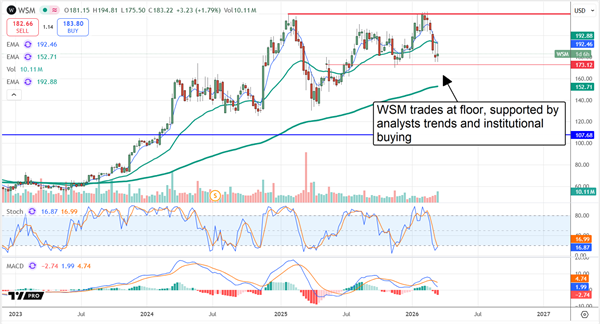
Williams-Sonoma Executes Well in Q4: Guides for Strength in 2026
Williams-Sonoma reported a solid quarter despite a revenue decline and a modest miss versus analysts' estimates. Revenue fell 4.1% to $2.36 billion, and margins compressed—this was the key takeaway. Gross and operating margins were pressured by tariffs and higher costs, but the hit was smaller than feared. Operating margin was down 120 basis points year-over-year yet still ahead of forecasts, and GAAP diluted EPS came in at $3.04, $0.13 above expectations.
The internal details were encouraging. The weakness was concentrated in the Pottery Barn segment—the company's largest operating division—with comps down 2.3% and net revenue down 8.8%. All other banners delivered comp-store growth. The flagship Williams-Sonoma banner was the standout, with a 7.2% comp and higher net revenue versus the prior year. Guidance was another positive: management is targeting roughly 4.7% revenue growth at the midpoint, driven by a 4% comp, with an operating margin near 17.8%.
Analysts noted the margin compression but viewed it as manageable, given that operating margins have been running above target and the 17.8% forecast for 2026 sits at the high end of the company's target range. Several post-release revisions lifted price targets, nudging the consensus higher. The stock carries a Moderate Buy rating, and the upper-end analyst targets leave room for new all-time highs.
Institutions Signal a Floor for WSM Stock in Q1 2026
Institutional ownership is unusually high for this name—nearly the full float is held by institutions. That concentration is a strong endorsement of the company's quality and its likely stock-price trajectory, reinforced by recent buying trends. Institutions shifted to distribution in Q4 2025, which capped the price action, but returned to accumulation in early 2026.
Near-term catalysts include upcoming earnings releases, where continued underlying strength is expected. Management is leaning into digital initiatives and AI, expanding B2B and international efforts, and growing its store footprint—each a potential growth driver.
Risks remain, chiefly margin compression and tariffs. So far, the company appears to be navigating those pressures effectively, and potential AI-driven efficiencies could help offset cost headwinds. The most likely scenario is that Williams-Sonoma continues to perform well, keeps analysts and institutions broadly satisfied, and sees its stock price progress over time.
This email message is a paid advertisement sent on behalf of Timothy Sykes, a third-party advertiser of DividendStocks.com and MarketBeat.
If you need help with your newsletter, feel free to contact MarketBeat's South Dakota based support team at contact@marketbeat.com.
If you no longer wish to receive email from DividendStocks.com, you can unsubscribe.
© 2006-2026 MarketBeat Media, LLC. All rights protected.
345 N Reid Pl., Sixth Floor, Sioux Falls, S.D. 57103. USA..
