Ollie's Bargain Outlet is on track for a robust rebound that could take its price to record-high levels. Analysts and institutions reveal... ͏ ͏ ͏ ͏ ͏ ͏ ͏ ͏ ͏ ͏ ͏ ͏ ͏ ͏ ͏ ͏ ͏ ͏ ͏ ͏ ͏ ͏ ͏ ͏ ͏ ͏ ͏ ͏ ͏ ͏ ͏ ͏ ͏ ͏ ͏ ͏ ͏ ͏ ͏ ͏ ͏ ͏ ͏ ͏ ͏ ͏ ͏ ͏ ͏ ͏ ͏ ͏ ͏ ͏ ͏ ͏ ͏ ͏ ͏ ͏ ͏ ͏ ͏ ͏ ͏ ͏ ͏ ͏ ͏ ͏ ͏ ͏ ͏ ͏ ͏ ͏ ͏ ͏ ͏ ͏ ͏ ͏ ͏ ͏ ͏ ͏ ͏ ͏ ͏ ͏ ͏ ͏ ͏ ͏ ͏ ͏ ͏ ͏ ͏ ͏ |
| | Written by Thomas Hughes 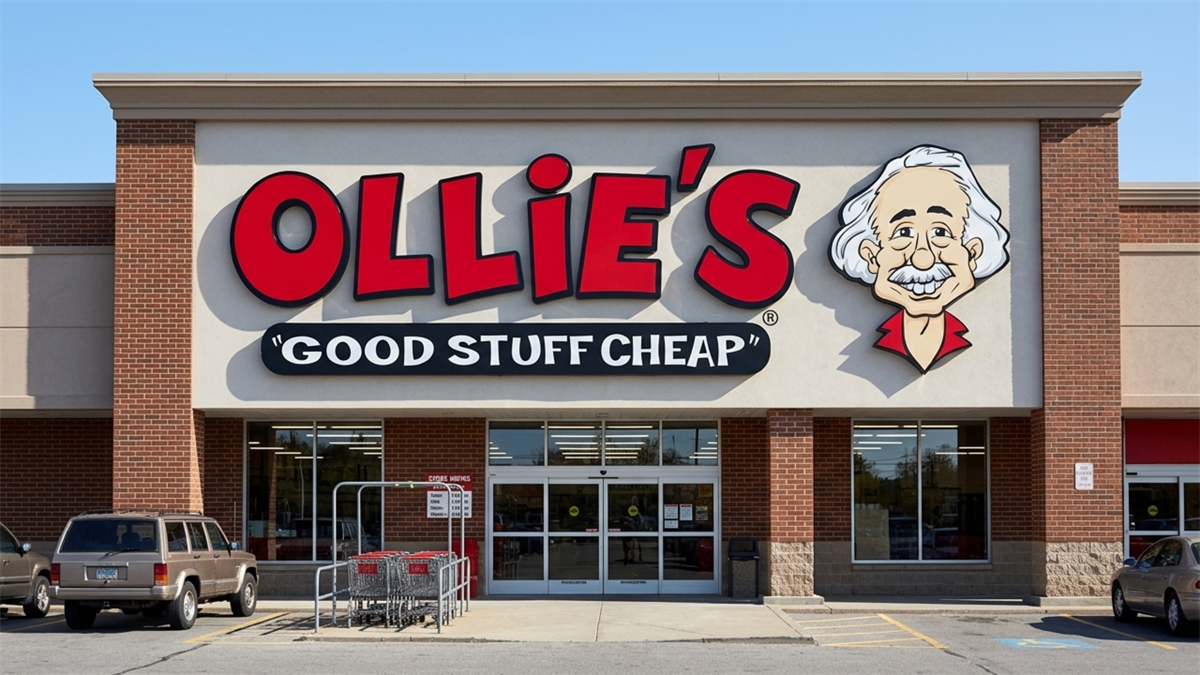
Ollie’s Bargain Outlet's (NASDAQ: OLLI) stock price downtrend is over. The Q4 2025 results are in, and they reaffirmed a robust outlook. Although the report was below the consensus forecast and guidance followed suit, the misses were slim, growth and outlook are robust, and the weakness wasn’t as unexpected as the consensus suggested. Analysts at RBC issued cautionary statements ahead of the release while highlighting the company’s position, aggressive expansion, and potential for outperformance in the coming years. In their view, the Big Lots bankruptcy and customer conversion to Ollie’s are multi-year events yet to play out, and it's not priced into the stock. Ollie’s Outperforms Peers as Expansion Takes Hold Ollie’s had a strong quarter despite revenue growth falling short of the consensus estimate. The company’s $779.26 million in net revenue is up 16.8% year-over-year, well ahead of competitors, underpinned by better-than-expected comp and store-count growth. The comp came in at 3.6%, slightly better than RBC’s forecast, while store count increased by 15.4%. Margin news is also solid despite falling short, with spending control and revenue leverage offsetting store opening expenses. Adjusted EPS missed the consensus by two cents, but the miss is slim, and earnings growth outpaced revenue by a narrow margin. Looking ahead, opening expenses are coming and should return to trend, providing visibility into margin and earnings quality improvements over the next two to three years. Guidance is likewise tepid relative to MarketBeat’s reported consensus, narrowly falling short of consensus, although expecting solid growth. As it stands, the company expects revenue in the range of $2.985 billion to $3.013 billion, with a midpoint just short of the $3 billion consensus, and an earnings midpoint of $4.45 versus $4.53 expected, which amounts to about 10% on the top line. Ollie’s Cautious Guidance Sets Stage for Bullish Revision Cycle Among the opportunities for investors is the potential for cautious guidance, which is significant. Not only is there last year’s 15.4% store-count growth to consider, but the company plans to add another 11.6% in stores this year, and there are other tailwinds brewing. Analysts forecast potential for consumer tailwinds tied to tax season. Not only are returns being delivered, but the average check is more than 10% larger than last year, providing liquidity to Ollie’s consumer base. In this scenario, Ollie's will outperform guidance, improve it as the year progresses, leading analysts into a similarly bullish cycle. Ollie's carries a Moderate Buy consensus rating with no Sell ratings among the 16 analysts tracked by MarketBeat. No revisions were issued immediately after the Q4 release, but several analysts commented, highlighting the growth potential and strength in loyalty members (up 12.1%), while expressing concern about future comparisons. Not all believe in the long-term strength of the Big Lots conversion, but the group is bullish on the stock price, forecasting an average upside of roughly 30%. Ollie’s stock trades below the low end of the analysts' range in early March, underscoring the deep-value opportunity and potential for a rebound. Institutions reveal the real opportunity, as they own almost 100% of this stock and buy on a quarterly basis. Reasons for them to own it include the fortress balance sheet, self-funded growth, growth outlook, and cash flow. The capital return potential adds another layer. The company doesn’t pay dividends, choosing to reinvest instead, but it does buy back shares in sufficient quantity to offset any dilution. The share count decline is incremental, but there, providing a base from which future returns can grow. Competitors and industry leaders such as TJX Companies (NYSE: TJX) are well-known dividend and share-repurchase machines, a status Ollie’s is growing into. Ollie’s Stock Price Bounces From Rock Bottom Ollie’s stock price hit rock bottom late in 2025, rebounded quickly, and retested the level again in early 2026. Following the guidance update, shares rose more than 5%, confirming support at this crucial level. This level is significant because it was a resistance target set in 2019 that was broken in early 2025 and is now confirmed as a new, strong support level for this market. The likely outcome is that this market will continue advancing in 2026, potentially accelerating the move as the year progresses. 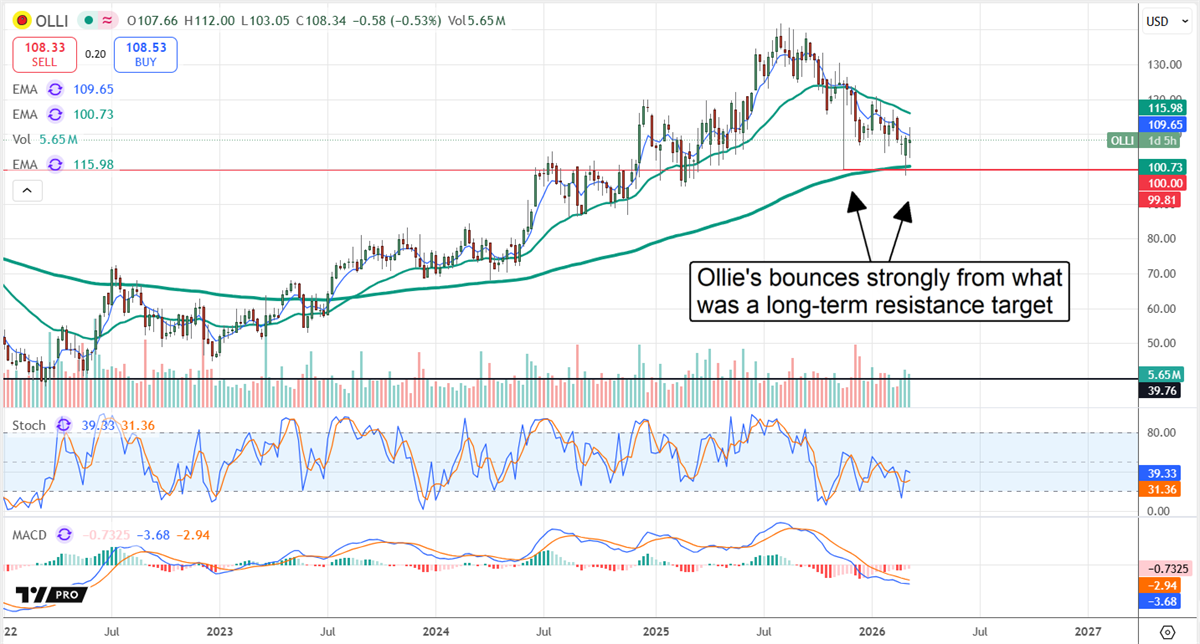
 Read This Story Online Read This Story Online |  Since entering the market in 1982, Louis Navellier predicted nearly every twist and turn in U.S. stocks, from Black Monday and the dot-com crash to the housing crisis and the rise of Nvidia in 2005. That's why the New York Times calls him an icon among growth investors. Since 1998, his proprietary system would've returned 13,126% in backtests, 13X the S&P and 106 times the average investor. Now he's uncovered one investment involving President Trump's plan to lead the world in artificial intelligence, a closely guarded high-tech facility Elon Musk is building in Memphis, and a paradigm shift that could add as much as $23 trillion to the global economy, and he's investing $358 million of his own firm's money in the outcome. Get the name and ticker of Louis Navellier's free pick now |
| Written by Chris Markoch 
Stock splits are actions taken by corporations to make their shares nominally affordable for more retail investors. These usually occur after a period of significant growth and/or innovation. What is it about stock splits that captures the imagination of investors? After all, the intrinsic value of the company hasn’t changed. But investor psychology is one of the most important factors that drives a stock’s short-term performance. It can be hard for retail investors to consider buying a stock trading at $500, let alone $1,000. Investors with only small amounts to invest may find lower-priced shares more accessible because they can buy more of them. However, there are times you get what you pay for: stocks seeing strong share-price growth typically have a strong fundamental story to back it up. For example, Costo Wholesale Corp. (NASDAQ: COST) has been on many analysts’ lists of companies that could potentially split its stock for years. As of this writing, COST stock trades for just over $1,000 per share. That’s pricey, but the stock has delivered share price growth of over 200% in the last five years. Investors who shied away at $500 missed that gain, which didn’t include the company’s dividend. On the other hand, Walmart Inc. (NASDAQ: WMT) announced a stock split in January 2024. The stock hasn’t missed a beat, climbing over 45% in the last 12 months and over 175% in the last five years, not counting the company’s dividend. The takeaway for investors is that quality matters. Owning companies with strong growth can make a stock split an additional benefit, not a gimmick to buy the company’s shares. Here are three companies that could split their stock in 2026. Semiconductor Leader KLA Approaches $1,400 Per Share KLA (NASDAQ: KLAC) designs and manufactures equipment, software, and services used by chipmakers for process control and yield management applications. It’s not surprising that KLAC stock has jumped over 375% in the last five years, and over 100% in 2025. However, even as KLAC stock trades over $1,400 per share, it’s still about 13% below its consensus price target of approximately $1,600. After a strong run as part of the artificial intelligence trade, it could be time for a stock split. But investors may have to wait. KLA just hosted an Investor Day on March 12. At that time, they announced some goodies for shareholders, including a $7 billion share repurchase program and an impressive 21% increase to its dividend, which is the 17th consecutive year it has increased the payout. A company can announce a stock split at any time, and KLA reports its Q3 earnings for fiscal 2026 on April 29. April 29. But after the announcements at its March 12 Investor Day, the board may be inclined to hold off. Still, with the share price above $1,400, investors will keep wondering when a split might come. Eli Lilly’s GLP-1 Leadership Keeps the Growth Story Strong Eli Lilly & Co. (NYSE: LLY) isn’t part of the technology sector, but the stock is acting like one. LLY stock is up over 350% in the last five years. However, like the “growthy” tech sector, the stock has been leveling out lately. It was up “just” 18% in 2025 and is down about 9% through March 12. LLY stock trades for just under $1,000 as of this writing, and analysts give the stock a consensus price target suggesting it could grow by 25%. That’s backed by the expectation of earnings growth of around 35% in the next 12 months. But it’s the reason behind the growth that drives the split conversation. Eli Lilly is the market share leader in the GLP-1 weight loss market by a large amount. The company is likely to expand that lead if the U.S. Food & Drug Administration approves its oral GLP-1 drug candidate in 2026. That may be a reason for the company to take a wait-and-see approach about a split. Another may be that shareholders just got a 15.3% dividend increase that was announced in December 2025. McKesson’s Quiet Rally Pushes the Stock Near $1,000 McKesson Corp. (NYSE: MCK) is one of the leading medical stocks in the healthcare industry. McKesson delivers medicines and medical supplies to hospitals, pharmacies, and doctors' offices across the country, ensuring the right medicines reach the right places so patients can get the care they need. MCK stock is up more than 400% in the last five years and 47% in the last 12 months. That includes being up 15% in 2026 as of March 12. In its most recent earnings report, management raised its guidance for FY2026, including 12% to 16% revenue growth and 17% to 19% growth in adjusted earnings per share. The latter was higher than analysts’ projections for 11% growth. The MCK stock price is over $900 per share and is pushing the top of its 52-week range. However, unlike the other names on this list, MCK is trading in line with its consensus price target. But analyst sentiment remains bullish with many price targets over $1,000. That includes JPMorgan Chase & Co, which has the highest price target of $1,107. Read This Story Online |  Since the outbreak of war, gold is down roughly 3.5% and prices of the best gold stocks are down even more, but this is because gold rose roughly 180% from its bottom in 2022 and is taking a breather after a blistering run in 2024-2025. Gold is primarily a slow-moving, long-term play on the decreasing value of paper assets and fiat currencies, and while war will accelerate the decline of the dollar's purchasing power, this doesn't show up in the gold price immediately—central banks now hold more gold than US Treasuries for the first time in 30 years, and the best gold miners are now selling at fire-sale prices thanks to recent volatility. See my top four picks for the coming gold mania |
| Written by Chris Markoch 
When President Trump signed an executive order calling for the restoration of America's maritime dominance, it set off a chain of events that should have caused investors to pay attention. The executive order has many layers, but the highlight is titled America’s Maritime Action Plan (MAP), a sweeping blueprint to rebuild domestic shipbuilding through hundreds of billions in federal financing. Before this gets dismissed as frivolous spending, there are some hard truths to consider. First, less than 1% of new commercial ships are currently built in the United States. Second, China has aggressively dominated global shipbuilding for years. The MAP is Washington's answer to that imbalance. But the MAP isn't the only money on the table. The Pentagon's proposed fiscal year 2026 (FY2026) budget and a separate reconciliation package together earmark tens of billions specifically for naval shipbuilding. This includes new Virginia-class submarines and guided missile destroyers. The MAP and the defense budget are separate programs, but they're pulling in the same direction. For investors, that creates an interesting setup. A handful of defense contractors sit squarely in the crosshairs of this spending wave. Some are pure-play military shipbuilders. Others bring a mix of defense and commercial exposure. And at least one adds a European defense tailwind on top of any U.S. upside. Below, we break down three aerospace and defense stocks that stand to benefit, and what investors need to know before adding any of them to a portfolio. The Pure-Play Leader in U.S. Naval Shipbuilding Huntington Ingalls (NYSE: HII) stands to be one of the clearest beneficiaries of new maritime spending. The company is the nation’s largest military shipbuilder. Prior to this announcement, Huntington Ingalls was already forecasting expectations to secure up to $50 billion in new government contracts over the next 24 months. In its most recent earnings report, Huntington Ingalls reported full-year revenue of $12.5 billion, which was 8.2% higher year-over-year (YOY). Included in that was a 14% YOY increase in shipbuilding throughput, which is expected to increase to 15% in 2026. But HII stock trimmed its 2026 gains after the report on some short-term margin concerns. Analysts expressed concern that next year’s earnings might not support the stock’s price after its surge of over 100% in the past 12 months. The Trump administration’s MAP ambitions must have been an open secret to institutional investors. HII stock saw a surge in institutional investment in the fourth quarter of 2025, which corresponded with a surge in stock price starting in December 2025. That said, Huntington Ingalls' stock trades slightly above its consensus price target as of mid-March. However, since the start of the year, analysts have been raising their targets, with the highest price being from Citigroup, which raised its target to $465 from $450 on Feb. 12. A Combination of Shipbuilding Strength and Dividend Growth If Huntington Ingalls is the primary beneficiary, then General Dynamics (NYSE: GD) would be a close second. The company is involved in shipbuilding through its Bath Iron Works and Electric Boat divisions. GD stock is only up over 30% in the last 12 months, but gained about 4% after the plans for MAP funding were announced. That came on the heels of the company’s January earnings report in which General Dynamics delivered a double beat. Revenue was up 10.1% YOY, and earnings were up 13.4% on a YOY basis. GD stock also trades slightly below its consensus price target. However, as with HII stock, analysts have been raising their price targets. Susquehanna has the highest price target for the stock at $420. General Dynamics plays to income and growth investors. The company is a dividend aristocrat that recently increased its dividend for the 34th consecutive year. That raised the attractive annual payout per share to $6.36. A Choice for Global Defense and Maritime Exposure BAE Systems (OTCMKTS: BAESY) is headquartered in London, which may limit its exposure to MAP funding. However, it does have a U.S. subsidiary focused on shipbuilding. If the U.S. fleet upgrade becomes a full-court press, there could be room for BAE Systems to capture some of those dollars. That would be in addition to the boost the company is getting from increased spending in European countries. The company is the largest defense contractor in Europe with a maritime segment that represents over 22% of its 2024 revenue, which was up 10% on a YOY basis. BAESY stock is up more than 40% in the last 12 months and is up more than 30% in 2026, with strong growth in the last three months. That’s pushed the stock near its 52-week high. However, analysts still rate the stock a consensus Buy. Read This Story Online |  The gold trade Wall Street won't tell you about (before March 18) Most investment banks now predict gold will cross $10,000 an ounce. But the smartest way to profit has nothing to do with bullion, ETFs, or mining stocks. There's an overlooked approach that turned every $5,000 invested into more than $1.6 million during one historic gold rally - and the next surge could begin as early as March 18. Click here to see our full March 18 gold prediction - right here - absolutely FREE. |
|
| |
|
|