
Dear Reader,
Last year I ran for Mayor of New York City.
And lost to a 34-year-old Democratic Socialist.
Now I'm convinced what's starting in New York will spread across America.
Just for starters:
- The new mayor wants to spend $70 million of taxpayer money just to study whether government-run grocery stores are a good idea.
- He's threatening a 9.5% property tax hike on every homeowner in the city.
- And he wants to raise taxes on every corporation and high earner.
This isn't just a New York story. Nearly 40% of Americans now have a "positive" view of socialism.
But what nobody's talking about is WHY this is happening... and where it's all headed.
I have my MBA from Harvard and spend my time in correspondence with billionaires like Warren Buffett and Bill Ackman. I've spent 30 years on Wall Street. And there's a specific term for what's unfolding in America right now... one that points to an economic event unlike anything we've seen in over 100 years.
I'm not running for office again. But if you care about your wealth, your family, and your future, you need to understand what's really coming.
I've put together a free analysis explaining exactly what I see, and the specific steps I recommend you take with your money today.
I strongly encourage you to check it out here.
Regards,
Whitney Tilson
Editor, Stansberry Investment Advisory
Former Hedge Fund Manager
Co-Founder, Teach for America
Harvard MBA
P.S. What's happening today will reset the financial system in a way most of us can't imagine. If I'm even half right, it's going to have a huge impact on your money and your future. Get the details here...
Winnebago's Q2 Earnings Show It Navigating a Tough Landscape
By Chris Markoch. Posted: 3/26/2026.

Key Points
- Winnebago’s Q2 FY2026 earnings beat expectations, but revenue growth driven by pricing rather than volume is raising sustainability concerns.
- Macroeconomic uncertainty, including interest rates and geopolitical tensions, is weighing on consumer confidence ahead of peak RV season.
- Analysts remain bullish on WGO stock with over 20% upside, but increased institutional selling signals caution in the near term.
- Special Report: The Biggest IPO Ever: Claim Your Stake Today
Winnebago Industries Inc. (NYSE: WGO) is one of the leading recreational vehicle (RV) manufacturers in the U.S. But market dominance aside, when the company reported earnings on March 25, the results—while solid—showed that revenue gains are being driven more by price increases than by higher unit volume.
Investors initially found that dynamic unsustainable. After digesting the Q2 2026 earnings report, WGO shares fell nearly 7% by the close.
Former White House Insider Predicts New Gold Surge (Ad)
Analyst Jim Rickards believes gold could climb to $10,000 per ounce or higher in the coming years - and he says investors still have time to position ahead of the move.
His top recommendation is a $2 stock he describes as sitting on the largest gold deposit in the world, with an extraction green light potentially arriving April 15.
See Jim Rickards' number one gold recommendation for 2026That said, the results were better than expected on both the top and bottom lines. Revenue of $657.4 million topped analyst expectations of $628 million and was nearly 6% higher than the $620.2 million recorded in the same quarter of 2025. Adjusted earnings per share of $0.27 met expectations and rose about 42% year-over-year.
Those numbers are particularly encouraging given that this quarter is historically light — it falls largely outside peak RV season. Here is what current shareholders and prospective investors can take away from the company's Q2 report.
Earnings Highlight Consumer Uncertainty Heading Into RV Season
Unlike major automakers, Winnebago isn't a broad consumer bellwether. Still, as a company in the consumer discretionary sector, its results offer insight into consumer confidence and willingness to make big purchases.
As the company enters peak RV season, consumers appear cautious about committing to large discretionary purchases. According to the Conference Board's Consumer Confidence Index, measures "remained well below the four-year peak achieved in November 2024."
That sentiment contrasted with the start of the year, when consumer optimism had been rising on the back of lower gas prices, larger tax refunds and lower interest rates — all of which supported bullish sentiment.
Now, near the end of Q1, consumers and investors face new uncertainties. Escalating tensions in the Middle East and the potential for broader disruptions could keep upward pressure on oil prices, which would erode some of the relief from tax refunds. At the same time, the direction of interest rates remains unclear, and no analyst can say with certainty where rates will be for the rest of 2026.
Even so, Winnebago is navigating a difficult environment reasonably well and could be well positioned if the economy grows steadily. Still, geopolitical and macroeconomic uncertainty makes short-term forecasting challenging.
Winnebago Balances Slower Growth With Strong Financial Discipline
To get a balanced view of Winnebago's position, note that the company has posted higher year-over-year revenue and earnings in each of its last three quarters. Those trends do not indicate a company in distress.
However, that growth pales compared with the surge in 2020 and 2021 during the pandemic, when demand for RVs spiked. RVs are largely one-time purchases and the market has become more saturated since that peak, though year-over-year gains show demand still exists.
Winnebago's ability to perform now depends in part on the broader economy — something it cannot control. The company has, however, been taking steps to control what it can: shoring up the balance sheet and reducing net leverage. While reported cash was lower than a year ago, the company trimmed its leverage ratios.
Winnebago is also maintaining shareholder returns. The board kept its quarterly dividend at $0.35 per share (equivalent to $1.40 annually), which appears reasonable relative to projected earnings. The company also has about $180 million remaining under its prior stock buyback authorization, reinforcing its focus on capital returns.
WGO Stock Outlook Hinges on Analyst Optimism vs. Institutional Selling
Winnebago's Q2 report did little to settle the tug-of-war between analyst optimism and institutional selling. On MarketBeat, analyst forecasts show an average one-year price target of $42.80, implying potential upside of more than 30% at the time of this writing.
That average is down from roughly $60 a year ago but has been relatively steady for the past nine months. Of the 11 analysts currently covering WGO, the consensus rating is Hold, with four assigning a Buy.
At the same time, institutional investors have been net sellers over the past year. Institutions accounted for roughly $1.45 billion in outflows versus about $275 million in inflows — the largest level of institutional selling since Q1 2024.
The selling volume hasn't been extreme, but it has picked up in the last two quarters. Analysts may be more optimistic than institutional investors; if so, watch analyst activity and institutional flows closely in the coming weeks.

The current pullback appears driven more by macroeconomic uncertainty than by company-specific problems. Long-term investors willing to be patient can collect the dividend while waiting for an improved economic backdrop. Prospective buyers who prefer a technical trigger may watch the 50-day simple moving average (50-day SMA); a decisive close and hold above that level could signal a momentum shift.
Lululemon's Share Price Bottom Is In: Nowhere to Go But Up
Submitted by Thomas Hughes. Article Published: 3/20/2026.

Key Points
- Lululemon is set up to rebound in 2026 as it builds momentum in international sales, drives cash flow, and buys back shares.
- Analysts weigh on price action in early 2026, as weak guidance undermines confidence, but outperformance is likely.
- Institutions are accumulating LULU at long-term lows, providing a floor for the action and limiting downside risk.
- Special Report: The Biggest IPO Ever: Claim Your Stake Today
Lululemon's (NASDAQ: LULU) share price may face hurdles in 2026, but indications from technical charts, valuation metrics, analysts, institutions, and recent earnings results suggest lower prices are unlikely. There is always risk with any retail stock, but at current levels Lululemon's upside potential outweighs the downside, offering an attractive reward profile for investors willing to buy in.
The charts are where it all starts. Lululemon's technicals point to a potential bottom and a rebound across multiple timeframes.
Former White House Insider Predicts New Gold Surge (Ad)
Analyst Jim Rickards believes gold could climb to $10,000 per ounce or higher in the coming years - and he says investors still have time to position ahead of the move.
His top recommendation is a $2 stock he describes as sitting on the largest gold deposit in the world, with an extraction green light potentially arriving April 15.
See Jim Rickards' number one gold recommendation for 2026The monthly chart is the weakest but still aligns with a bottom near $164, roughly the late‑2019 highs.
That level coincides with the early‑2020 COVID‑driven lows and is likely to be a strong floor given the price action then and the opportunity today.
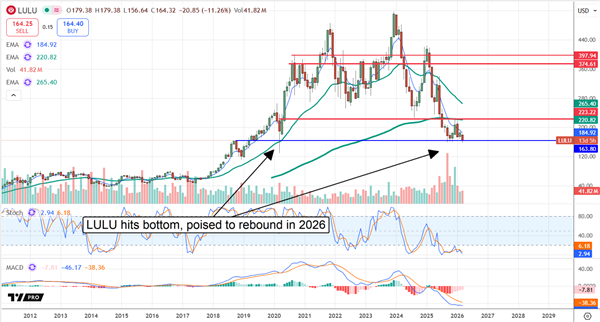
The weekly and daily charts strengthen the outlook, suggesting not only a price floor but also early signs of an advance. In this scenario, Lululemon's stock is positioned to appreciate through 2026 and gain momentum as investor dollars rotate back into the name.
Valuation metrics point to a deep value opportunity: LULU is trading near early‑2020 price levels while revenue is more than 185% higher. The market premium assigned in 2019 is no longer justified, yet the outlook remains robust — trading at roughly 12X earnings appears too low. That implies potential for both near‑term multiple expansion and longer‑term growth. Relative to the S&P 500 average valuation, the near‑term thesis suggests nearly 100% upside, while long‑term forecasts point to substantially larger gains — in some scenarios as much as 500% by 2035 or sooner.
Analysts and Institutions Signal a Floor for Lululemon
Analyst sentiment has pressured the stock in 2026. Even with several price‑target cuts following the fiscal 2025 release, the pattern of revisions is consistent with a market bottom. The low end of reduced targets sits below the current price, but those lowest targets are outliers.
The consensus of six targets issued within the first 18 hours after the release was $180 — below the broader consensus but still well above the critical support level — with the high‑end target pointing to $225.
At present, analyst sentiment does not provide an immediate catalyst for a rebound, though it could turn more positive later in the year as subsequent quarterly reports arrive.
The company's cautious 2026 guidance was the main driver of the sentiment shift; upcoming results that outperform that guidance could reverse the trend and prompt analysts to raise targets.
Institutional activity also supports the case for a price floor, suggesting the downside is limited.
Institutions own more than 85% of the stock. After distributing shares in the back half of 2025, they returned to accumulation in Q1 2026 — buying more than $2 for every $1 sold in early Q1 — a strong pace that provides tangible support.
Lululemon Ended 2025 on a High Note: Guides Downbeat for 2026
Lululemon delivered a solid quarter to close 2025, generating $3.64 billion in net revenue — a 0.8% year‑over‑year increase and 170 basis points ahead of consensus. Strength came from international sales, offset by mild declines in the Americas and against a difficult comp that included an extra week in the prior year. Adjusting for that calendar effect, growth was stronger at about 6%, with comps up 3% systemwide and 15 net new stores added.
Margins held up better than feared. While earnings contracted, the hit was smaller than forecast: GAAP EPS came in at $5.01, roughly a quarter above expectations. Importantly, cash flow, the balance sheet, and capacity for buybacks are in better‑than‑expected shape — strengthening the case for a share price rebound.
Share buybacks are significant. Lululemon reduced its share count by 3.85% in fiscal 2025 and is expected to continue aggressive repurchases in 2026. The balance sheet shows no material red flags, indicating the company is well capitalized and positioned to execute its strategy and build shareholder value.
This message is a sponsored message sent on behalf of Stansberry Research, a third-party advertiser of Earnings360 and MarketBeat.
This ad is sent on behalf of Stansberry Research, 1125 N Charles St, Baltimore, MD 21201. If you would like to optout from receiving offers from Stansberry Research please click here.
If you have questions or concerns about your newsletter, feel free to email our U.S. based support team at contact@marketbeat.com.
If you no longer wish to receive email from Earnings360, you can unsubscribe.
© 2006-2026 MarketBeat Media, LLC.
345 North Reid Place #620, Sioux Falls, South Dakota 57103. USA..
