
Dear Reader,
Last year I ran for Mayor of New York City.
And lost to a 34-year-old Democratic Socialist.
Now I'm convinced what's starting in New York will spread across America.
Just for starters:
- The new mayor wants to spend $70 million of taxpayer money just to study whether government-run grocery stores are a good idea.
- He's threatening a 9.5% property tax hike on every homeowner in the city.
- And he wants to raise taxes on every corporation and high earner.
This isn't just a New York story. Nearly 40% of Americans now have a "positive" view of socialism.
But what nobody's talking about is WHY this is happening... and where it's all headed.
I have my MBA from Harvard and spend my time in correspondence with billionaires like Warren Buffett and Bill Ackman. I've spent 30 years on Wall Street. And there's a specific term for what's unfolding in America right now... one that points to an economic event unlike anything we've seen in over 100 years.
I'm not running for office again. But if you care about your wealth, your family, and your future, you need to understand what's really coming.
I've put together a free analysis explaining exactly what I see, and the specific steps I recommend you take with your money today.
I strongly encourage you to check it out here.
Regards,
Whitney Tilson
Editor, Stansberry Investment Advisory
Former Hedge Fund Manager
Co-Founder, Teach for America
Harvard MBA
P.S. What's happening today will reset the financial system in a way most of us can't imagine. If I'm even half right, it's going to have a huge impact on your money and your future. Get the details here...
As Energy Surges on Crack Spreads, Consider Taking Gains on 2 Small Cap Oil Stocks
Reported by Dan Schmidt. Originally Published: 3/24/2026.

Key Points
- Crude oil prices have surged since the start of the Iran War, boosting the stocks of oil and gas companies across the industry.
- One unlikely beneficiary has been downstream refiners that benefit from large crack spreads, which measure the difference in raw and refined petroleum products.
- If these spreads normalize quickly, refiner margin compression will follow, so it might be time to take profits on these two soaring small-cap refiners.
- Special Report: Elon Musk already made me a "wealthy man"
Oil and gas stocks have surged since the start of the Iran conflict, largely because the Persian Gulf plays a crucial role in global oil flows. About 20 million barrels per day pass through the Strait of Hormuz—roughly 20% of worldwide supply.
But the real story for investors goes beyond rising crude prices: refiners are benefiting from an unusually wide gap between crude and refined product prices—diesel, gasoline and jet fuel. These gaps, known as crack spreads, have boosted downstream oil stocks, particularly in the U.S.
The Biggest IPO Ever: Claim Your Stake Today (Ad)
What if you could shrink your entire wealth journey from decades down to just 24 hours?
Sounds impossible…
But I'll show you how Elon Musk is about to make it a reality.
This could be the best investment opportunity of the decade.That dynamic makes two small-cap refiners worth a closer look: their recent gains are tightly tied to today's unusually favorable spreads and could unwind quickly if conditions normalize.
Why Crude Prices Can Matter Less for Downstream Companies
If you've filled up recently, you've probably noticed how quickly pump prices have climbed. According to AAA, the average national fuel price in the United States is currently $3.94—up more than $1 in just a month.
Unless you rely on diesel, you may not have followed diesel prices closely—but they've risen even faster. Crack spreads help explain why the energy sector is divided into upstream, midstream and downstream companies:
- Upstream: Companies that directly benefit from higher oil prices because they extract crude.
- Midstream: Operators of the infrastructure—transportation, storage and processing—that connects upstream and downstream.
- Downstream: Firms that refine, process and market finished products, including gasoline, diesel and petrochemicals.
Downstream companies' profitability depends less on absolute crude prices and more on the crack spread—the gap between crude oil and refined product prices. Oil prices have risen since the conflict began, but refiners have been insulated by widening crack spreads after Persian Gulf refining capacity went offline, which has boosted margins.
Many market participants had priced in a short conflict, but now that fighting appears entrenched, industry stocks have rallied sharply. That repricing, however, may overlook margin headwinds that could appear as quickly as crack spreads widened.
Key catalysts to watch include:
- If the Strait of Hormuz reopens: Shipping could resume unevenly—crude supply might recover slowly while refined products return faster—pushing wholesale product prices down while crude remains elevated and compressing refinery margins.
- Demand destruction from prolonged shocks: Prolonged high crude prices can sap economic activity. If demand for travel and transportation falls, purchases of refined fuels would decline, weighing on refiners' revenue.
Governments are also releasing crude from strategic reserves to limit price spikes, which could normalize spreads. Meanwhile, China's policy choices matter: if it ramps up gasoline and diesel exports to Europe and Asia, U.S. refiners' margins could compress quickly.
2 Oil and Gas Stocks That Don't Want Spreads to Normalize
Large-cap refiners have tools to offset spread volatility—hedging programs, diversified operations and stronger balance sheets. Small-cap refiners often lack those cushions, so a rapid crack spread reset could lead to sharp stock repricings.
Below are two small-cap downstream names where taking profits may be worth considering.
CVR Energy: Beware the False Breakout
CVR Energy Inc. (NYSE: CVI) is up more than 60% this month, helped by higher petroleum and fertilizer prices.
The company's Petroleum Products division refines crude into diesel, gasoline and jet fuel, while its Nitrogen Fertilizers segment produces ammonia and urea.
In Q4 2025, CVR reported a year-over-year revenue decline of 7%, so the recent price shock has been timely for its results.
CVI shares have surged past their 50- and 200-day moving averages in recent weeks, but the rally looks fragile.
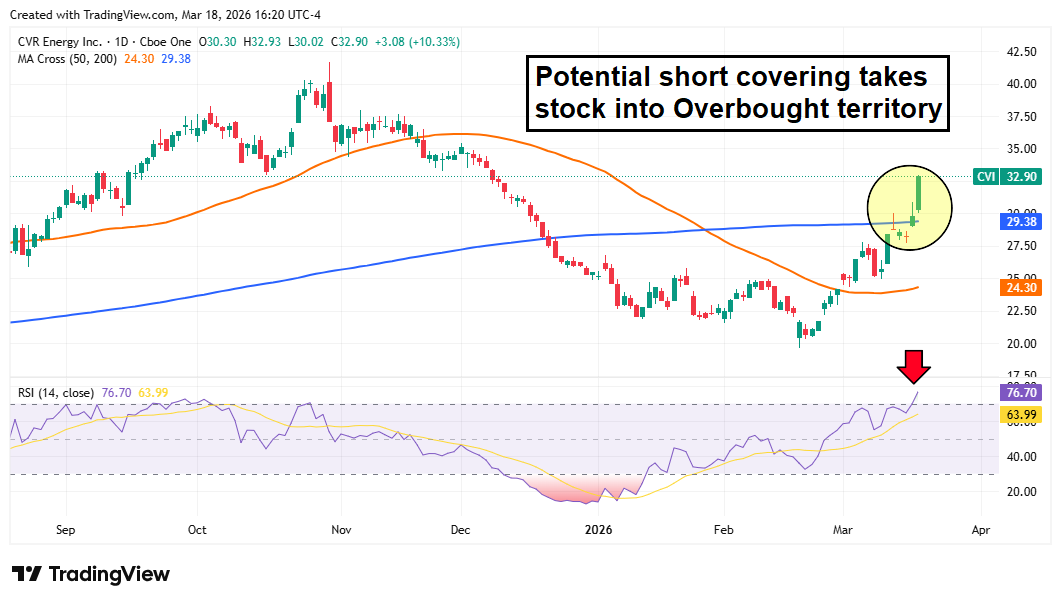
The Relative Strength Index (RSI) is in overbought territory (above 76), and nearly 6% of the float is sold short, suggesting part of the move may be short-covering. Despite the surge, five of six analysts covering CVI rate the stock a Sell.
PBF Energy: Earnings Beat Could Be a Ticking Clock
PBF Energy Inc. (NYSE: PBF) received a company-specific tailwind from its Q4 2025 results, helping fuel a steep rally.
While revenue missed targets, EPS of $0.49 beat expectations for a $0.15 loss.
Management said crack spreads were benefitting the company even before the initial strikes against Iran.
The stock is up more than 80% so far in 2026, including a gain exceeding 40% in the past month.
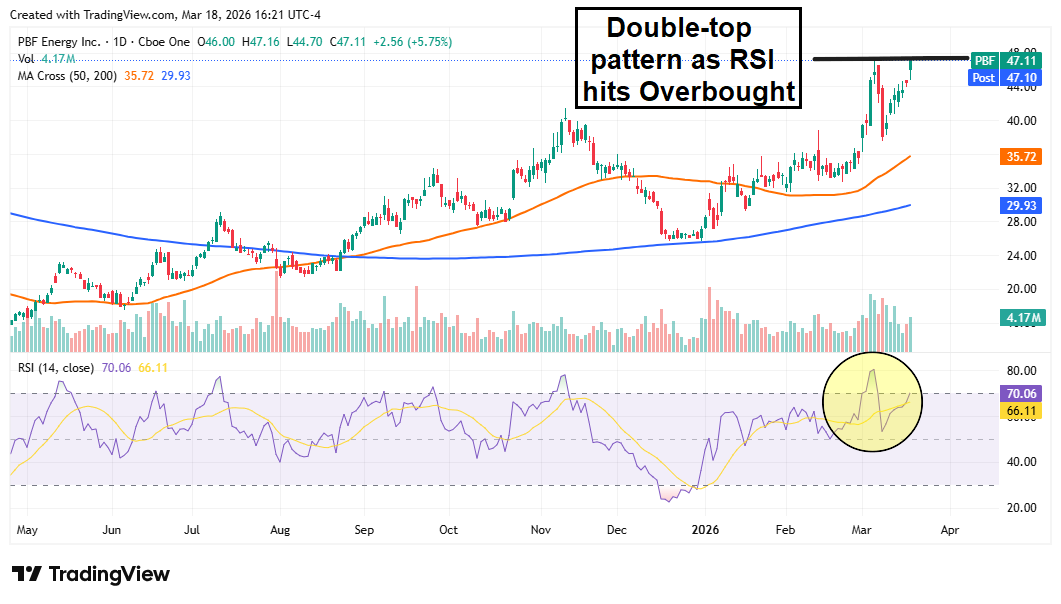
Now that the earnings tailwind is fading, technical and fundamental headwinds are appearing. With short interest above 20%, the stock has seen activity from both bulls and bears, pushing it into overbought RSI territory and forming a potential double-top on the daily chart.
Insiders sold more than $300 million of PBF shares in Q1 with little offsetting buying, and analysts continue to rate the company a Sell with a consensus price target more than 30% below current levels.
Is 2026 the Year of Space Stocks? 2 Stocks to Watch
Written by Ryan Hasson. Posted: 3/25/2026.

Key Points
- The potential SpaceX IPO has put the space sector in the spotlight, but Rocket Lab and Planet Labs are already delivering exceptional returns with or without it.
- Rocket Lab completed 21 successful launches in 2025, achieving a 100% mission success rate, and grew its backlog to $1.85 billion.
- Planet Labs just reported record revenue, reached adjusted EBITDA profitability for the first time, and saw several analysts raise price targets to $40.
- Special Report: Elon Musk already made me a "wealthy man"
The space sector may be on the verge of its biggest moment yet. Reports and rumors suggest SpaceX, the world's largest private space company, could announce its long-awaited IPO as early as mid‑2026, with early estimates valuing it near $1.5 trillion. If realized, that would rank among the largest IPOs in history and could lift the entire aerospace sector.
Even before SpaceX lists publicly, the space industry is producing standout performers. Rocket Lab (NASDAQ: RKLB) is up roughly 230% over the past year. Planet Labs (NYSE: PL) has surged more than 700% over the same period and is up about 65% year to date. With a rising defense budget, a potential landmark IPO on the horizon, and several names already delivering exceptional returns, 2026 is shaping up to be a defining year for space stocks. Here are two to watch closely.
Rocket Lab: Building the Infrastructure of the Space Economy
The Biggest IPO Ever: Claim Your Stake Today (Ad)
What if you could shrink your entire wealth journey from decades down to just 24 hours?
Sounds impossible…
But I'll show you how Elon Musk is about to make it a reality.
This could be the best investment opportunity of the decade.Rocket Lab is an end-to-end aerospace company that provides launch services, spacecraft and space systems to commercial and government customers. Its primary launch vehicle, the Electron, is a small-lift orbital rocket designed to deploy satellites and rideshare payloads to low Earth orbit. With more than 250 satellites launched and over 1,700 satellites in orbit carrying Rocket Lab technology, Electron has become one of the most frequently flown and dependable small-lift rockets in the world.
The company's most anticipated catalyst is Neutron, a medium‑lift rocket intended to compete directly with SpaceX's Falcon 9. Built for mega‑constellation deployment and deeper-space missions, Neutron can carry payloads up to 13,000 kilograms, substantially expanding Rocket Lab's addressable market.
The fundamentals for Rocket Lab continue to impress. In Q4 2025, Rocket Lab reported EPS of negative 3 cents, beating the consensus estimate of negative 5 cents, while quarterly revenue rose 48% year over year to $155.08 million. The company closed out 2025 with a record 21 successful launches, a 100% mission success rate, and a backlog that climbed 73% to $1.85 billion. Roughly 37% of that backlog is expected to convert to revenue over the next 12 months, providing strong forward visibility. Analysts maintain a consensus Moderate Buy rating, with a price target implying more than 15% additional upside from current levels.
Planet Labs: Record Revenue and a Breakout Quarter
Planet Labs was founded with a bold mission: to image the entire Earth every day and make that data visible, accessible and actionable. The company operates one of the largest fleets of Earth‑imaging satellites, delivering high-frequency, high‑resolution imagery and analytics to customers across government, agriculture, energy and finance.
That mission is translating into accelerating financial results. In its most recent quarter, Planet Labs reported revenue of $86.8 million, up 41% year over year and a new quarterly record. Full‑year revenue for the fiscal year ending 2026 rose 26% to $307.7 million, also a record.
Perhaps most significantly, the company reached adjusted EBITDA profitability for the first time in a fiscal year and generated positive free cash flow — two milestones that signal a meaningful inflection in the company's maturity.
Backlog climbed 79% year over year to $900 million, driven by strong government demand, new satellite launches and expanding partnerships.
Looking ahead, management guided fiscal 2027 revenue of $415 million to $440 million. Institutions have been active buyers, with $693 million in inflows over the prior 12 months versus $308 million in outflows. After the results, analysts at Cantor Fitzgerald, Wedbush and Needham raised their price targets to $40, implying roughly 47% upside at the time of those reports.
With a potential SpaceX IPO on the horizon and sector momentum building, both Rocket Lab and Planet Labs merit close attention.
This message is a paid sponsorship for Stansberry Research, a third-party advertiser of DividendStocks.com and MarketBeat.
This ad is sent on behalf of Stansberry Research, 1125 N Charles St, Baltimore, MD 21201. If you would like to optout from receiving offers from Stansberry Research please click here.
If you have questions about your account, feel free to email our U.S. based support team at contact@marketbeat.com.
If you no longer wish to receive email from DividendStocks.com, you can unsubscribe.
© 2006-2026 MarketBeat Media, LLC. All rights reserved.
345 N Reid Place #620, Sioux Falls, S.D. 57103-7078. U.S.A..
