
Triple-Digit Growth Meets a Potential Turning Point: Why BNZI’s AI Marketing Surge, Strategic Expansion, and Rising Earnings Estimates Could Signal a Breakout Opportunity in 2026!
With explosive revenue growth, a transformative acquisition pipeline, expanding enterprise adoption, and a fresh Zacks Rank #2 (Buy),BNZI is emerging as a compelling small-cap turnaround story positioned at the intersection of AI, marketing, and sales acceleration.
Greetings All,
The marketing technology landscape is undergoing a fundamental transformation as artificial intelligence reshapes how companies engage customers and drive revenue.
Legacy systems built on fragmented tools are rapidly being replaced by unified, data-driven platforms capable of delivering measurable outcomes.
Banzai International (NASDAQ: BNZI) has positioned itself ahead of this curve by building its platform AI-first, integrating marketing automation, content creation, and sales enablement into a single ecosystem.
This strategic positioning allows BNZI to compete not just as another MarTech provider, but as a next-generation platform focused on performance, scalability, and ROI.
EXPLOSIVE FINANCIAL PERFORMANCE SIGNALS SCALABILITY
BNZI’s financial results underscore the strength of its model and execution. The company delivered full-year 2025 revenue of $12.2 million, representing a remarkable 169% increase year-over-year. Fourth-quarter revenue climbed 116% to $2.8 million, while gross profit surged 148% to $2.3 million. Even more notable is the expansion in gross margin to 81.9%, highlighting the scalability and efficiency of its SaaS-based approach.
These numbers point to more than just rapid growth—they reflect a business model gaining operating leverage and moving closer to sustainable profitability.
Management’s strategy of acquiring revenue-generating software assets and integrating them into a unified platform appears to be working, driving both top-line expansion and margin improvement.
TRANSFORMATIVE ACQUISITION EXPANDS FULL-FUNNEL CAPABILITIES
A key catalyst for BNZI’s next phase of growth is its planned acquisition of ConnectAndSell, an AI-powered sales acceleration platform. This move is expected to contribute approximately $15 million in annual revenue, potentially more than doubling BNZI’s current revenue base.
Beyond the immediate financial impact, the strategic importance of this deal lies in its ability to extend BNZI’s capabilities from marketing into direct sales execution.
By combining demand generation with real-time sales engagement, the company is building a full-funnel solution that can significantly increase customer lifetime value and unlock cross-selling opportunities. If executed successfully, this integration could materially strengthen BNZI’s competitive positioning in the AI-driven MarTech space.
ENTERPRISE ADOPTION VALIDATES PLATFORM STRENGTH
BNZI’s platform has already demonstrated strong market acceptance, serving more than 150,000 customers across a wide range of industries. Its client roster includes major enterprises and well-known brands, indicating that its technology is both scalable and enterprise-ready.
This level of adoption supports a recurring revenue model with strong retention dynamics, while also creating network effects that enhance upselling opportunities.
As more organizations seek integrated AI solutions to streamline marketing and sales workflows, BNZI is well-positioned to benefit from this secular shift.
ZACKS UPGRADE AND EARNINGS MOMENTUM SUPPORT BULLISH CASE
BNZI’s improving fundamentals have not gone unnoticed on Wall Street. The stock was recently upgraded to a Zacks Rank #2 (Buy), driven by a significant upward trend in earnings estimate revisions.
Over the past several months, analysts have raised their expectations materially, signaling growing confidence in the company’s outlook.
This is particularly important because earnings estimate revisions are one of the most powerful drivers of near-term stock price movement. As institutional investors adjust their valuation models to reflect higher expected earnings, increased buying activity often follows.
In BNZI’s case, the upgrade suggests that its underlying business trajectory is strengthening in a way that could translate into stock price appreciation.
TECHNICAL SIGNALS POINT TO POTENTIAL TURNAROUND
While BNZI has experienced recent share price weakness, technical indicators suggest a possible shift in momentum. The formation of a hammer candlestick pattern—a classic signal of a potential bottom—indicates that selling pressure may be subsiding and buyers are beginning to step in.
When combined with improving fundamentals and rising earnings estimates, this technical setup strengthens the case for a potential trend reversal. For investors focused on turnaround opportunities, the convergence of technical and fundamental signals makes BNZI particularly noteworthy.
BOTTOM LINE: A HIGH-GROWTH AI STORY WITH TURNAROUND POTENTIAL
BNZI is evolving from an emerging growth company into a more fully realized AI-powered platform targeting the massive marketing technology market. Its combination of triple-digit revenue growth, expanding margins, strategic acquisitions, and increasing institutional validation creates a compelling narrative.
The recent Zacks Rank #2 (Buy) upgrade and rising earnings estimates reinforce the idea that the company’s trajectory is improving at a critical moment. At the same time, technical indicators suggest the stock may be nearing a bottom, setting up a potential inflection point.
Buffett Spent 60 Years Ignoring Tech and the Bill Is Coming Due
Author: Bridget Bennett. Date Posted: 5/9/2026.
Key Points
- Warren Buffett's Berkshire Hathaway has underperformed the S&P 500 by roughly 39 percentage points over the past year, raising questions about whether value investing can keep pace with the AI-driven market.
- Berkshire is holding close to $347 billion in cash—nearly 40% of its market cap—a signal that management is bracing for a potential market correction rather than chasing current highs.
- James Early of Curia Financial argues Constellation Software is the most "Buffett-like" way to play an overblown SaaS selloff driven by AI fears.
- Special Report: Have $500? Invest in Elon’s AI Masterplan
The stock market is hitting new all-time highs, while Berkshire Hathaway is building a cash fortress. That tension tells investors something important about where we are in this cycle.
James Early, founder of Curia Financial and a longtime Buffett follower, attended Berkshire Hathaway's annual meeting in Omaha earlier this month. What he saw left him more willing to trim his position than add to it.
Berkshire's Cash Pile Is Sending a Signal
[Watch] FREE STOCK PICK for Elon Musk’s Starlink SuperIPO (Ad)
A little-known stock pick with money-doubling potential over the next year is revealed for free in the first three minutes of a new video. This company is a critical piece of Elon Musk's fast-growing Starlink technology. It could climb 100 percent or more over the next year as Elon brings Starlink public in what may be the biggest IPO in history. No credit card is required to get the ticker.
Watch the free video to get the ticker today.Berkshire Hathaway (NYSE: BRK.B) is sitting on roughly $347 billion in cash—nearly 40% of its total market cap.
The company did repurchase about $200 million of its own stock last quarter, but that's a rounding error next to a cash hoard of that size.
Meanwhile, Greg Abel, who took over as CEO three months ago, is running his first annual meeting at the helm of one of the world's most closely watched companies.
Early describes Abel as solid but not electric. "You can't replace the irreplaceable," he says of Buffett and the late Charlie Munger.
But the more pressing question isn't who's running the meeting; it's why so much cash is sitting idle while the market keeps climbing.
Buffett offered one telling frame at the meeting: the market is always a mix of church and casino, and lately the casino side has been getting more traffic. That's not a forecast—it's a posture. And Berkshire's actions back it up.
The Underperformance Gap Is Real—and the Reason Matters
Over the past decade, BRK.B has trailed the S&P 500 by roughly 2.6 percentage points annualized. Over the past year alone, that gap has widened to approximately 39 percentage points. That's not noise. It's a story.
Early's answer is blunt: the Magnificent Seven.
The market has applied roughly double the earnings multiple to mega-cap tech compared with the rest of the S&P. And not because earnings growth has been dramatically different, but because investors are pricing in dramatically higher expectations.
Berkshire, with its railroads, insurance companies, and energy holdings, isn't in that trade.
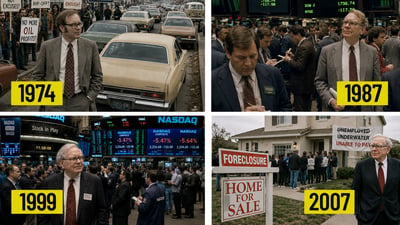
The historical parallel is uncomfortable but instructive. In 1999, Buffett looked just as out of step. Headlines declared he'd lost his edge. Then the dot-com bubble burst, and he was vindicated within 18 months. He's made this move before: hold cash, wait for blood in the streets, and acquire on the way down.
The question Early can't answer with certainty is whether the same playbook works in 2025.
AI Is Where Berkshire Is Most Exposed
The technology gap inside Berkshire's private portfolio is clearer than most investors realize.
Greg Abel acknowledged at the meeting that Burlington Northern Santa Fe is roughly a decade behind Union Pacific (NYSE: UNP) in technology adoption. GEICO faces a similar challenge against Progressive (NYSE: PGR), which was among the first insurers to sell policies online in the late 1990s and has never looked back.
Early's rough read of Abel's remarks: about 80% of his AI commentary focused on risk, not opportunity. That's not a company leaning into the moment. It's one watching it go by.
On the public equity side, Berkshire has made progress. Apple (NASDAQ: AAPL) became its single biggest return driver, and the portfolio has added Alphabet (NASDAQ: GOOGL) and Amazon (NASDAQ: AMZN) in recent years. But those moves came from portfolio managers Todd Combs and Ted Weschler, not from Buffett himself—and Combs has since departed.
The Contrarian Case for Constellation Software
Early isn't abandoning value investing. He's updating it. His current conviction pick is Constellation Software (OTCMKTS: CNSWF), a company he describes as "the most Buffett-like way to play the SaaS selloff."
Founded by Mark Leonard, Constellation has quietly acquired between 500 and 1,000 vertical market software companies over its history—small, niche businesses with long-term contracts, founder-led cultures, and high customer retention. Leonard recently stepped back from day-to-day operations for health reasons, with Mark Miller now serving as president.
The stock has been hammered on AI fears: the assumption that large language models will simply replace the specialized software these companies provide. Early thinks that logic is overdone.
Even if AI replicates 90% to 95% of what a vertically integrated software company does, the 5% it misses could create catastrophic risk for the businesses relying on it. Those aren't relationships you rip out for a vibe-coded alternative.
That risk/reward setup—quality software assets priced for an AI apocalypse that probably isn't coming—is exactly the kind of misvaluation Buffett has always hunted. The difference? Investing in Constellation is hunting it in technology rather than avoiding technology altogether.
What This Market Moment Is Really About
Early draws an analogy to the early internet era: companies that dismissed websites in 2000 look absurd in retrospect. AI may carry even more long-term weight. The hype cycle will correct—it always does—but the underlying transformation is likely underestimated over any decade-long horizon.
The risk for Berkshire isn't just underperformance. It's that railroads could be disrupted by autonomous trucking. That insurers without AI-driven underwriting lose ground permanently. That holding cash while waiting for a crash means missing the compounding that's already happening elsewhere.
Early still holds his Berkshire shares; he's just not adding. And for what it's worth, he's thinking harder about Constellation Software instead.
The market will eventually sort out what's priced right and what isn't. The setup worth watching: whether Berkshire's cash pile becomes a weapon—or just a record.
Datavalut Gains Traction: 5 Reasons to Sell Now
Author: Thomas Hughes. Date Posted: 5/15/2026.

Key Points
- Datavault is gaining business traction but faces significant headwinds from the stock price.
- Dilution, cash burn, and short sellers point to lower share prices before a substantial rally can begin.
- Upcoming catalysts promise to drive volatility over the summer and into the back half of this year.
- Special Report: Have $500? Invest in Elon’s AI Masterplan
Datavault (NASDAQ: DVLT) is gaining traction and appears on track to begin ramping revenue. However, a combination of factors suggests that a revenue ramp won’t be enough to make a difference for this stock’s price, which appears poised to move much, much lower.
The primary concern is cash burn. The company is effectively creating a new industry and building its own infrastructure in the process, which is burning cash at a rapid pace.
[Watch] FREE STOCK PICK for Elon Musk’s Starlink SuperIPO (Ad)
A little-known stock pick with money-doubling potential over the next year is revealed for free in the first three minutes of a new video. This company is a critical piece of Elon Musk's fast-growing Starlink technology. It could climb 100 percent or more over the next year as Elon brings Starlink public in what may be the biggest IPO in history. No credit card is required to get the ticker.
Watch the free video to get the ticker today.While it is capitalized today, that “strong” financial position came at a cost and only goes so far. As things stand, the company will most likely need additional capital by early 2027, if not by the end of 2026.
Datavault: Cash Burn, Dilution, and Short Interest in Play
Datavault’s balance sheet at the end of Q1 was much improved. The company’s cash balance remained flat, debt and liabilities were reduced, but assets and equity declined while the share count increased dramatically. That share count is why this company is in such good financial shape, up more than 10X year-over-year and still rising since the quarter ended. While further share-count increases aren’t expected in the near term, the most likely mid-term outcome is that it rises before it falls again, and those increases could be substantial.
The trailing 12-month dilution, cash burn, and threat of future dilution have set the stage for short-sellers, and they are active in this market. MarketBeat data shows them ramping up activity in 2026, with short interest holding near a lofty 12% and ready to pounce on bad news. The recent Q1 earnings report wasn’t horrible news, but it matched the outlook for future dilution and may trigger accelerated short activity.
Institutions and analysts provide little support for this market, leaving the door open to lower prices. While institutional activity shows the group buying at an aggressive pace, total interest is below 1%; the net activity is tepid at best and is more likely tied to short covering than true accumulation. Analysts, likewise, forecast substantial upside at the consensus, but it is a low-conviction target, with only two analysts tracked and only one with a price target. The consensus is Hold, with one optimistic Buy and one Sell, offering little impetus for institutions or retail investors to buy.
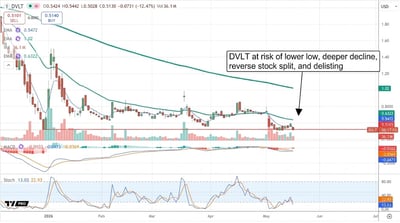
The price action was not encouraging following the earnings release, given the stock’s decline of more than 10%. The move confirms resistance at critical levels aligned with exponential moving averages and prior support, suggesting new lows may be set. The critical support target is a long-term low near 50 cents, a potential pivot point on a move lower. A break below that level would likely trigger selling, including from short-sellers and investors cutting losses.
Datavault Has Catalysts: Good, Bad, and Ugly Catalysts
An upcoming bearish catalyst would be the potential delisting from Nasdaq. Datavault received a delisting notice earlier this year due to its low stock price and has until August to rectify the situation. If the company can’t get its shares above $1 organically, which seems unlikely, a reverse stock split may become unavoidable. One possible outcome is that the company could retain its Nasdaq listing and, theoretically, have easier access to capital markets. The downside is that reverse stock splits seldom work for investors, often leading to increased short interest and even lower share prices.
Bullish catalysts include the Clarity Act and upcoming digital exchange launches. The Clarity Act is critical to the cryptocurrency industry because it clearly defines asset classes, enabling more efficient oversight, protecting developers, and providing pathways for institutional investment. Digital exchange launches are also critical to Datavault’s success, as they widen market access and exposure to its digitized assets.
Execution Is Critical: Missteps Will Show Up in the Price Action
The biggest risk for Datavault, aside from dilution, cash burn, and delisting, is execution. The company reaffirmed its year-end targets despite the significant Q1 miss, setting a high bar to meet. Challenges include building the network, integrating acquisitions, and attracting consumers while navigating a challenging and evolving regulatory environment. The likely outcome is that hurdles and delays will arise and be reflected in the stock price over time.
What the market may be getting wrong is the company’s ability to scale and its pending contracts. The company’s revenue fell significantly short of the high bar in place in Q1, but it grew more than 440% year over year and is expected to remain strong in upcoming quarters and years. The pipeline includes approximately $800 million in signed tokenization deals, with monetization expected by year-end. Assuming flawless execution and supportive market conditions, the company may quickly achieve profitability, reduce its need for future dilution, and provide a catalyst for short-sellers, analysts, and institutions to begin buying the stock.
This email content is a paid sponsorship from Huge Alerts, a third-party advertiser of DividendStocks.com and MarketBeat.
This message is a paid advertisement for Banzai International, Inc. (NASDAQ: BNZI) from Huge Alerts and Sideways Frequency. MarketBeat Media, LLC receives a fixed fee for each subscriber that clicks on a link in this email, totaling up to $4,500. Other than the compensation received for this advertisement sent to subscribers, MarketBeat and its principals are not affiliated with either Huge Alerts or Sideways Frequency. MarketBeat and its principals do not own any of the stocks mentioned in this email or in the article that this email links to. Neither MarketBeat nor its principals are FINRA-registered broker-dealers or investment advisers. The content of this email should not be taken as advice, an endorsement, or a recommendation from MarketBeat to buy or sell any security. MarketBeat has not evaluated the accuracy of any claims made in this advertisement. MarketBeat recommends that investors do their own independent research and consult with a qualified investment professional before buying or selling any security. Investing is inherently risky. Past-performance is not indicative of future results. Please see the disclaimer regarding Banzai International, Inc. (NASDAQ: BNZI) on Sideways Frequency' website for additional information about the relationship between Sideways Frequency and Banzai International, Inc. (NASDAQ: BNZI).
If you have questions about your subscription, feel free to contact our U.S. based support team at contact@marketbeat.com.
If you no longer wish to receive email from DividendStocks.com, you can unsubscribe.
© 2006-2026 MarketBeat Media, LLC. All rights reserved.
345 N Reid Pl. #620, Sioux Falls, SD 57103. USA..
