
Hi there,
Want The Early Bird’s Stock of the Day before it hits your email inbox?
We now send it by text each morning, so you can see the pick right away— a full day earlier than the newsletter.
Here’s what you’ll get:
One actionable stock idea selected by MarketBeat’s research team
The key headline(s) moving the stock
A quick bull case and bear case
Follow-up alerts when something changes
If you’d like to start (it’s free), tap here:
Get The Stock of the Day By Text
—The Early Bird Team
P.S. This is a free service. Message frequency will vary. Unsubscribe any time by replying "STOP" to our messages.
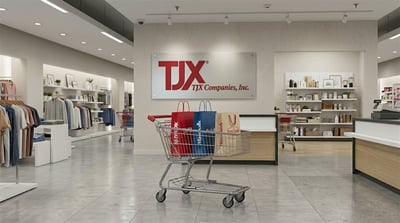
TJX: Retail’s Apex Predator Feasts on Inflation
By Jeffrey Neal Johnson. Published: 6/13/2026.
Key Points
- TJX Companies' business model uniquely benefits from broad retail distress and a challenged consumer economy.
- Impressive comparable store sales growth is driving significant profit margin expansion across TJX Companies' core brands.
- Management demonstrates strong conviction through a substantial share repurchase program and a multi-decade history of dividend payments.
- Special Report: Everyone wanted SpaceX. Smart money wants this.
If you are an investor looking for a defensive portfolio play that does not sacrifice the potential for aggressive capital appreciation, the current retail landscape feels like a minefield. Traditional mall brands are battling severe inventory gluts, and middle-class consumers are still dealing with prolonged inflationary pressure. Discretionary income is shrinking, leaving fewer dollars for full-priced apparel and home goods.
For most retailers, this environment signals margin compression and declining foot traffic. Yet within this distress lies a structural advantage for a select few.
Read this or regret it forever (Ad)
Porter Stansberry, founder of one of the world's largest financial research firms, says he's breaking the biggest story of his 26-year career. A famous historian whose books have sold over 45 million copies in 65 languages is warning of a structural shift so large it has only one historical parallel - 1776.
One Stanford economist calls it 'the biggest change ever - bigger than electricity, bigger than the steam engine.' Stansberry outlines the stocks to buy, the stocks to sell, and three money moves to position yourself on the right side of this shift.
Read Porter Stansberry's full breakdown and protect your wealth nowTJX Companies (NYSE: TJX) is actively turning these macroeconomic headwinds to its advantage, converting traditional retail distress into record-breaking margin expansion. By continuously capturing market share from full-price department stores, the king of off-price retail offers investors a defensive growth profile.
TJX Companies recently traded near the $170 level, just below its 52-week high—a price action that reinforces its status as the apex predator of the consumer discretionary sector.
Feasting on Scraps: How Distress Fuels the TJX Flywheel
Understanding TJX's structural advantage starts with the global supply chain ecosystem.
When traditional department stores misjudge consumer demand, face sudden order cancellations, or deal with seasonal overstock, off-price retailers step in to clear out that excess high-quality inventory for pennies on the dollar.
The worse the macroeconomic environment gets for traditional apparel, the better the inventory quality and pricing power can become for opportunistic buyers like TJX Companies.
This dynamic creates a treasure-hunt shopping experience that drives physical foot traffic and remains highly resilient against pure-play e-commerce competitors. An algorithm cannot replicate the thrill of discovering a designer handbag at a 70% discount.
TJX Companies' fiscal first-quarter 2027 earnings data proves the thesis. Its $1.19 in earnings per share (EPS) cleared analyst consensus estimates by a wide margin of 17 cents. Revenue expanded 9.2% year-over-year (YOY) to $14.32 billion. Marmaxx comparable store sales, the core of the business, rose a healthy 6% while generating a 90-basis-point expansion in profit margins. HomeGoods delivered even more aggressive growth, with comparable sales jumping 9%, pushing segment margins up an impressive 270 basis points.
Based on this strength, management raised its full-year fiscal 2027 outlook. It revised gross margin targets upward to a range of 31.2% to 31.3% for the fiscal year, with pretax profit margins expected to land between 11.9% and 12.0%. This operating leverage is the engine behind a solid 57.9% return on equity.
The Shareholder Spoils: Dividends and Buybacks
A business generating $6.13 per share in operating cash flow has the luxury of returning significant amounts of capital to shareholders while also funding domestic and international store expansion.
Management authorized an aggressive increase in full-year share buybacks, projecting repurchases between $2.75 billion and $3.0 billion. A corporate buyback program of this magnitude can not only reduce the share count and boost EPS, but also signal immense internal conviction in the trajectory of the balance sheet and future cash flows.
Income-focused investors also benefit from a legendary payout history. On June 9, 2026, the board declared a 48-cent-per-share quarterly dividend. This preserves a five-year streak of consecutive dividend payments, following a 13% payout hike announced in March.
Navigating four decades of economic cycles, recessions, and global supply chain disruptions while consistently raising payouts is the hallmark of a bulletproof business model and disciplined capital management.
Wall Street institutions are rapidly repricing the upside potential to account for this dual-engine capital return strategy.
Analysts at Truist Securities recently raised their price target to $190, while UBS reiterated a Buy rating.
Compared to peers like Ross Stores (NASDAQ: ROST) and Burlington Stores (NYSE: BURL), TJX Companies' sheer scale and roughly $186 billion market capitalization give it unmatched leverage over global manufacturing hubs.
The Smart Money Bets on TJX's Defense
Market sentiment remains broadly bullish, reflected directly in the options chain and short interest data.
Short interest is about 1.59% of the float. With just over 14 million shares sold short and a days-to-cover ratio of 2.4, institutional investors are showing little appetite for betting against the current valuation.
Heavyweights like Bank of America Corp. and Bank of New York Mellon maintain large anchor positions, underscoring TJX's defensive nature.
Recent headlines highlighting executive selling require context. TJX Executive Chair Carol Meyrowitz divested 55,624 shares on June 11, 2026, and CFO John Klinger sold 6,235 shares earlier in the month for roughly $1 million. These sales followed recent Form 144 filings and appear tied to previously awarded equity compensation, making them less alarming than open-market selling based on a changed view of the business.
Is TJX's Premium Price Tag Worth Paying For?
The fundamental data validates the off-price dominance thesis. Strained discretionary income will continue to push middle-class shoppers away from full-price retail and toward discount channels. The resulting margin expansion appears structurally durable as long as macroeconomic pressure persists. TJX Companies operates as the ultimate vacuum for retail distress, turning competitors' overstock problems into record-breaking cash flow.
Investors must weigh the current valuation multiple before deploying capital.
TJX Companies trades at a trailing price-to-earnings (P/E) ratio of 32.6 and a forward P/E ratio of 32.5. A premium multiple demands flawless execution. Any sudden deceleration in comparable store sales or unforeseen logistics bottlenecks could trigger a near-term price correction. This elevated multiple represents the fundamental cost of admission for holding the highest-quality asset in the discount apparel sector.
The primary risk is a rapid economic recovery that reinvigorates full-price retailers, potentially tightening the supply of deeply discounted, high-quality inventory for TJX Companies.
Cautious investors might consider adding TJX Companies to their watchlist and using potential broader market pullbacks to initiate a position. Establishing exposure during periods of temporary market weakness could allow investors to capture the long-term structural tailwinds of the off-price retail ecosystem without overpaying at peak valuation levels.
3 Dividend Kings With Income, Stability, and a Possible Catalyst
Submitted by Chris Markoch. First Published: 6/16/2026.

Key Points
- Coca-Cola, Colgate-Palmolive, and Stanley Black & Decker are Dividend Kings with durable payout records.
- A softer inflation outlook could help investors refocus on total return, not just dividend yield.
- Each stock offers a different mix of income, defensive stability, and recovery potential.
- Special Report: Everyone wanted SpaceX. Smart money wants this.
Many market analysts believe the current environment of entrenched inflation and higher-for-longer interest rates will remain a headwind on the economy into 2027. That combination has made dividend stocks less attractive in recent years.
But what if that narrative is wrong? On June 14, the outline of a peace deal was announced between the United States and Iran. If—and it’s still a big "if" as of this writing—the agreement goes forward, the Strait of Hormuz will reopen, easing oil prices, which have been a major contributor to the recent spike in inflation.
Read this or regret it forever (Ad)
Porter Stansberry, founder of one of the world's largest financial research firms, says he's breaking the biggest story of his 26-year career. A famous historian whose books have sold over 45 million copies in 65 languages is warning of a structural shift so large it has only one historical parallel - 1776.
One Stanford economist calls it 'the biggest change ever - bigger than electricity, bigger than the steam engine.' Stansberry outlines the stocks to buy, the stocks to sell, and three money moves to position yourself on the right side of this shift.
Read Porter Stansberry's full breakdown and protect your wealth nowIf inflation drifts lower, the odds of rate hikes will decline. In fact, it could even rekindle investor hopes for a rate cut later in 2026 or in early 2027.
That combination would allow investors to focus on a stock’s total return potential, which includes dividend yield plus capital appreciation. One area to focus on is dividend kings that look undervalued.
Coca-Cola Continues to Reward Long-Term Shareholders
Coca-Cola Co. (NYSE: KO) is up more than 14% in 2026 and shows why it fits perfectly with Warren Buffett’s value investing strategy. Over the past five years, KO has gained more than 48% and delivered a total return of over 71%. That includes its dividend, which yields about 2.6% and has increased for 64 consecutive years.
Coca-Cola is often compared with PepsiCo (NASDAQ: PEP), and in stronger economic periods Pepsi had the edge thanks to the diversity of its Frito-Lay acquisition. But in an economy where companies face margin pressure, Coca-Cola is benefiting from its more streamlined business model.
In the current quarter, Coca-Cola could get a marketing boost from its FIFA World Cup sponsorship, which may help offset ongoing pressure from higher commodity prices. That pressure isn’t likely to abate, but the annualized increases should normalize.
Stock charts tell a story, and the KO chart shows a company that has been a buy on any pullback. More importantly, the stock is up significantly since falling to around the low-$40s during the March 2020 market sell-off.
Colgate-Palmolive Delivers Stability and Dividend Growth
The overarching narrative has been that consumer staples stocks have performed poorly. But as history has shown, quality matters. Over the last five years, Colgate-Palmolive (NYSE: CL) is up more than 8.5%. It hasn’t outperformed the broader market, but it has delivered the defensive stability and dividend income investors expect from a high-quality consumer staples stock.
The near-term setup looks stronger. The stock is up more than 14% in 2026, and the company has demonstrated its ability to manage the impact of higher raw-material and logistics costs. Summer travel demand is expected to remain solid, which should help sales of the company’s signature personal care products. Investors should also not be too quick to discount Colgate-Palmolive's pet care segment, which includes the Hill’s brand.
As of June 15, CL trades about 5.8% below the consensus price target of analysts tracked by MarketBeat, at $95.88. The next catalyst for the stock could come from its earnings report expected in late July, which could reset the outlook for the stock in the second half. Either way, investors are getting a dividend that has increased for 63 consecutive years, yields 2.34%, and pays out $2.12 per share annually.
Stanley Black & Decker Offers Income and Recovery Potential
Stanley Black & Decker (NYSE: SWK) is an industrial stock with a consumer story that may be ready to refire. The company’s Q1 2026 earnings report showed strength in the company’s Engineered Fastening and PRO segments. That reflects the increased infrastructure spending flowing into the economy.
That has helped push SWK up more than 30% in the last 12 months and over 14% in 2026. Unlike the steadier consumer staples names, Stanley Black & Decker is still a recovery story, with shares well below prior highs. That weakness is also part of the opportunity. The company is a go-to name for the literal picks and shovels needed to build out infrastructure in all its forms.
In the second half, a stronger consumer could be a catalyst worth watching. Stanley Black & Decker is the parent company of the CRAFTSMAN brand. That’s part of the Tools and Outdoor segment, where organic revenue was down 1%, primarily due to lower retail volumes in North America.
But that’s where the opportunity may be. In the meantime, investors are being paid well to wait on SWK. The company’s dividend has increased for 58 consecutive years, yields 3.88%, and pays $3.32 per share annually.
This email is a sponsored email from The Early Bird, a third-party advertiser of Earnings360 and MarketBeat.
If you have questions about your account, please email our U.S. based support team at contact@marketbeat.com.
If you no longer wish to receive email from Earnings360, you can unsubscribe.
Copyright 2006-2026 MarketBeat Media, LLC.
345 North Reid Place, Suite 620, Sioux Falls, South Dakota 57103-7078. U.S.A..
