
Let’s be real about something.
SpaceX isn’t going public because Elon needs cash…
He’s going public because the AI infrastructure arms race just got expensive enough that even the world’s richest man needs the capital markets behind him.
Think about what that tells you about the scale of what’s being built.
Amazon, Google, Meta, and Microsoft have already committed $700 billion this year to build the foundation. SpaceX going public adds an entirely new weight to that pile.
And the small companies sitting in the path of that spending… the ones supplying the chips, the systems, the commuting backbone, are still flying under the radar for now.
I’ve identified the handful of companies best positioned to capture this summer’s buildout.
Chris Rowe
Alphabet's $80 Billion Offering: Worrisome Dilution or AI Confidence?
By Ryan Hasson. First Published: 6/2/2026.

Key Points
- Alphabet announced an $80 billion equity offering to fund AI infrastructure, with Berkshire Hathaway committing $10 billion as the anchor investor.
- The offering represents roughly 1.8% dilution, supported by a Google Cloud backlog exceeding $460 billion and 63% year-over-year cloud revenue growth.
- Shares have broken well below a key support level near $382, though 54 analysts maintain a Moderate Buy consensus with a $413.33 price target.
- Special Report: Elon Musk already made me a “wealthy man”
Alphabet (NASDAQ: GOOGL) has had a strong 2026 by almost any measure. The stock entered June up more than 20% year-to-date. Google Cloud delivered its strongest quarterly result in company history in Q1, and a series of major product announcements at Google I/O reinforced the company's position as one of the most formidable players in the AI race.
But Monday brought a different kind of headline. After the market close, Alphabet announced plans to raise $80 billion through stock sales, sending shares sharply lower. For investors watching the chart, the stock has now broken below a key short-term support level.
Your temporary download link is expiring (Ad)
Bill Poulos is giving away his 'Safe Trade Options Formula' book for free - but only for a limited time through a temporary download link.
He plans to charge for it soon. Download your copy now and lock it in at no cost, regardless of future pricing.
Download the Safe Trade Options Formula book for free before access closesThe question worth asking is whether that matters, or whether the initial market reaction misses the point.
What the $80 Billion Offering Actually Is
Understanding the announcement is important before drawing conclusions. Alphabet plans to raise the $80 billion through two separate mechanisms. The first is a $40 billion direct placement to institutional investors, and the second is a $40 billion at-the-market program. The anchor investor in the direct placement is Berkshire Hathaway (NYSE: BRK.B), which is committing $10 billion, a significant endorsement from one of the world's most respected long-term capital allocators. Berkshire had already tripled its Alphabet stake in Q1 2026 under new CEO Greg Abel.
Alphabet stated plainly in its release that demand for its AI solutions from enterprises and consumers is currently exceeding available compute supply. The capital is intended to fund AI infrastructure to close that gap. At a market cap of almost $4.5 trillion, $80 billion represents close to 1.8% dilution. That is not trivial, but it is not alarming either, particularly when the company is generating $174 billion in operating cash flow over the trailing 12 months and growing Google Cloud at 63% year over year is telling the market that it cannot build fast enough to meet demand.
Is This a Warning Sign or a Statement of Confidence?
The honest answer is that it depends on how you frame it. The bearish read is straightforward: Alphabet is taking on additional equity dilution on top of a debt load that has already exceeded $100 billion after raising more than $85 billion in debt across six currencies over the past year. The 2026 CapEx guidance of $180 billion to $190 billion, with management signaling further increases in 2027, reflects a capital-intensive cycle that is compressing near-term free cash flow. Investors who bought GOOGL for its capital efficiency and clean balance sheet have a legitimate point in pushing back.
The bullish read is equally compelling. Companies do not raise $80 billion in equity when they are uncertain about demand. They raise it when they have more contracted revenue than infrastructure to serve it. The Google Cloud backlog of over $460 billion is the supporting data point. Berkshire Hathaway writing a $10 billion check alongside the offering is not the behavior of an investor who is worried about the thesis.
The Fundamental Foundation Remains Strong
It is worth stepping back from the noise of a single evening's price action and looking at what Alphabet actually is right now. Annual revenue of $422.50 billion. Net income of $132.17 billion. Google Cloud growing at 63% year over year with a backlog approaching half a trillion dollars. Eight and a half million monthly developers building on Google's models. First-party API token processing has increased sixfold over the past year. These are not the numbers of a company that is struggling to justify its valuation.
And the sentiment among analysts remains steadfastly bullish, too. The consensus among 54 analysts is a Moderate Buy, with a price target of $413.33, implying nearly 10% upside from current levels.
Short-Term Support Broke, But the Long-Term Trajectory Remains Firm
Monday's selloff in after-hours trading looks more like a reflexive reaction to dilution headlines than a considered reassessment of Alphabet's long-term trajectory. The $80 billion offering is large in absolute terms, but modest relative to the scale of the business and the opportunity it is being deployed to capture.
Whether the technical setup resolves to the upside or requires further consolidation before the next move is the key question to watch in the days ahead. For now, the stock broke below a multi-month support level near $382, so for the bulls to regain short-term control, it would need to reclaim that level.
Berkshire Sells Visa, Domino's, and Pool Corp: Should You Follow?
Submitted by Dan Schmidt. Date Posted: 5/26/2026.

Key Points
- Berkshire Hathaway's first 13F under CEO Greg Abel shows the company exited 16 positions totaling $8.1 billion, its largest net equity sale since Q3 2024.
- Abel's portfolio now holds just 26 stocks with a record $397 billion cash position, signaling a view that the broader market is currently overvalued.
- Exits from Domino's Pizza and Pool Corp. reflect deteriorating fundamentals and macro headwinds, while the Visa sale appears tied to unwinding departed investor Todd Combs' book.
- Special Report: Elon Musk already made me a “wealthy man”
The torch has officially been passed. On May 15, Berkshire Hathaway (NYSE: BRK.A) released its first Form 13F under new CEO Greg Abel, marking the first time in more than 60 years that Warren Buffett’s name did not appear on the filing. Abel’s tenure began when the 95-year-old Buffett officially stepped down on Jan. 1, and the new CEO’s first 13F shows an equity book that is shrinking while cash levels rise. Berkshire fully exited 16 different positions totaling $8.1 billion, its largest net equity sale since Q3 2024. Is this a continuation of Buffett’s value-centric approach, or a new CEO flexing his muscle? A few clues emerge when breaking down the filing.
What Greg Abel’s First Quarter as CEO Says About Berkshire’s Strategy
In many ways, Abel’s first 13F showed that Berkshire remains as focused as ever on patiently waiting for bargains. The company’s equity book now holds just 26 stocks, down from more than 40 last year, and its cash position sits at a record $397 billion. A few points stand out:
-
BlackRock Knows Something You Don't (yet) (Ad)
JPMorgan is already moving $2 billion a day through it. BlackRock has a fund running on it. Goldman Sachs has announced full integration. President Trump signed a law requiring every U.S. financial institution to migrate onto a new high-speed Money Grid by April 2027.
With $382 trillion projected to flow through these rails, one scarce digital asset - mandatory for every transaction - is being quietly accumulated by BlackRock, JPMorgan, Fidelity, and Andreessen Horowitz before the story goes mainstream.
Get the name, ticker, and full breakdown in this free special reportHigher Concentration: Abel’s equity book is smaller and filled with high-conviction bets, including moving Alphabet Inc. (NASDAQ: GOOGL) into a top-seven position. Buffett was famous for avoiding expensive tech stocks, so this suggests Abel is more willing to swing big when he sees an opportunity, even if it runs against traditional value metrics.
Value Still the Overwhelming Focus: Abel deployed capital into multiple beaten-down stocks trading at discounts to their historical averages, including Delta Air Lines Inc. (NYSE: DAL) and Macy’s Inc. (NYSE: M). Investments like these show that valuation remains the backbone of the Berkshire portfolio.
Unwinding the Combs Book: One of Berkshire’s top investors, Todd Combs, left for JPMorgan late last year, and many of the positions closed out in Q1 had been opened by him. Closing out Combs’ book was clearly a priority for Abel, who now controls more than 90% of Berkshire’s trading.
Analyzing 3 Berkshire Stock Sales From the Latest 13F
The biggest theme emerging from Abel’s filing is that Berkshire sees the market as overvalued and is raising cash. Many of the stocks sold in Q1 no longer fit the tight valuation profile Berkshire seeks in its holdings, so capital will remain in Treasuries until discounts like those in Delta or Macy’s materialize.
Visa: Strong Fundamentals Point to Likely Philosophical Exit
Visa Inc. (NYSE: V) seems like the type of company Berkshire would target in the current environment: trading below its 10-year average forward P/E following an exceptional quarter. The company reported revenue of more than $11.2 billion in fiscal Q2 2026, up 17% year over year (YOY). EPS rose 20% YOY, and both figures easily surpassed analysts’ estimates. Management also raised full-year revenue and EPS guidance.
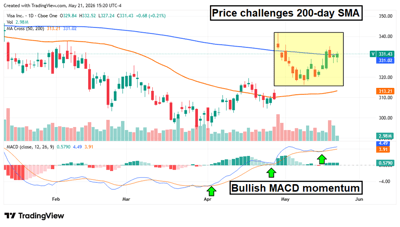
Abel’s exit from Visa shares looks more like a cleanup of Combs’ equity book than a change in fundamental thesis. The company reported its strongest quarter in years, and the daily chart shows several bullish technical signals, including a breakout on the Moving Average Convergence Divergence (MACD) indicator. If the price breaks resistance at the 200-day moving average, there could be further gains ahead.
Domino’s Pizza: Fundamental Growth Story Under Pressure
Here’s one where the exit matches deteriorating fundamentals. Berkshire opened a position in Domino’s Pizza Inc. (NASDAQ: DPZ) in 2024, and the quick exit following a disappointing pair of quarters points to a change in the individual company thesis rather than a broader strategy shift. In Q4 2025, management laid out a same-store sales goal of 3% for 2026 and guided for 2.3% in Q1. But in the numbers released during the Q1 2026 conference call on April 27, U.S. same-store sales grew just 0.9%, and international same-store sales actually declined 0.4%. CEO Russell Weiner was forced to revise Domino’s 2026 same-store sales outlook down to the low single digits amid the threat of a pullback in low-income consumer spending.
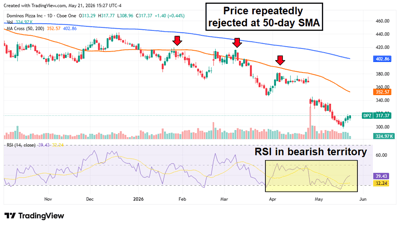
The chart also paints an ugly picture. DPZ shares are down nearly 25% so far in 2026, and there is no bottom in sight. The price has faced stiff resistance at the 50-day moving average, pushing shares lower over the last six months. The Relative Strength Index (RSI) is also struggling to move out of bearish territory, so the technicals match the fundamentals at Domino’s. Abel’s decision to exit this position looks shrewd in retrospect.
Pool Corp: Housing Uncertainty Stifles Business Outlook
Pool Corp. (NASDAQ: POOL) is also facing serious headwinds, though the most prominent is beyond management’s control. The company’s growth prospects depend on a robust housing market and new construction spending, both of which have been stymied by persistent inflation and high interest rates. The Q1 2026 earnings report was solid but unspectacular, with net sales growing 6% YOY but still falling below expectations. Most of the sales growth came from price increases, and the company installed just 58,000 pools in 2025, far below the 75,000-100,000 range seen during the post-COVID-19 peak.
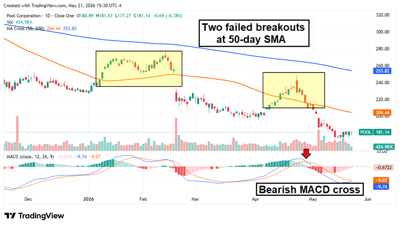
Until rates move lower, it's unlikely POOL shares will break out of this bearish momentum. The stock has already had two failed breakouts at the 50-day moving average this year, and the MACD flashed a bearish crossover last month, hinting at more downside ahead. Macro conditions are weighing heavily on the stock, and that is a variable Abel wants out of the Berkshire portfolio.
This email content is a sponsored message from True Market Insiders, a third-party advertiser of MarketBeat. Why was I sent this email?.
If you have questions about your subscription, feel free to email MarketBeat's U.S. based support team at contact@marketbeat.com.
If you would no longer like to receive promotional emails from MarketBeat advertisers, you can unsubscribe or manage your mailing preferences here.
© 2006-2026 MarketBeat Media, LLC. All rights reserved.
345 North Reid Place #620, Sioux Falls, S.D. 57103. U.S.A..
