 Dear Reader, On May 3rd, 2025, Warren Buffett looked at his shareholders for the last time and said: "The dollar is going to hell." The man who defended the US dollar for 60 years just told you it's done. Ray Dalio agrees. 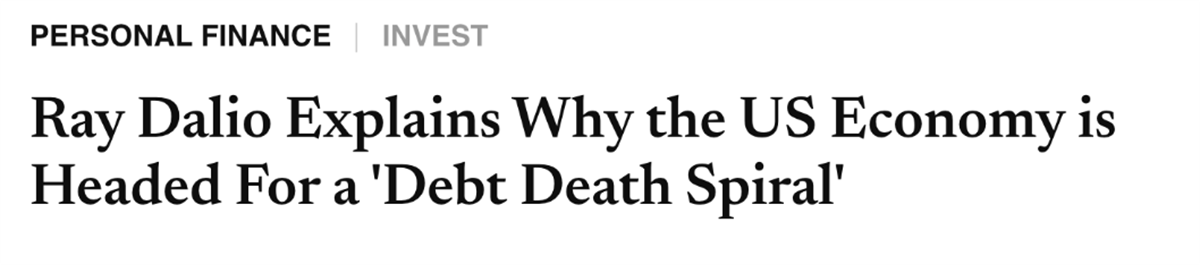
Source: International Business Times
The founder of Bridgewater Associates ($150 billion AUM) calls it a "debt death spiral." $38.4 trillion in debt. Adding a trillion every 60 days. A billion every 8 hours. The math doesn't work anymore. If the dollar falls, most people will get hurt badly. But there's a specific asset class and investment system that actually thrives when the dollar collapses. It's called the ABN System. It adapts the principles of Blackrock's investing strategy so everyday investors can apply it to protect themselves. Over 4,500 members have already implemented this system. If you have $50k+ exposed to the dollar right now (including your 401(k), stocks, real estate, savings), you need to pay attention. Watch how to protect yourself from what Dalio and Buffett see coming (free training) -> To your freedom,
Tan Gera, CFA©
Decentralized Masters P.S. JPMorgan warned we're at 120% debt-to-GDP. Greece collapsed at 130%. Watch the presentation now.
Exclusive Content
Visa’s Open USD Push Puts Circle’s Stablecoin Moat Under PressureReported by Jeffrey Neal Johnson. Article Published: 7/5/2026. 
Key Points
- A 140-member consortium launched Open USD, a shared-yield stablecoin that redistributes reserve interest to network partners, threatening crypto-native issuers.
- Circle Internet Group faces existential margin pressure after Coinbase, which paid $908 million in 2024 revenue-sharing, defected to the Open Standard alliance.
- Visa posted $3.31 EPS, beat estimates, initiated a $20 billion buyback, and received a Piper Sandler upgrade as capital rotates toward legacy payment networks.
- Special Report: American’s Biggest Threat Is Here
The financial plumbing of the global economy is being rewritten. For much of the past decade, stablecoin issuance—digital dollars that live on blockchain networks—was largely dominated by crypto-native firms. Traditional payment processors seemed to be watching from the sidelines, occasionally announcing small-scale pilot programs. That dynamic changed this week. The launch of Open USD by a 140-member consortium marks a decisive institutional move into decentralized payment infrastructure. By redistributing reserve interest directly to network partners, traditional financial processors are using shared-yield tokenomics against early market entrants. Legacy networks are now scaling the digital dollar while eroding the proprietary advantages of pure-play crypto issuers. The GENIUS Act and the Green Light for Legacy Capital
To understand the magnitude of this shift, it helps to look back at the July 2025 passage of the GENIUS Act. This regulatory framework provided the federal compliance structure traditional finance had been waiting for. Legacy players like Visa Inc. (NYSE: V) and Mastercard (NYSE: MA) have never ignored the blockchain space. They were waiting for the legal green light to deploy capital at scale without jeopardizing their core businesses. With regulatory clarity secured, the broader fintech ecosystem moved quickly. Stripe laid the operational groundwork by acquiring the stablecoin platform Bridge for $1.1 billion, putting seasoned operators at the helm of a new standard. The result is the Open Standard consortium, a massive alliance featuring Visa, Stripe, BlackRock (NYSE: BLK), Alphabet (NASDAQ: GOOGL), and Coinbase (NASDAQ: COIN). This is not a defensive move by traditional finance. It is an aggressive, calculated infrastructure upgrade designed to own the rails of cross-border money movement. Tokenomics 2.0: Siphoning the Crypto YieldIt is worth unpacking the structural evolution introduced by Open USD, because it directly challenges the core business model of first-generation stablecoins. When an institution mints a legacy stablecoin, it hands over fiat currency, and the issuer deposits those funds into short-term U.S. Treasuries. The issuer then keeps the yield generated by those reserves. When interest rates are high, this model produces exceptional cash flow. Open USD operates on a shared-yield architecture. Instead of hoarding Treasury interest at the issuer level, the Open Standard consortium redistributes that yield back to the network partners that facilitate transactions. It also eliminated minting and redemption fees. This creates a frictionless, yield-generating asset for enterprise partners, instantly making proprietary, closed-loop stablecoin models less competitive. A Leaky Moat: Circle's Margin Compression CrisisThis architectural shift poses an existential threat to companies heavily reliant on the legacy model. Circle Internet Group (NYSE: CRCL) generates roughly 99% of its revenue from the interest earned on reserves backing the USDC stablecoin. When the core product is commoditized by a consortium offering better economics to distributors, margin compression can be swift and severe. The clearest sign of this structural vulnerability is the defection of key ecosystem partners. Coinbase previously served as a major distribution hub for USDC. In 2024 alone, Coinbase extracted $908 million from Circle through distribution and revenue-sharing agreements. With the launch of Open USD, Coinbase has joined the Open Standard alliance. The economic incentive is obvious. Rather than taking a negotiated cut from a third-party issuer like Circle, exchange networks and payment processors can use Open USD to internalize reserve yields directly. This supply-chain defection forces Circle into an impossible position. To retain enterprise distributors, Circle must either slash fees to zero or give up reserve yield. Either outcome would severely damage profitability. $20 Billion Buybacks and Unstoppable MarginsThe market is already pricing in the erosion of the proprietary stablecoin moat. Shares of Circle Internet Group have faced heavy downward pressure, currently trading near $62 after falling nearly 21% since the start of the year. Circle recently reported quarterly earnings that reflect the strain, with earnings per share (EPS) missing estimates by 6 cents and net margins languishing at negative 2.76%. Institutional sentiment is also turning against the pure-play crypto issuer. Short interest in Circle rose 45.4% month over month and now represents 10.06% of the public float. A short squeeze requires a bullish catalyst, but the structural weakening of the business model points in the opposite direction. Internal confidence appears equally shaken. Insiders have made zero open-market purchases over the past six months and have instead been heavy sellers, dumping more than $158 million in stock over the last 90 days. Wall Street analysts are also revising valuation models aggressively, with Compass Point cutting its price target on Circle from $97 to $55. As capital leaves vulnerable pure-play issuers, it is rotating toward the legacy networks leading the Open USD charge. Visa is one of the primary beneficiaries of this institutional shift. Visa is currently trading near $351 and has a market capitalization exceeding $630 billion. Visa is showing exactly how to use an entrenched market position to capture new technology. Integrating Open USD into globally ubiquitous payment rails helps neutralize the threat that decentralized finance could disrupt cross-border revenue. The fundamentals supporting Visa remain strong. The company recently posted $3.31 in EPS, easily beating consensus estimates of $3.10, driven by 17.1% year-over-year revenue growth. Profitability metrics remain exceptional, including a 51.68% net margin and a 65.00% return on equity. A forward price-to-earnings (P/E) ratio of 26.84 looks reasonable for a network positioned to capture the next generation of digital payments. Analysts are taking note of the expanded moat. Piper Sandler recently upgraded Visa from overweight to strong buy, citing confidence in its cross-border transaction strategy and resilient consumer discretionary spending. While Circle faces insider selling, the Visa board is signaling confidence in the current valuation and future cash flows. Visa recently initiated a $20 billion share repurchase program. That authorization provides a major tailwind for the stock, offering structural support while management executes its digital asset expansion. Buybacks of this size say a great deal about how Visa leadership views its strategic position. Plugging the Leaks in Your Crypto PortfolioThe era of digital assets existing in a silo outside the traditional financial system is over. The 140-member consortium behind Open USD shows that legacy payment processors have both the capital and the strategic foresight to absorb disruptive technologies. By using shared-yield economics, Visa and other legacy giants are capturing a multi-trillion-dollar stablecoin market while systematically weakening the business models of early crypto-native pioneers. Investors navigating the shifting payments sector should consider the durability of revenue streams. Portfolios heavily weighted toward single-product crypto firms reliant on proprietary yield models face significant structural risk. By contrast, exposure to entrenched, highly profitable networks that are executing large share repurchase programs offers a compelling way to capture the upside of the digital dollar's global expansion.
This content is for educational purposes only. The opinions expressed are from DM Intelligence LLC, doing business as Decentralized Masters, who are not licensed financial advisors or registered investment advisors. The reader acknowledges that DM Intelligence LLC is not responsible for any losses, direct or indirect, resulting from the use of this information, including errors, omissions, or inaccuracies. Results are not typical and will vary. Success with digital currencies requires time, effort, and involves substantial risk including total loss of investment. Past performance does not indicate future results. All investments are at your own risk. You may unsubscribe at any time.
. |


