
Dear investor,
Imagine going back in time…
And investing in Apple before the iPhone.
You could have seen a peak gain as high as 7,537%.
If you missed out on that generational run, don’t worry…
Because you’re about to get a 10x bigger opportunity thanks to the world’s richest man.
According to multiple insider sources who’ve been inside Tesla’s secret facilities recently…
Elon Musk is working on HIS ‘iPhone’ — a breakthrough technology that he says will be “10x bigger than the largest product in history.”
Which means it could do $20 trillion in lifetime sales, and potentially make early investors 10x wealthier than Steve Jobs’ iPhone.
And that’s why Nvidia’s CEO just said:
“This is the next biggest opportunity after AI… The ChatGPT moment for [Elon’s iPhone] is just around the corner.”
Because ‘Elon’s iPhone’ isn’t just another smartphone…
It’s the NEXT EVOLUTION of the smartphone.
And we think it could launch July 22nd.
So if you want to be an early investor…
(Before it goes mainstream…)
You need to act NOW.
Click here to get the full details before it’s too late.
3 Top Financial Institutions Announce Over $70 Billion in Share Repurchases
Submitted by Leo Miller. First Published: 6/30/2026.
Key Points
- JPMorgan Chase and Morgan Stanley passed the Federal Reserve's stress test and announced buyback programs worth $50 billion and $20 billion, respectively.
- Both JPMorgan and Morgan Stanley plan to raise their quarterly dividends, with Morgan Stanley increasing its payment by 15% to $1.15 per share.
- Jefferies Financial Group missed revenue and EPS estimates but authorized a $250 million buyback and posted record first-half revenue in its two largest segments.
- Special Report: Everyone wanted SpaceX. Smart money wants this.
Top financial institutions have just announced significant share buyback programs, many of them after passing the Federal Reserve’s stress test. The Fed’s stress test sets up a hypothetical recession and assesses whether a bank’s balance sheet can hold up under pressure.
The key figure to watch is a company’s common equity tier 1 (CET1) capital ratio. This measures the amount of capital a bank holds relative to its loans, adjusted for the risk of those loans. If loans default, that capital absorbs the losses. Stress tests examine whether a bank’s CET1 ratio stays above the minimum requirement of 4.5% during a severe downturn. Remaining above that threshold indicates a bank is well prepared to absorb large potential losses during a recession without negatively affecting depositors.
The numbers don't add up (Ad)
Warren Buffett's preferred market valuation tool just hit 217% - the highest reading ever recorded. Historically, anything above 200% is considered a danger zone, and the last time sentiment stretched this far, the Nasdaq took over a decade to recover.
Thor Metals Group has put together a free guide for investors who want to understand their options outside of heavily concentrated AI and tech positions. No sales pitch - just the information.
Claim your free guide from Thor Metals Group todayFrom firms that passed the Fed’s stress test to companies posting strong financial results, here are the latest buyback announcements in the finance sector.
JPMorgan Soars Past Stress Test, Announces Massive Buyback Plan
First up is JPMorgan Chase & Co. (NYSE: JPM). With a market capitalization of approximately $880 billion, JPMorgan Chase is by far the world’s most valuable banking stock. The company performed very well on the Fed’s stress test.
During the forecast period, JPMorgan's CET1 ratio began at 14.6% and fell only as low as 12.6%, staying well above the requirement and allowing the bank to pass.
With enough capital to weather a severe downturn while remaining above its requirement, JPMorgan can return more capital to shareholders. In response, the company announced a whopping $50 billion share buyback program.
This buyback program is equal to a hefty 5.6% of its market capitalization. JPMorgan is on a strong financial footing and can significantly reduce its outstanding share count going forward, providing a tailwind to per-share metrics. In fiscal 2025, the firm reduced its share count by 4%.
The company also intends to increase its quarterly dividend from $1.50 to $1.65 per share. Banks often announce their intention to increase dividends after stress tests. This is simply because the timing of the tests does not always align with the customary schedule for dividend declarations. As a result, the increase that follows is largely a formality. After the increase, the firm’s indicated yield would rise to a solid 2%.
Morgan Stanley: $20 Billion Buyback, 15% Dividend Increase
Although not as large as JPMorgan Chase, Morgan Stanley (NYSE: MS) is another major player in the banking industry. With a market capitalization near $330 billion, it ranks among the world’s 10 most valuable companies in the financial sector.
Morgan Stanley's CET1 ratio started the period at 15% and fell only to 12.5% during the recession forecast period, earning a passing grade. In response, the firm announced the reauthorization of its share buyback program, which is worth up to $20 billion.
While this program is not entirely new, it is still noteworthy. Had Morgan Stanley not passed the stress test, it may not have been able to reauthorize the program. With this reauthorization, the company’s buyback capacity is equal to a substantial 6% of its market capitalization. Like JPMorgan, the company expects to increase its dividend next quarter.
This would push Morgan Stanley's quarterly payment up by 15%, from $1 to $1.15 per share. After the increase, Morgan Stanley's indicated dividend yield would be just under 2.2%. Overall, Morgan Stanley is in a robust capital position based on the Fed’s testing, giving it the ability to return more capital to shareholders.
Jefferies: Strong Underlying Performance Plus Capital Returns
Last up is Jefferies Financial Group (NYSE: JEF), which did not participate in the stress test. The stock has run into some trouble in 2026, down more than 20% on the year. Shares were routed after the company’s latest earnings report. Jefferies significantly missed estimates on both sales and earnings per share (EPS). Despite growing by 35% year over year (YOY) to $2.21 billion, revenue came in well short of estimates of $2.30 billion. EPS also soared by 155% YOY to $1.02, but analysts expected an even larger increase to $1.16.
Jefferies also bought back a very large amount of shares during the quarter, spending $197 million on buybacks. In addition, the firm authorized a $250 million share buyback program. With Jefferies having a market capitalization of only around $10 billion, this program is equal to a sizable 2.5% of the firm’s value.
Overall, the firm failed to live up to relatively high analyst estimates, leading shares to fall almost 10% after its latest earnings release. However, Jefferies' business is clearly performing well at an underlying level. During the first half of 2026, the firm posted record revenue in its two largest segments, Investment Banking and Capital Markets. Additionally, capital returns are a meaningful part of this company’s story. It spent significantly on buybacks, has the capacity to spend more, and has a dividend yield near 3.3%.
Analysts Eye Recovery in Jefferies After Earnings Fall
Across JPMorgan, Morgan Stanley, and Jefferies, significant use of buybacks and dividends is a common theme. Among this group, Wall Street analysts are forecasting substantial gains in Jefferies. The MarketBeat consensus price target near $63 implies upside of more than 25%.
As Employers Drop Obesity Drug Coverage, Hims & Hers Could Be the Winner
Submitted by Jessica Mitacek. First Published: 7/6/2026.

Key Points
- Employers are expected to drop coverage for GLP-1 weight-loss drugs in 2027, potentially driving patients toward Hims & Hers Health's telehealth subscription platform.
- Hims & Hers shares have surged more than 45% in 30 days and about 160% since their February low, leaving the stock technically overbought.
- Wall Street remains largely cautious on HIMS, with a consensus Hold rating, rising short interest, and increased insider selling despite the stock's rally.
- Special Report: Everyone wanted SpaceX. Smart money wants this.
The healthcare sector has been one of the S&P 500’s best-performing groups over the past month, rising about 6%. While that rebound has been led by a handful of mega-cap Big Pharma companies, the strength has also extended to smaller firms.
One example is mid-cap Hims & Hers Health (NYSE: HIMS), the telehealth platform that provides direct-to-consumer (D2C) personal care products and virtual medical services.
The numbers don't add up (Ad)
Warren Buffett's preferred market valuation tool just hit 217% - the highest reading ever recorded. Historically, anything above 200% is considered a danger zone, and the last time sentiment stretched this far, the Nasdaq took over a decade to recover.
Thor Metals Group has put together a free guide for investors who want to understand their options outside of heavily concentrated AI and tech positions. No sales pitch - just the information.
Claim your free guide from Thor Metals Group todayOver the past 30 days, HIMS has risen more than 45%, lifting the stock’s year-to-date (YTD) gain to nearly 20%. After a move like that, the stock may be due for a short-term breather. But according to healthcare industry experts, a looming catalyst could deliver an outsized benefit to Hims & Hers in 2027 and beyond, setting up a buying opportunity on the next pullback.
The GLP-1 Craze Is Pushing Up Employers’ Healthcare Plan Costs
As the cost of weight-loss drugs continues to climb, Reuters recently reported that some employers are planning to drop coverage for GLP-1 treatments, including Wegovy, Ozempic, Zepbound, Mounjaro, and Foundayo—products manufactured by Novo Nordisk (NYSE: NVO) and Eli Lilly (NYSE: LLY).
Last year, more than 40% of employers covered weight-loss drugs, and estimates for this year are roughly the same. But analyses from two industry groups cited by Reuters suggest that could change in 2027.
According to the policy research group Business Group on Health, about 10% of employers that currently offer coverage for GLP-1 drugs for weight loss said they planned to drop them in 2027. A separate survey by Mercer, a benefits consultancy, found that 5% of large employers plan to drop coverage in 2027 or are actively considering it.
While that is unfortunate news for those undergoing treatment, it is welcome news for HIMS shareholders. Patients losing healthcare coverage for GLP-1 drugs could be a boon for Hims & Hers Health, which currently generates around one-third of its revenue from its weight-loss business.
Analysts expect the company’s revenue to grow from an estimated $2.89 billion in 2026 to $3.45 billion in 2027, and increased subscription demand for weight-loss drugs amid shrinking insurance coverage could play a significant role in that top-line growth.
Lost coverage for GLP-1 treatments should spur a migration to D2C telehealth providers, with Hims & Hers serving as a natural destination thanks to a platform that bundles access to medical providers, unlimited clinical consultations, and pharmacy fulfillment services into one streamlined subscription.
Technical Analysis and Wall Street Suggest a Correction Is Ahead
With its recurring revenue model, Hims & Hers should be a long-term beneficiary of reduced coverage. The platform charges a $39 fee for the first month of its weight-loss membership. After that, the charge rises to $149 for clinical subscriptions, not including the cost of the medication itself. Medication is billed separately, and Hims says the membership does not include or guarantee a prescription. Compounded oral options, for instance, can run from $145 to more than $199 per month, while branded GLP-1 pens—like Wegovy—can cost even more.
However, after gaining approximately 160% from its YTD low on Feb. 27, HIMS appears overdue for a correction. According to the Relative Strength Index (RSI)—a technical momentum indicator that shows whether a stock is overbought (above 70), oversold (below 30), or fairly valued somewhere in between—HIMS has moved into overbought territory.
As shown by the green arrow below, the RSI on HIMS’s one-year chart currently reads 70.86, suggesting that the stock is overbought and due for a reversal:
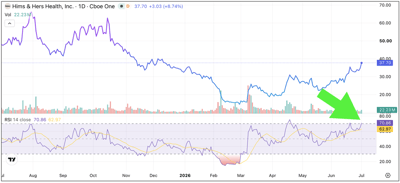
Technical analysis is hardly a perfect science. But the last two times the stock’s RSI breached 70—first in mid-April and then again in mid-June—HIMS pulled back more than 28% and nearly 8%, respectively, before continuing its rally.
Meanwhile, Wall Street remains bearish on the stock after its outperformance this year. Of the 16 analysts currently covering HIMS, only four assign it a Buy rating.
Overall, the stock receives a consensus Hold rating and a 12-month price target that implies more than 19% potential downside from current prices.
Concerningly, with a high-volatility beta of 2.35, current short interest in HIMS now stands at more than 32% of the float, or about 65.4 million shares valued at $1.97 billion.
That is the most the stock has been shorted since March and marks a nearly 5% month-over-month increase.
At the same time, insider activity has shown an uptick in selling this year. In Q1 2026, $3.46 million worth of HIMS shares were sold with no buys. In Q2, that figure rose to $4.86 million sold against $1.17 million bought.
This email content is a sponsored email sent on behalf of StocksToTrade, a third-party advertiser of MarketBeat. Why was I sent this email content?.
If you need help with your newsletter, feel free to email MarketBeat's South Dakota based support team at contact@marketbeat.com.
If you would no longer like to receive promotional emails from MarketBeat advertisers, you can unsubscribe or manage your mailing preferences here.
© 2006-2026 MarketBeat Media, LLC. All rights protected.
345 N Reid Place #620, Sioux Falls, S.D. 57103-7078. U.S.A..
