SK hynix's Q2 revenue missed estimates, but analysts remain bullish on HBM demand, margin gains, and an NVIDIA deal, citing significant... ͏ ͏ ͏ ͏ ͏ ͏ ͏ ͏ ͏ ͏ ͏ ͏ ͏ ͏ ͏ ͏ ͏ ͏ ͏ ͏ ͏ ͏ ͏ ͏ ͏ ͏ ͏ ͏ ͏ ͏ ͏ ͏ ͏ ͏ ͏ ͏ ͏ ͏ ͏ ͏ ͏ ͏ ͏ ͏ ͏ ͏ ͏ ͏ ͏ ͏ ͏ ͏ ͏ ͏ ͏ ͏ ͏ ͏ ͏ ͏ ͏ ͏ ͏ ͏ ͏ ͏ ͏ ͏ ͏ ͏ ͏ ͏ ͏ ͏ ͏ ͏ ͏ ͏ ͏ ͏ ͏ ͏ ͏ ͏ ͏ ͏ ͏ ͏ ͏ ͏ ͏ ͏ ͏ ͏ ͏ ͏ ͏ ͏ ͏ ͏
|
|
| Written by Thomas Hughes 
Given SK hynix’s (NASDAQ: SKHY) dominant position in digital memory—and high-bandwidth memory (HBM) in particular—it's a good stock to own, perhaps one of the best for 2026 and the next few years. The biggest risk for U.S. investors is hype and a premium placed on recently listed American Depository Receipts (ADRs), which have impaired the risk/reward profile. The story as July comes to an end, however, is that the premium is eroding and opening the buying opportunity that smart money has waited for. Analysts Stay Bullish on SK hynix Despite the Q2 MissAnalysts' sentiment is firm, pointing to significant upside for this stock (both the South Korean shares and the ADRs) and was unimpaired by the weakness in Q2 earnings. Weaknesses were linked to timing, mix, and shifts, including the launch of next-gen HBM products, which are scheduled to ramp in the back half of the year. Analyst coverage of SKHY on MarketBeat is slim, with only three analysts tracked, but is robust when coupled with coverage of South Korean markets. Together, there are 40 current reports reflecting a Moderate Buy/Strong Buy consensus and over 100% upside potential. Consensus of U.S.-listed coverage suggests a 150% upside, a target echoed in coverage of competitor Micron (NASDAQ: MU). SK hynix Misses High Bar With Robust QuarterSK hynix missed consensus estimates for revenue, but the bar was set high, with 100% of analysts having lifted targets since the last report and whispers suggesting as much as 300% growth was possible. The critical details from the release include the 257% year-over-year increase, sequential acceleration, and the margin strength it drove. Top-line results were underpinned by AI, with DRAM and HBM pricing compounding volume gains. Other end markets, including PC and smartphones, were less robust but are limited by supply, which is expected to improve over time. 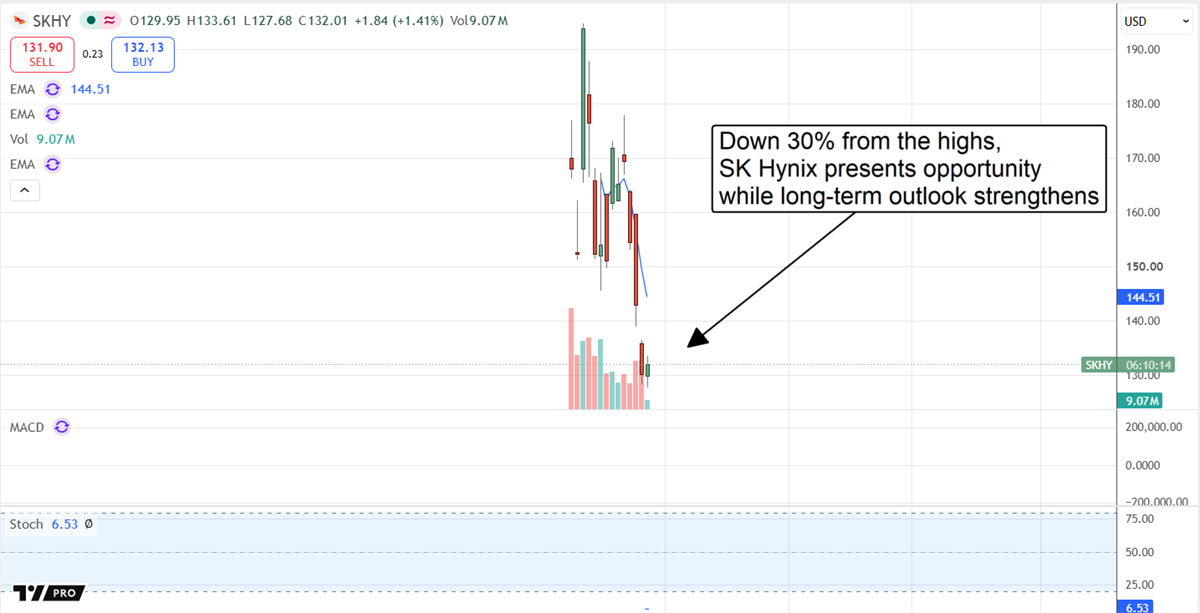
SK hynix, aided by capital raised through its U.S. listing, aims to double chip wafer capacity within the next five years. A deal with NVIDIA (NASDAQ: NVDA) is also in play, aiming to scale capacity across multiple production clusters to support AI infrastructure needs. Valued at over $500 billion, the deal also secured years of future memory supply, cementing SK hynix’s growth trajectory and pricing power. Q2 margin news was stellar. Surging demand, pricing power, and capacity utilization drove margin gains down the stack. The critical details are the 557% increase in operating profit and guidance, which noted increasing and broadening demand linked to high-performance computing and inference needs. Additionally, 10 new long-term agreements with hyperscale clients were mentioned, confirming a structural shift in the memory market. Memory is no longer a niche market, constrained by quarterly pricing fluctuations, but a critical piece of digital infrastructure commanding multiyear contracts and price stability. SK hynix’s Biggest Risks? Execution and CompetitionSK hynix’s biggest risks are execution and competition. On the one hand, supply constraints, capacity expansion, and the risk of oversupply limit growth prospects and set the market up for a massive correction. On the other hand, competitors like Micron are working hard to capture market share while expanding capacity to meet demand, thereby threatening SK hynix’s future growth and increasing the risk of market oversupply. The caveat is that AI spending plans have yet to be curtailed, leaving the fundamental story intact, and signs suggest the AI memory upswing is only just begun. This year’s catalysts include product launches. HBM4 began shipping in Q2, but the product ramp is slated for the second half, which will unlock GPU supply chain capacity. HBM4 is critical to Vera Rubin production, which, in turn, is critical to AI datacenter buildout. Oracle’s (NYSE: ORCL) contracts, for one, are heavily back-ended, dependent on capacity and computing power yet to be unleashed. Other launches include industry-specific solutions for mobility and personal computing, which are forecast to drive growth. AI Memory Demand Is Structural, Not CyclicalWhat the market gets wrong about SK hynix and other memory leaders is that AI is not a typical, cyclical blip in the memory chip demand cycle. It is a structural shift that is gaining momentum. While the push for training infrastructure may slow, it is leading to inference, which requires exponentially more memory. Each query requires a new memory dump, and the number of queries is growing daily while the models become more complex. The takeaway is that the memory cycle isn’t ending, as some fear, but is in its earliest phases and could accelerate over the next few quarters. Dividends, Buybacks, and a Cash Flow StoryInvestors can also benefit from SK hynix’s cash flow. The company is committed to capital returns, paying a baseline dividend with contingencies to increase payments as income improves. The Q2 release reaffirmed the commitment and raised the stakes, indicating an intention to accelerate returns, potentially including share buybacks. ADR holders are entitled to a proportional share of distributions, expected to be paid each quarter.  Read This Story Online Read This Story Online |

Marc Chaikin, founder of Chaikin Analytics, is sharing a strategy he calls 'Sell This, Buy That' - a way to move out of overpriced AI stocks before the tech trade breaks down and into lesser-known names with real potential to challenge the Mag 7.
One pick he calls 'an upgrade to Tesla stock' is a little-known company that just inked a partnership with Nvidia, positioning it ahead of Tesla in the autonomous vehicle race. Get the name, ticker, and full Hotlist before markets open
|
| Written by Sam Quirke 
Seagate Technology (NASDAQ: STX) has recently been caught in a brutal sell-off, with shares tumbling more than 20% as investors fled anything tied to the artificial intelligence (AI) trade. Even after that pullback, the stock remains up more than 170% year to date, leaving it more exposed than most as concerns grew that the AI-driven storage boom could be wobbling. Seagate's Q4 fiscal year 2026 earnings report, however, offered a resounding answer to the doubters. Not only did the company comfortably beat expectations for the latest quarter, but its guidance for the period ahead blew straight past what Wall Street was looking for, reinforcing the idea that the storage boom and Seagate’s rally still have plenty of room to run. The market’s initial verdict says it all. After a sharp pre-earnings sell-off, the stock’s positive reaction to the report suggests investors may have been too quick to write off the AI storage trade. Seagate’s Results Show the Storage Boom Is Still IntactThe headline numbers left little room for argument. Seagate delivered earnings well ahead of consensus on revenue that climbed nearly 50% year-over-year, itself comfortably ahead of estimates. The reason behind that strength is exactly the one the bulls have been pointing to all along, and CEO Dave Mosley echoed it. He credited robust cloud data center demand and disciplined execution, alongside durable long-term demand for the mass-capacity storage that Seagate specializes in. In other words, the explosion of AI is creating a seemingly relentless need to store enormous quantities of data, and Seagate is perfectly positioned to capture it. Just as importantly, the company's newest high-capacity technology is allowing it to scale up shipments profitably. That combination of surging demand and improving product mix is precisely what has underpinned the margin expansion story investors have been so excited about. The Technology Behind Seagate’s AI Storage EdgeBehind all of this is the cutting-edge technology that has quietly become Seagate's biggest advantage. Its latest generation of hard drives uses a new recording method that packs far more storage onto each disk, allowing the company to deliver the enormous capacities that AI data centers are crying out for without a matching jump in cost. This is what separates Seagate from a business that’s simply selling more of the same product. Every leap in density means more storage shipped from the same footprint, at a better margin, which can only mean good things for the stock. Seagate’s Guidance Strengthened the Bull CaseAs strong as the headline numbers for the quarter were, it was the company's outlook that truly caught the eye. Seagate guided to revenue of around $4.1 billion for the current quarter, comfortably ahead of the $3.78 billion analysts had been expecting. The earnings guidance was even more striking, with the company calling for roughly $7.30 in non-GAAP earnings per share against a consensus estimate that was closer to $5.63, dwarfing it by a wide margin. This is the crux of why the report will be so reassuring for anyone who's been worried that the storage rally has run its course. Seagate is not just riding a temporary spike in demand. It's telling investors, in the clearest terms available to it, that this momentum is actually accelerating. Seagate’s Rally Still Has to Prove It Can LastThe analyst community had been overwhelmingly positive going into the report, with firms like Wells Fargo and Citigroup raising their price targets in recent weeks, and that’s unlikely to change anytime soon. Citigroup's fresh $1,300 price target is particularly noteworthy given the substantial upside it implies from recent trading levels. Between those updates and the stock’s positive post-earnings reaction, it’s easy to see why the overall consensus rating on the stock is a Moderate Buy. For investors weighing it all up, Seagate’s latest earnings report has done exactly what it needed to. The storage boom that has powered its remarkable run through the first half of the year shows no sign of running out of road. The margin story is playing out as the bulls predicted, and management's guidance points to more strength ahead. Considering the stock is still trading well below its recent high, you can’t help but feel this post-earnings window might be a golden opportunity to take advantage of. Read This Story Online |

MP Materials surged 111%. Lithium Americas climbed 194%. Trilogy Metals jumped 211% overnight. Three stocks, three months, every one doubling - and they all share one common thread.
Trump's National Energy Dominance Council quietly touched each one first. Now they're targeting a five-trillion-dollar rebuild of the American power grid, and one company sits at the center of it. See the committee's next target before the market catches on
|
| Written by Ryan Hasson 
Alphabet (NASDAQ: GOOGL) finds itself in a somewhat unusual and precarious spot. The company just delivered one of the strongest quarters in its history, yet the stock closed Tuesday down just over 18% from its 52-week high and is now up only about 7% for the year. A mega-cap stock posting record results while its share price retreats toward its 200-day moving average leaves little middle ground. Either the market is handing long-term investors a rare entry, or the AI spending fears driving the weakness are about to get worse. The Quarter Deserved BetterThe results themselves left little to criticize. Revenue rose 24% year over year to $119.8 billion, extending the company's double-digit growth streak to 12 straight quarters. Google Cloud stole the spotlight again, accelerating to 82% growth at $24.8 billion, roughly 11% above what analysts had modeled, while the cloud backlog swelled to $514 billion. Cloud operating income more than tripled to $8.8 billion. Search grew 17%, quieting the cannibalization debate for another quarter. One accounting factor, however, needs to be noted. Reported earnings per share (EPS) of $9.11 were inflated by a $99 billion unrealized gain on Alphabet's Anthropic and SpaceX (NASDAQ: SPCX) stakes, with operational earnings landing near $2.87 per share. That same gain is now distorting the stock's headline price-to-earnings (P/E) ratios, which screen unusually low as a result. So investors comparing valuations should look through that noise rather than take the multiple at face value. What the Market Is Actually Afraid OfThe GOOGL sell-off has one source: spending. Capital expenditures (CapEx) hit $44.9 billion in the quarter, double the prior year, and management lifted its full-year guidance to $195 billion to $205 billion, up from the prior $180 billion to $190 billion range. Free cash flow flipped to a $5.9 billion outflow as a result. In a market that’s already extremely anxious about AI CapEx across the mega-caps, Alphabet's volunteering to spend even more was read as a risk rather than a signal of demand. The bulls' counterargument writes itself, though. A $514 billion backlog is contracted future revenue, and infrastructure is what converts it. Monday brought a reminder of that demand, with Verizon (NYSE: VZ) signing a dark fiber agreement with Alphabet, reportedly worth over $1 billion, to support AI data center connectivity. The Technical PictureFrom a technical perspective, GOOGL traded right down toward its 200-day simple moving average (SMA) and found support exactly where it needed to, near $320. Going forward, that is the important line in the sand for the bulls. One can argue that if the stock breaks below that support area and its post-earnings low, the structure breaks, and shares could enter a stage-four decline. But if it stabilizes above that zone and forms a higher low on the higher timeframe, this pullback could prove to be a great entry for long-term investors, coming after a major reset from the high. What the Street Is DoingNotably, the analyst community has leaned into the weakness rather than away from it. The consensus rating on GOOGL was recently upgraded to a Buy across 54 analysts, with the average price target rising to $419.86, implying upside of almost 26% from Tuesday's close. The high target sits at $515. Alphabet also scores in the 96th percentile of MarketBeat's MarketRank. The caution flags are real but familiar: the TradeSmith Health Indicator slipped into the Yellow Zone just over a week ago, and insider selling has continued, neither of which is unusual for a stock working through a drawdown of this size. Overdone, or Just Beginning?The honest read is that the fundamental case and the price action are telling two different stories, and the $320 level is where they meet. Nothing in the quarter weakened Alphabet's position. Cloud is accelerating, the backlog is enormous, and the Street responded to the sell-off by raising ratings and targets. What has changed is the market's tolerance for the spending required to serve that growth, and that tolerance may stay thin until free cash flow stabilizes. For long-term investors, an 18% discount on a business performing this well, sitting right at major long-term support, is about as clean as entries get in mega-cap tech. For everyone else, the inflection point is simpler: watch the $320 area. Hold it, and the higher low builds the next leg. Lose it, and the CapEx fears will have won the argument for a while longer. Read This Story Online |

BioStem Technologies (OTC: BSEM) just secured four new U.S. design patents for its fenestrated placental allograft technologies, adding to a portfolio of more than 100 patents and applications worldwide.
The company has filed a Form 10 registration statement with the SEC, a key step toward a planned Nasdaq uplisting aimed at expanding liquidity and capital access.
Zacks Small-Cap Research maintains a $25.50 price target on BSEM, citing its BioREtain platform, wound-care opportunity, and hospital expansion catalysts. See why BSEM is drawing analyst attention in regenerative medicine now
|
|
More Stories
|
|
|