
| Unsubscribe |
Dear reader,
Most investors run from volatility. The method I have used for the last decade turns it into a weekly paychecks.
Instead of betting on which way the market moves, this strategy harvests income from the swings themselves.
One setup. Once a week. Designed to pay, week after week — without guessing direction or day trading.
[See how volatility becomes cash flow →]

Delta vs. United: Which Airline Is Better Built for Higher Fuel Costs?
Authored by Chris Markoch. Article Posted: 7/18/2026.

Key Points
- Delta Air Lines and United Airlines both absorbed sharply higher jet fuel costs this quarter, but Delta's earnings and margins held up better than United's.
- Delta's Monroe Energy refinery and hedging gains provided more structural fuel-cost protection than United's liquidity-based approach of raising cash reserves.
- Both airlines successfully raised ticket prices to offset fuel inflation, with Delta achieving comparable unit-revenue growth while expanding capacity far less than United.
- Special Report: SpaceX is offering you shares. Don't take them.
Airline stocks’ sensitivity to jet fuel prices is tested whenever fuel prices spike. In 2026, fuel costs are testing every airline’s balance sheet. This quarter, both Delta Air Lines (NYSE: DAL) and United Airlines (NASDAQ: UAL) passed the test on paper. But they passed it in very different ways—and the difference matters more than the headline numbers.
Delta’s adjusted fuel price rose to $3.93 a gallon, up 75% year over year. United’s was worse: $4.19 a gallon, up nearly 80%. Neither number is small. United took a significant year-over-year hit to adjusted earnings per share (EPS) and now expects almost $6 billion in incremental fuel expense for full-year 2026, up from its original budget.
They proved it worked in '76. Then buried it. (Ad)
In 1976, Chevron tapped an energy source with no fuel costs, no carbon, and no supply chain - then killed the project. Unocal and Texaco did the same. All three buried the results because it threatened their core business.
Now one company has spent sixty years developing what Big Oil refused to touch. Google locked in a 15-year contract, Bill Gates wrote a $100 million check, and on August 18th the government hands it a competitive edge no other energy source receives.
Discover the company that spent 60 years proving this technology worksThat’s real data that investors shouldn’t dismiss as quarterly noise. The question is which airline has the structural tools to pass those costs through to ticket prices without losing travelers.
How Higher Jet Fuel Costs Are Impacting Delta and United
As noted above, United’s adjusted EPS fell 48.6% year over year, from $3.87 to $1.99. Delta’s adjusted EPS fell 26%, from $2.12 to $1.56. The same pattern was evident in margin compression. United’s adjusted pre-tax margin fell just over six points, from 11% to 4.8%. Delta’s fell four points, from 11.7% to 7.7%. Delta’s earnings base shrank by a smaller proportion, even though both carriers faced comparable fuel inflation.
To be fair, not all of the weakness in United’s EPS and margin numbers was due to fuel costs. The company absorbed $184 million in one-time labor contract charges this quarter, compared with $561 million a year ago.
Delta’s Fuel Hedging Strategy Vs. United’s Liquidity Approach
At the crux of the “built for higher fuel costs” question is the strategy of fuel hedging. Most U.S. major airlines walked away from large-scale fuel hedging years ago. Unlike European carriers such as Air France-KLM (OTCMKTS: AFLYY) or Ryanair (NASDAQ: RYAAY), which routinely lock in 70%–90% of their fuel needs through derivative contracts extending a year or more, U.S. legacy carriers have largely stopped using the strategy.
Industry reporting has pegged the impact of that exposure, and it explains the problem well. A 1-cent move in jet fuel can cost a major U.S. carrier roughly $50 million a year, with no derivative book to absorb the blow.
Delta is the partial exception because it owns Monroe Energy, a refinery in Trainer, Pennsylvania, that supplies a meaningful share of its jet fuel needs. Third-party refinery sales hit $2.09 billion this quarter, up 83% year over year, and Delta credits the refinery with an 11-cents-per-gallon benefit this quarter, including a 5-cent hit from a temporary outage.
Delta’s earnings report showed $301 million in mark-to-market hedge adjustments and settlements this quarter alone. That’s not the 80%+ coverage ratios seen at Ryanair or Air France-KLM, but it’s meaningfully more structural protection than a pure spot-market buyer.
United’s approach is based on liquidity.
Management raised $3.7 billion in new liquidity through private bank transactions this quarter, explicitly describing it as “low-cost insurance” against a further oil spike.
Per sources, United has also secured select fuel supply contracts that limit some exposure—but these reportedly fall well short of the large-scale, derivative-based hedging programs that European carriers or Delta’s refinery model provide.
Can Delta and United Pass Higher Fuel Costs to Travelers?
Rising jet fuel costs only matter if passengers aren’t willing to pay. So far, that hasn’t been the case. United grew capacity 3.5% year over year while still pushing adjusted unit revenue (TRASM) up 12.1%. Delta grew capacity roughly 1% while pushing TRASM up 12.4%.
Delta is generating comparable unit-revenue growth with a fraction of United’s capacity growth—a tighter, lower-risk version of the same pricing story. United is growing into demand more aggressively, which raises the ceiling if travel remains strong and the downside if it doesn’t.
Why Travel Demand Remains Strong Despite Higher Airfares
Both United and Delta cited increases in premium and economy/main-cabin demand. United’s Basic Economy revenue rose 11%, and its overall economy-cabin unit revenue rose 12%. That was the airline’s second consecutive quarter of positive economy growth after a long soft patch. Delta’s main-cabin ticket revenue rose 8%, also its second straight quarter of positive main-cabin growth, while premium ticket revenue rose 17%.
At first glance, that pattern looks contradictory. The broader travel narrative through 2025 and into 2026 has been a “K-shaped” split: strong premium demand alongside a documented pullback in budget-conscious leisure travel, with ultra-low-cost carriers absorbing the brunt of that softness. If price-sensitive travelers are genuinely pulling back across the industry, why are Delta and United both showing positive growth in their cheapest cabins at the same time?
It may come down to a shift in market share rather than a demand surge. Neither Delta nor United built its brand around the price-sensitive flyer, but both have spent recent years building lower-tier fare products. United’s Basic Economy and Delta’s comparable main-cabin fares are designed to compete for that traveler when needed.
As ultra-low-cost carriers cut capacity or struggle with their own economics, some of that traffic doesn’t vanish. It shifts “below the line” to a legacy carrier’s cheapest available seat. That would reconcile positive economy-cabin growth at Delta and United with a well-documented pullback at dedicated budget carriers.
Which Airline Is Better Positioned for Higher Fuel Costs?
Warren Buffett has been one of the most outspoken critics of airline stocks. Buffett’s argument comes down to high operating costs outweighing travel demand, which can be fickle. But every rule has occasional exceptions. In 2026, the airline industry is having a moment in which, for now, the math is working in its favor.
That doesn’t mean this time is different. It just means that there’s an opportunity for growth despite higher jet fuel prices—as long as travelers are willing to absorb the higher costs.
If stock price growth is the only consideration, both UAL and DAL are attractive targets. In fact, an argument could be made that United has more short-term upside. But for an investor looking for long-term growth, Delta’s hedging strategy should do a better job of protecting its margins. Plus, DAL’s dividend increased about 15% (from $0.1875 to $0.2150 per share) and will be paid on July 30, 2026, to shareholders of record as of July 9.
Aehr Test Systems Stock Soars on Earnings, Eyes Over 150% Revenue Growth
Authored by Leo Miller. Article Posted: 7/17/2026.
Key Points
- Aehr Test Systems shares jumped nearly 22% after the company beat earnings estimates and issued strong fiscal 2027 revenue guidance of $130 million to $150 million.
- Aehr's fourth-quarter revenue grew 33.7% year-over-year to $18.84 million, while adjusted gross margin soared 1,000 basis points to 45%, aided by AI-related demand.
- Aehr's forward price-to-sales ratio has fallen about 56% from its peak, and analysts at Craig Hallum and Lake Street Capital set price targets implying roughly 40% upside.
- Special Report: SpaceX is offering you shares. Don't take them.
As AI stocks swing up and down, few names have felt those movements as much as Aehr Test Systems (NASDAQ: AEHR). This small-cap stock has risen about 320% in 2026 and had a market capitalization of $2.7 billion in mid-July.
Though shares have been in a downtrend over the past 30 days, they rebounded sharply after Aehr posted its latest earnings report, spiking nearly 22% in a single day.
They proved it worked in '76. Then buried it. (Ad)
In 1976, Chevron tapped an energy source with no fuel costs, no carbon, and no supply chain - then killed the project. Unocal and Texaco did the same. All three buried the results because it threatened their core business.
Now one company has spent sixty years developing what Big Oil refused to touch. Google locked in a 15-year contract, Bill Gates wrote a $100 million check, and on August 18th the government hands it a competitive edge no other energy source receives.
Discover the company that spent 60 years proving this technology worksAehr’s large move came as the company surpassed estimates during the quarter and issued encouraging guidance.
This guidance meaningfully changes how investors should view Aehr’s valuation and increases confidence in its outlook.
Aehr’s Revenue Rises Over 30%, Gross Margin Explodes Upward
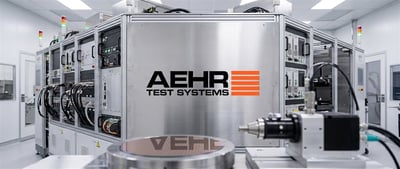
Aehr makes machines that put semiconductors under intense conditions to test them for defects. As data center operators look to increase performance by weeding out faulty chips, Aehr has been gaining considerable order momentum.
In the fourth quarter of its fiscal year 2026 (FY2026), Aehr posted revenue of $18.84 million. (Note that Aehr’s fiscal reporting period is several quarters ahead of the calendar year.) This represented growth of 33.7% year over year (YOY).
Notably, this marked the first time in more than a year that Aehr’s quarterly revenue growth was positive, an important inflection point for its business. However, analysts were already expecting a strong performance, with Aehr only slightly beating estimates of $18.69 million.
Alongside this, Aehr crushed estimates for earnings per share (EPS). EPS came in at 11 cents, a sharp improvement from a loss of 1 cent a year ago. Analysts had anticipated that EPS would remain unchanged at a loss of 1 cent. This performance came as Aehr significantly outperformed on adjusted gross margin, which soared 1,000 basis points to 45%, driven by higher sales, improved manufacturing capacity utilization and a higher-margin product mix.
Despite Aehr’s impressive quarter, full FY2026 revenue declined 15% YOY to $50 million. Aehr’s business has been transitioning from an overwhelming focus on EV markets to a greater focus on non-EV markets, including AI.
Aehr Provides Blockbuster Guidance
Aehr’s Q4 FY2026 results were strong, but the company’s guidance is what really stole the show. In FY2027, Aehr expects to generate full-year sales of between $130 million and $150 million. This would represent a 160% to 200% increase over FY2026.
This guidance crystallizes Aehr’s success in generating orders for its Sonoma and FOX-XP systems. Over the past few quarters, Aehr has repeatedly announced significant orders within the AI chip industry. This has led the company to make strong statements about bookings, including that second-half FY2026 bookings would come in “at the high end of its $60 million to $80 million range.” A record $41 million hyperscaler order allowed it to surpass that estimate.
Aehr’s substantial revenue guidance provides a clear measure of how far the company has come.
Another figure underpinning this confidence is Aehr’s effective backlog of $100.6 million. The company simply has to deliver these booked orders to realize the revenue, absent cancellations. Assuming Aehr ships its full order backlog in FY2027, it would account for 67% to 77% of the company’s revenue guidance. This provides a strong degree of visibility into Aehr meeting its revenue expectations. It is important to note, though, that Aehr did not explicitly say that its full backlog would necessarily convert to revenue in FY2027.
The additional customer demand Aehr anticipates for the rest of the year represents the difference between its backlog and its guidance. Notably, the company stated that it sees an opportunity to raise its guidance even higher in FY2027.
Aehr expects its adjusted pretax profitability to be between 18% and 22% of revenue in FY2027. At the midpoint, this would imply adjusted pretax income of $28 million. In FY2026, that figure was -$3.7 million, showing that Aehr expects to significantly improve its profitability profile.
Aehr’s Forward Price-to-Sales Ratio Drops Over 50% From Highs
Using the midpoint of Aehr’s revenue guidance would give it a forward price-to-sales (P/S) ratio of around 20x. That is still a very high figure by most standards, but it is down approximately 56% from Aehr’s forward P/S peak of 45x. This shows that the firm’s valuation has come much closer to aligning with its revenue expectations.
Additionally, after Aehr’s earnings report, analysts at Craig Hallum and Lake Street Capital placed $125 and $110 price targets on the stock, respectively. The average of these figures implies upside of nearly 40%. Aehr clearly remains a highly volatile and risky stock, but that risk is meaningfully lower than it has been over the past several months. Shares remain substantially below their highs, and the company just provided consequential data supporting its fundamental outlook.
Investors interested in Aehr should closely watch how the company’s orders, guidance and conversion of backlog into revenue progress going forward.
This message is a sponsored message for Traders Edge Network, a third-party advertiser of Earnings360 and MarketBeat.
If you have questions or concerns about your account, please don't hesitate to contact MarketBeat's South Dakota based support team at contact@marketbeat.com.
If you no longer wish to receive email from Earnings360, you can unsubscribe.
© 2006-2026 MarketBeat Media, LLC.
345 North Reid Place, Sixth Floor, Sioux Falls, S.D. 57103-7078. United States..
