
Visa placed Hims & Hers Health into its Acquirer Monitoring Program after a billing dispute spike, adding penalty costs amid an FTC lawsuit... ͏ ͏ ͏ ͏ ͏ ͏ ͏ ͏ ͏ ͏ ͏ ͏ ͏ ͏ ͏ ͏ ͏ ͏ ͏ ͏ ͏ ͏ ͏ ͏ ͏ ͏ ͏ ͏ ͏ ͏ ͏ ͏ ͏ ͏ ͏ ͏ ͏ ͏ ͏ ͏ ͏ ͏ ͏ ͏ ͏ ͏ ͏ ͏ ͏ ͏ ͏ ͏ ͏ ͏ ͏ ͏ ͏ ͏ ͏ ͏ ͏ ͏ ͏ ͏ ͏ ͏ ͏ ͏ ͏ ͏ ͏ ͏ ͏ ͏ ͏ ͏ ͏ ͏ ͏ ͏ ͏ ͏ ͏ ͏ ͏ ͏ ͏ ͏ ͏ ͏ ͏ ͏ ͏ ͏ ͏ ͏ ͏ ͏ ͏ ͏
|
|
| Written by Jeffrey Neal Johnson 
The telehealth sector relies heavily on frictionless subscription models to sustain top-line growth. When consumers find those subscriptions difficult to cancel, they bypass customer service and call their credit card providers. A recent surge in these chargebacks has forced a major global payment network to intervene in the operations of a leading virtual care provider. Visa Inc. (NYSE: V) recently placed Hims & Hers Health (NYSE: HIMS) into its Acquirer Monitoring Program following a spike in billing disputes. This action introduces an immediate financial penalty for every contested transaction, directly targeting the unit economics of the telehealth platform. For investors watching Hims & Hers Health gap down, the situation reveals a critical vulnerability: aggressive customer acquisition strategies can erode long-term profitability. Understanding the mechanics of this payment network penalty is essential for evaluating the forward guidance of consumer-direct medical platforms. Card Declined: Unpacking the Visa PenaltyOn the surface, the narrative around Hims & Hers Health centers on rapid expansion into new healthcare verticals. Beneath that growth, a fundamental friction is playing out. In late July, the Federal Trade Commission, joined by the attorneys general of California and Utah, filed a lawsuit alleging that Hims & Hers Health engaged in deceptive billing practices. The complaint alleges that the platform trapped users in recurring subscriptions by deliberately obscuring the cancellation process behind confusing interfaces. When consumers cannot easily click a button to stop a charge, they initiate a chargeback. Visa responded to this elevated dispute volume by triggering its Acquirer Monitoring Program. Every time a patient disputes a charge, Visa levies an $8 penalty. While an $8 surcharge might seem negligible against the backdrop of a multibillion-dollar valuation, it functions as a systemic tax on the revenue engine. The aggregate penalty, approaching roughly $75,000 for a single recent month, is less concerning than what it represents: a structural flaw in customer retention that regulators and payment networks are no longer willing to ignore. Subscription models rely on a delicate balance between customer acquisition costs and lifetime value. When chargebacks spike, that equation breaks down. Tollbooth Economics: Visa Wins While Hims PaysThe immediate fundamental concern for investors is margin compression. Hims & Hers Health already reported a sharp contraction in gross margin in its second-quarter earnings, down to around 64% from roughly 76% a year prior. Adjusted earnings before interest, taxes, depreciation, and amortization guidance for the third quarter also landed on the softer side of analyst expectations, signaling that internal operational friction is already degrading profitability. To exit Visa's penalty box, Hims & Hers Health must suppress its dispute rate below 1.5% for three consecutive months. Doing so inherently requires introducing more friction into its high-speed customer acquisition funnel. Implementing clearer cancellation buttons, sending mandatory opt-in confirmations, and overhauling billing transparency naturally slows down subscriber momentum. These necessary compliance measures create a definitive drag on top-line growth. Any deceleration in subscriber additions forces the market to reprice the valuation multiple. Conversely, Visa remains entirely insulated. Visa's asset-light, tollbooth model allows it to maintain net margins hovering near 51%. Visa collects its standard processing fees along with newly imposed penalty surcharges, which are entirely unaffected by the regulatory turbulence shaking the telehealth space. Visa does not assume customer acquisition risk, yet it participates in every transaction, good or bad. Executive Ejection: Insiders Exit Before the TollsWhen fundamental metrics begin to shift, tracking management's capital allocation provides essential context. The 12-month insider trading profile for Hims & Hers Health shows heavy distribution, registering nearly $60 million in annualized selling against negligible open-market purchases. Timing adds weight to these transactions. Payment processor Stripe reportedly notified Hims & Hers Health of its penalized status in early August. Shortly after that notification, the Chief Financial Officer liquidated over 14,000 shares through a series of block sales. Executives sell equity for many reasons, including tax obligations, pre-planned 10b5-1 programs, and routine diversification. However, large distributions clustered closely around undisclosed operational headwinds often signal internal capitulation regarding near-term margin stabilization. When the architects of a balance sheet reduce their exposure ahead of mounting compliance costs, the broader market takes notice. Investors should weigh this outflow against the upcoming earnings cycle, as executives will need to answer for these rising regulatory costs. The Peptide Fast Lane: A Bullish BypassA purely bearish outlook ignores the structural tailwinds that can overpower these payment-processing friction costs. Hims & Hers Health has experienced a strong revenue surge driven by its aggressive rollout of compounded GLP-1 weight-loss peptides. This segment operates in a complex, highly lucrative regulatory environment dependent on federal drug shortage classifications. The Food and Drug Administration allows compounding pharmacies to recreate branded medications when the original drugs are in national shortage. Should the regulatory landscape shift favorably, or if Hims & Hers Health successfully scales its customized peptide offerings without federal interference, the resulting top-line expansion could easily dwarf the Visa penalties. The underlying demand for GLP-1 alternatives remains staggering. Hims and Hers' stock trades at a price-to-sales ratio just over 3, indicating the market is still pricing in sustained, aggressive growth. Any positive regulatory catalyst surrounding the peptide pipeline possesses the precise characteristics needed to ignite a rapid short squeeze. Traders heavily shorting the equity based solely on the billing dispute narrative face high binary risk if the compounding pharmaceutical division receives a clear regulatory runway. Pick a Lane: Infrastructure Vs. GrowthMarket participants currently face a polarizing environment. The fundamental short thesis relies on impending compliance costs, elevated processing fees, and the systemic drag of a Federal Trade Commission lawsuit eroding free cash flow. If Hims & Hers Health struggles to lower its dispute rate without throttling new customer additions, downward revisions to forward revenue guidance become increasingly possible. On the other side of the trade, the compounded weight-loss pipeline offers explosive upside optionality that routinely defies standard valuation models. Investors might view this environment as a reason to stay on the sidelines until a clearer trend emerges in the upcoming earnings cycle. Those seeking exposure to the overarching digital economy without the regulatory risk often gravitate toward the infrastructure layer. Holding a payment network like Visa allows investors to benefit from transaction volume across the entire consumer health sector, collecting consistent tolls regardless of which individual telehealth platform wins the market share battle. Evaluating both the friction of the penalty box and the promise of the peptide pipeline will be critical for anyone allocating capital in this space.  Read This Story Online Read This Story Online |

A little-known company trading under $1 could become Elon Musk's next supplier, with a possible announcement expected by Wednesday, August 26.
Tech investing veteran Jeff Brown notes that the last time Musk struck a deal with a small company in this sector, the stock soared nearly five times in a single session. He has reopened his strategy session with full details on this potential opportunity. Watch Jeff Brown's urgent strategy session before the Wednesday deadline
|
| Written by Chris Markoch 
Long-term Treasury yields are rebounding despite the government's expanded bond-buyback plan, putting renewed pressure on rate-sensitive stocks. The 30-year recently reached its highest yield since 2007, prompting the U.S. Treasury Department to announce expanded long-duration buybacks to relieve pressure on the long end of the bond market. Yields bounced right back anyway. That's a sign that buyback programs alone may not be enough to keep a lid on borrowing costs. To be fair, bond yields don't move stock prices directly. But they move the assumptions investors use to price stocks, and that's where the real damage, or opportunity, happens. It's accurate to note that 30-year yields are not high in historical terms. But the long arc of history doesn't mean much to investors, consumers and businesses that became accustomed to operating in a world where low yields were expected. When financing costs stay elevated, businesses sensitive to dividends, growth, and momentum get repriced first, often before their actual earnings show any strain. The key is to understand how higher bond yields could impact specific stocks and sectors. Because the risks are different, but equally real. Realty Income: The Monthly Income Payer May Get Comparison ShoppedRealty Income (NYSE: O) is known as The Monthly Dividend Company®. As a real estate investment trust (REIT), the company is required to pay out at least 90% of its earnings to shareholders as a dividend. The predictability of that dividend is also matched by an attractive 5.25% yield. However, Realty Income has also delivered attractive share price growth despite a challenging commercial real estate market. That's why Realty Income has delivered a total return of over 640% in the last 20 years. Higher long-term interest rates may start to make Realty Income's dividend look less competitive. That could change if the company continues to deliver double-digit stock price growth. That will depend on earnings, which may come under pressure if higher long-term bond yields elevate the company's financing costs. Analysts forecast approximately 3.8% earnings growth over the next 12 months. That's consistent with its earnings growth rate over the last 10 years, which may make it more attractive for current shareholders to hang on to their shares. However, investors on the sidelines may want to wait for confirmation of that earnings growth before committing capital. D.R. Horton: A Direct Correlation With a Frozen Housing MarketD.R. Horton (NYSE: DHI) is one of the nation's largest homebuilders. It may surprise investors to see that DHI is up nearly 55% over the last five years despite a housing market that seized up once interest rates started to move higher. Homebuilders are not only dealing with soft consumer demand, but also with higher input costs. Theoretically, higher bond yields could lead to actions that bring inflation down. That would help with the input cost issue. But the demand problem will only be solved by lower mortgage rates, which are inconsistent with higher Treasury yields. This has shown up in the company's earnings per share (EPS), which are down year over year (YOY) for the past four quarters. In a higher-for-longer rate environment, D.R. Horton will likely have to rely on more promotions. That will put pressure on margins. Adding to that pressure, the homebuilder cut its forward revenue guidance when it reported Q3 2026 earnings in July. Bullish analysts point out that Berkshire Hathaway recently took a new stake in DHI. The company, formerly led by Warren Buffett, tends to be early. Skeptics will say Berkshire may be too early on this one. Palantir: Yields May Be the Immovable Object to Block MomentumPalantir Technologies (NASDAQ: PLTR) delivered one of the strongest earnings reports of the current cycle on Aug. 3. PLTR is up over 40% since the report after the company demonstrated its key role in the AI ecosystem. By every measure that matters, Palantir delivered a strong report. But its momentum has stalled around $170. That is due in no small part to higher Treasury yields. On the one hand, that just confirms a higher floor, which was likely and deserved after the strong report. On the other hand, the resistance to move higher could be attributed, in part, to higher yields, which are prompting investors to rethink risk-on assets with high valuations. The takeaway for investors is that it may take a period of multiple compressions for PLTR to move higher. That scenario would be a gift to many investors who were late to Palantir, as analysts continue to raise their price targets despite the valuation concerns. Read This Story Online |

|
| Written by Thomas Hughes 
After years of struggling to gain traction, with numerous false starts and subsequent corrections, MongoDB (NASDAQ: MDB) has finally turned the tide. The stock price drifted lower in late spring, touched its long-term 150-week exponential moving average, and has been surging ever since. The takeaway: long-term buy-and-hold investors, short-term traders, and speculators are gobbling up shares. Analysts' activity reflects a bullish market posture, with an aggressive series of forecast revisions since the late-May release. These revisions strengthen the consensus and are leading this market to fresh highs. Investors can assume high conviction in the outlook, with 24 of the 36 analysts tracked issuing revisions or initiating coverage since May 29, an 80% Buy-side bias in the data, and an uptrend in price targets. Consensus assumes fair value near the top of the long-term range, but the trend is clear: consensus is up more than 15% over the period, with a high-end price target of $560. MongoDB Atlas Changed the Narrative: MDB Is AI-Critical for InferenceMongoDB’s Atlas platform is a game-changing event for the company's cloud-native business. It transformed the business from a simple database provider into an automated, unified, cross-cloud data platform. Its tools help automate developer workflows, enabling them to do their primary job, write code, instead of all the back-end management that wastes so much time. Other advantages include native AI and vector searches, native multicloud functionality, and autoscaling, which preclude the need for multiple vendors and patchwork solutions. MDB enables businesses and enterprises to securely share sensitive, real-time information with agents and models for better contextualization and inference outcomes, and it is now entrenched in the AI ecosystem. MongoDB is native across hyperscale environments and has deepening relationships with several major hyperscalers. They are, in effect, part of the sales team, pushing MDB services because they drive use of the underlying cloud platforms. Price Action Points to Fresh Highs by Year’s EndMongoDB’s recent price spike is significant because it sets the stage for a bigger gain. The push above $470 set a long-term high, and the stock now shows signs of consolidation, likely to be confirmed following the company's fiscal Q2 release in early September. Analysts are forecasting another strong quarter and are likely to be surprised to the upside, given the Q1 results. Not only did top-line growth accelerate versus the prior year and outperform consensus, but guidance also increased, and the remaining performance obligation (RPO) suggests caution in the outlook. RPO increased by 88%, more than 3x the Q1 revenue growth and the same as the forecast for fiscal Q2. 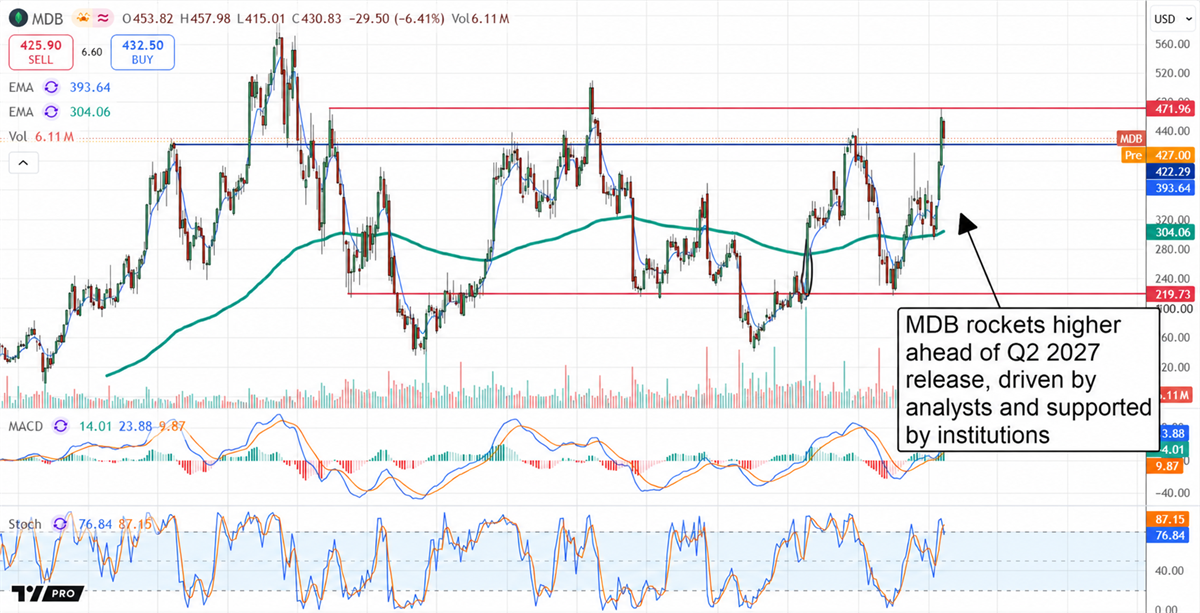
In this scenario, a significant catalyst is in the works that could drive the market to a new high and keep analysts bullish. Technically, the price action suggests $130 of upside upon a break of the consolidation range, with as much as $180 at the high end. This would put MDB stock in the $600 to $650 range. MongoDB’s Price Rally Has LegsInstitutional activity is another signal that this move has legs. The group owns nearly 90% of the stock and has been aggressively accumulating. More importantly, the data show accumulation accelerating in early Q3 2026 ahead of the report, aligning with the cue from analysts. This group is driving price action, limiting downside risk in August. The likely outcome is that they continue to limit risk in the coming quarters, potentially accelerating the rally if results are as strong as trends suggest. MongoDB’s biggest risk this year is its valuation. Trading near long-term highs, the stock is about 70x its current-year outlook and 40x the five-year forecast, pricing in significant growth. This opens the door to execution risk, quarterly weakness, or a slowdown in growth that could impair price action. Delays, missteps, or disruptions will show up in the stock price action, most likely as a deep correction. Competition is also a risk, but MongoDB's differentiated services and impact on hyperscaler business mitigate it; hyperscalers may prefer to sell their own databases, but are just as happy to give clients access to MongoDB when it drives business for their clouds. MongoDB’s balance sheet raises no red flags. The company has a solid cash position, ample liquidity, no long-term corporate debt, and improving cash flow. The likely outcome is that the company can continue to execute its strategy, convert backlog into revenue, and build on its momentum. As it stands, major catalysts in 2027 and 2028 are linked to the data center buildout. Most major data centers tied to the AI boom are slated for completion by then, at which point MDB will start generating revenue from that activity. Read This Story Online |

When Greece collapsed... the EU and IMF swooped in with $300 billion in bailouts. When America crosses that line... there is no bigger economy to save us. The U.S. IS the emergency bailout for the rest of the world.
In a free presentation I just recorded, I show you exactly what the U.S. government's plan is... Why it's going to create the single biggest wealth transfer of our generation... and how you can position yourself on the right side of it.
We believe America's only escape from $39 trillion in debt depends on a single technology (and it's already being funded with $2 trillion) ... BlackRock, Goldman, and 170 public companies are already positioning. Watch the free AI briefing (urgent) →
|
|
More Stories
|
|
|



![[EMERGENCY] The last time a country hit this debt level...](https://www.marketbeat.com/images/webpush/files/thumb_20260812124927_pushuntitled-design-33.jpg)
