
| Unsubscribe |
Warren Buffett trusts one indicator above all others… with good reason.
Today, it's flashing the same warning it flashed in 1929...
1969...
and 2000.
Every time, it said the same thing:
Get out of stocks – get into gold.
Every time, it was right.
Go here to see what the “Buffett Indicator” says today – and what it means for gold investors
In 1929, it hit 130% right before the crash.
In 1969, it went so high that Buffett closed down his fund. He could find anything worth buying.
Then, in 2000, it hit 140% right before the dot-com collapse.
The important point is…
Each time this indicator reached an extreme high…
Gold ran for a decade while stocks went nowhere.
So what's it reading today?
At 231%, the Buffett Indicator is at its highest level in history.
It’s so far out of normal range, the talking heads have decided to ignore it. Big mistake.
My name is Garrett Goggin and I’m not like other so-called gold analysts. My portfolio is up as much as 1,200% in two years…
It’s also why Porter Stansberry recently called me:
"THE most knowledgeable gold investor in the world. If you want to maintain your standard of living… you have GOT to be allocated to gold. And there's nobody better in the entire world to explain exactly how to do that [than Garrett]."
When money finally rotates out of overpriced tech and into gold...
The gold bull market will enter its most violent — and most profitable — phase.
You can ride the tech roll-over lower...
Or get positioned in the best gold picks before the rotation hits.
Go here to see how to position your portfolio in my four top mining picks
Garrett Goggin, CFA, CMT
Lead Analyst and Founder, Golden Portfolio
Popular’s Earnings Beat Shows Why This Bank Stock Keeps Climbing
Written by Peter Frank. Date Posted: 8/1/2026.

Key Points
- Popular’s latest results show why the bank has attracted analyst support and investor attention.
- Earnings growth, capital strength and shareholder returns remain central to the bull case.
- Credit costs, leadership change and a stock trading near analyst targets still give investors reasons to stay selective.
- Special Report: SpaceX is offering you shares. Don't take them.
Recent results from Popular (NASDAQ: BPOP), Puerto Rico's largest bank, show why analysts rate the bank a solid Buy.
The midsized bank is steadily growing earnings, returning capital to shareholders and achieving ratios that would make many other banks envious. Shareholders are likely to be pleased as well.
Four boxes decided who got $3B on May 21 (Ad)
On May 21, 2026, a federal board voted unanimously to lend one gold company roughly $3 billion.
The company passed a strict four box screen: American soil, full permits, meaningful scale, and small enough that the capital transforms it. Majors like Newmont failed on scale; juniors failed on permits.
It trades at about 1/50th the size of Newmont, with final loan papers expected in the second half of 2026.
See the company's name and ticker before the news spreads.The stock is up more than 50% over the past 12 months and roughly 40% since the start of the year.
The question for new investors is whether the easy gains are behind it and whether the bank still has plenty of room to run.
Popular’s Earnings Momentum Still Backs the Rally
Popular’s rally has real fundamentals behind it. The bank's second-quarter results showed net income climbing to $278 million, up 13% from the first quarter and 32% year-over-year (YOY). Diluted earnings per share rose to $4.35, an increase of 41% from the prior year's quarter and well above analysts' expectations.
At the same time, net interest income grew to $693 million as the bank held its net interest margin steady at 3.66%. Non-interest income advanced 7% to $181 million on stronger card and service fees. Both operating and interest expenses declined from the prior year.
As a result, return on average tangible common equity reached 17.02% for the quarter, up 3.76 percentage points from a year ago. That figure would stand out even among better-known names. With a common equity tier 1 ratio of 16.08% and total risk-based capital of 17.85%, the bank also has plenty of room to keep lending and return cash to shareholders.
Indeed, Popular used that room in its recent announcement, saying it was seeking to raise its quarterly dividend 20% to 90 cents per share. The board also authorized a new $1 billion stock buyback program after largely working through a prior $500 million authorization.
Management also grew more confident about what lies ahead.
The company lifted its full-year 2026 net interest income growth target to 8% to 9% from a previous 5% to 7% range. It raised its quarterly non-interest income outlook to $165 million to $170 million and trimmed its expected operating expense growth.
Popular’s Banking Footprint Gives It Multiple Growth Paths
All these figures point to a durable franchise. Popular remains the dominant bank in Puerto Rico, with assets near $79 billion, total loans of $39.7 billion and deposits of $70.2 billion.
Its mix of consumer, commercial and card lending across Puerto Rico and the U.S. mainland gives it several ways to grow. Its mainland U.S. operations, which account for roughly 30% of its business, provide important diversification beyond its island banking franchise. As the island's economy continues to normalize, Popular is positioned to benefit from steady loan demand while absorbing a slowdown in any one segment.
Analysts Still See Upside, But the Gap Has Narrowed
Popular’s stock price has followed its earnings trajectory throughout the year. Trading near $176 per share, the stock has climbed from the mid-$120s at the start of the year. With a price-to-earnings ratio below 12, its valuation remains below that of many comparable banks in the broader finance sector.
The dividend yield sits at about 1.70% based on the current quarterly payout of 75 cents, a figure that should improve once the proposed dividend increase takes effect.
Analysts have broadly taken notice, assigning a consensus Buy rating to the stock. Of the 13 analysts tracking the company, 12 have issued a Buy recommendation and one has suggested a Hold. Overall, the 12-month price target is $184.42 per share, leaving modest upside from recent trading levels. The highest price target for the next 12 months is $214, while the lowest is $156 per share.
Credit Noise Is Manageable, But Worth Watching
None of this means the story is risk-free. Credit costs are showing signs of moving in the wrong direction. The net charge-off ratio rose to 1.05% in the second quarter, driven largely by a single $71 million charge-off tied to one resolved commercial relationship. Excluding that item, the ratio would have been a strong 0.33%.
Even so, management raised its full-year net charge-off guidance to an annualized range of 65 to 80 basis points, and the allowance for credit losses now stands at $785 million. Nonperforming loans as a percentage of total assets are creeping up but remain manageable at 0.69%.
Beyond that, no bank is immune to macroeconomic factors and unexpected disruptions. Despite a string of recent, consistent growth, Popular has experienced ups and downs over the years for various reasons.
Popular’s Leadership Shift Keeps Capital Priorities in Focus
Leadership change also adds another, though perhaps muted, variable at this point in the cycle. CEO Javier D. Ferrer is set to retire effective Aug. 31, 2026, with current CFO Jorge J. García stepping into the CEO role. New CFO and chief risk officer appointments will take effect in September.
On the positive side, the promotions are all coming from inside the company, with executives already familiar with the balance sheet. But new leadership can still bring shifts in risk appetite or capital-allocation priorities that are worth watching.
There’s also the question of how much good news is already priced in. With shares trading close to the consensus target, there is not much expectation for a quick upswing. Then again, with short interest at a modest 3.06% of float, the market does not appear to be betting on a decline anytime soon.
Popular Still Looks Strong, But the Setup Is More Selective
Overall, Popular makes a strong case for inclusion in an investor’s financial-sector portfolio. With high returns on tangible equity, strong capital levels, a growing dividend, increasing earnings and an active buyback program, the company appears to have earned its current Buy recommendation.
Given the limited current upside, though, new investors may need to be more selective after such a strong run. Assuming a multiyear horizon and the ability to tolerate some credit-cycle noise, investors considering the banking sector should weigh whether Popular’s fundamentals still justify paying up near recent levels.
Rio Tinto’s Results Make the Case for Looking Beyond Tech in the AI Trade
Written by Chris Markoch. Date Posted: 8/2/2026.
Key Points
- Rio Tinto’s first-half results showed strong cash flow, higher earnings and a larger interim dividend.
- Copper, aluminum and lithium are becoming more important to the company as AI infrastructure, electrification and grid demand grow.
- Iron ore remains a major cash generator, but investors still need to watch commodity prices, currency pressure and geopolitical risks.
- Special Report: SpaceX is offering you shares. Don't take them.
Rio Tinto (NYSE: RIO) just delivered a first-half report with numbers that support a broader thesis rooted in a major shift: Physical assets are entering a multi-year period of outperformance. Higher bond yields, oil supply concerns, and an artificial intelligence (AI) infrastructure buildout are converging, and Rio Tinto sits at the intersection of all three trends.
Rio Tinto posted EBITDA of $14.8 billion, up 28% year-over-year. Free cash flow nearly doubled, jumping 75% to $3.8 billion, while underlying earnings rose 43% to $6.9 billion. The board responded with a $3.4 billion interim dividend, up 43% from a year ago.
The $15 Gold Fund That Pays Up to $1,152/Month (Ad)
Gold is hitting record highs, but most investors are leaving income on the table. A $15 fund is quietly paying out up to $1,152 a month to regular investors - no mining stocks, no options, no physical metal required.
Chief Income Strategist Tim Plaehn calls it a breakthrough strategy that transforms gold's rally into reliable monthly payouts. The next distribution is just days away.
Discover the gold income fund before the next payout dateHowever, the bigger story is why those results matter. It goes back to the broader thesis that hard assets are at the beginning of a multi-year bull cycle. Copper, aluminum, and lithium now generate more than half of Rio Tinto's EBITDA. That mix gives investors direct exposure to electrification, grid buildout, and AI-driven power demand. Meanwhile, iron ore continues to support the balance sheet through this transition.
Copper and Iron Ore Drive Rio Tinto's Diversified Growth
Copper EBITDA surged 84% to $5.7 billion, driven by the ramp-up at the company’s Oyu Tolgoi project and a 39% jump in average realized copper prices. Aluminum and lithium combined rose 38% to $3.3 billion. Iron ore remained roughly flat at $6.8 billion, making it the company's largest single contributor.
Here’s why that balance matters. Copper is needed in the AI and electrification trade, while iron ore is a steady cash generator. Together, they reduce Rio Tinto's dependence on any single commodity cycle. That level of diversification is rare among pure-play miners.
Management also flagged accelerating productivity gains. The company banked $870 million in savings during H1 and is targeting a $1.8 billion annualized run rate by year-end. Lower unit costs mean margins can hold even if commodity prices soften later in the cycle.
Rio Tinto Stock Hasn't Caught Up to Strong Fundamentals
Despite the strong first-half results, RIO shares have pulled back from 2026 highs near $110. The stock now trades around $96, still well above its 200-day moving average near $89. It's also about 9% below its consensus price target of $105.50. That gap between fundamentals and price action is worth watching.
The daily chart shows a bullish MACD crossover forming in recent sessions, with the MACD line at 0.88 crossing above the signal line at -1.01. That's typically an early momentum signal. Shares are also up nearly 3% following the results, suggesting the market is still digesting just how strong the first half was.
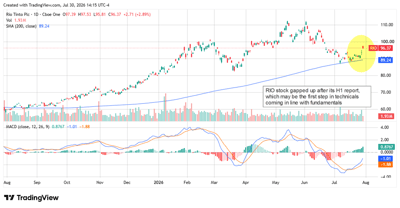
The disconnect may reflect broader sentiment toward miners rather than Rio Tinto specifically. Investors have spent much of 2026 rotating toward technology and away from commodities. That rotation looks increasingly mistaken given the factors driving demand for copper, aluminum, and lithium.
AI Infrastructure Is Driving Demand for Industrial Metals
Three forces are converging to favor hard assets over the next several years. Higher bond yields raise the cost of capital for speculative growth stories. Oil supply disruptions, including the Middle East tensions cited in the report, raise energy input costs across the board. Rio Tinto's diesel costs alone rose by $0.8 per ton year-over-year due to higher oil prices.
At the same time, AI infrastructure buildout requires enormous quantities of copper and aluminum. Data centers need grid capacity, transmission lines, and backup power, all of which are copper-intensive. Rio Tinto's guidance indicates that copper production will grow to 800,000 to 870,000 tons for full-year 2026.
This isn't a story about one commodity. It's about physical inputs becoming the bottleneck for the next phase of economic growth. Companies that own the mines, rather than just the technology layer, may capture outsized value.
Key Risks Investors Should Watch
Not every signal is favorable. Iron ore prices dipped modestly through the first half, and IOC production in Canada fell 22% year-over-year. The Oyu Tolgoi tax dispute with Mongolia, which involved $443 million paid under protest, adds geopolitical risk to the copper growth story.
Currency headwinds were also present in the results. A weaker U.S. dollar against the Australian and Canadian dollars reduced underlying EBITDA by $700 million. If the dollar continues weakening, that pressure could persist. Investors should weigh these risks against the productivity and diversification tailwinds.
Rio Tinto Offers Long-Term Exposure to AI and Infrastructure
Rio Tinto's first-half results showed what a well-diversified physical-asset business can deliver in a favorable pricing environment. Free cash flow rose 75%, dividends increased 43%, and copper EBITDA nearly doubled —all of which support the underlying thesis. Hard assets are becoming harder to ignore.
For investors building portfolios around the next several years of higher rates, energy uncertainty, and AI infrastructure spending, Rio Tinto offers direct, diversified exposure. The stock's pullback from 2026 highs, despite improving fundamentals, may represent an entry point rather than a warning sign.
This email communication is a paid advertisement provided by Golden Portfolio, a third-party advertiser of Earnings360 and MarketBeat.
If you need assistance with your newsletter, please don't hesitate to email our U.S. based support team at contact@marketbeat.com.
If you no longer wish to receive email from Earnings360, you can unsubscribe.
© 2006-2026 MarketBeat Media, LLC. All rights reserved.
345 N Reid Place #620, Sioux Falls, SD 57103. USA..
