
| Unsubscribe |
Ian Cooper here,
Before I became a successful trader…
I was a struggling journalist facing serious financial pressure.
Bills piling up.
Stress mounting.
Running out of time.
And like many beginners, I thought options trading was insanely complicated.
But during my search for a simpler way to trade…
I stumbled onto a straightforward strategy that changed everything.
Not because it was flashy.
Because it was SIMPLE.
Now I’m sharing the details in a free report called:
“The Simple Path To Success With Options”
Here’s just some of what you’ll discover:
- ✔ The repeatable options trade that changed my life
- ✔ Why simplicity often beats complexity in the market
- ✔ How to copy step-by-step trade blueprints starting tonight
- ✔ The easiest way to get started with options trading
If you’ve ever felt overwhelmed by options…
This is the best place to start.
In your corner,
Ian Cooper
Snowflake’s AI Momentum Is Forcing a Fresh Look at the Stock
Author: Thomas Hughes. Posted: 9/4/2026.

Key Points
- Snowflake’s fiscal second-quarter results beat expectations, but the bigger catalyst was management’s stronger product revenue outlook.
- AI adoption is increasing demand for Snowflake’s data, governance and coding tools rather than reducing the need for enterprise software.
- Valuation and dilution remain real risks, but improving margins, cash flow and guidance give bulls a stronger case.
- Special Report: The company SpaceX cannot operate without
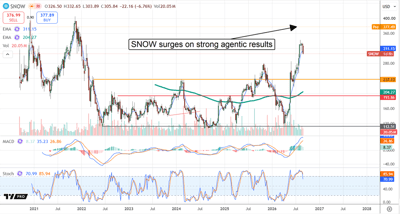
Snowflake’s (NASDAQ: SNOW) stock surged more than 20% following its Q2 fiscal year 2027 (FY2027) release, driven by its guidance. The stock could continue to rise because of what’s ahead. Strong as the results were, the outlook suggests the SaaS-pocalypse sell-off was not only misguided but also too broad. AI poses a threat, and disruption is possible, but established, enterprise-grade software companies that provide utility for clients are better positioned to deploy and monetize AI than AI is to create entirely new software industries. AI is complex and requires massive infrastructure, governance and security that average businesses cannot manage.
The market got agentic AI wrong: It didn’t reduce workloads or data needs; it only accelerated them.
Wall Street Braces for the Biggest Tech IPO Wave in History (Ad)
Reuters calls it a combination without precedent in U.S. market debuts. Barron's estimates the coming AI IPO wave could be worth 4 trillion dollars, led by OpenAI and Anthropic.
Former IPO insider Jason Bodner previously flagged Nvidia before its 7,161% run, Super Micro Computer before its 2,601% run, and The Trade Desk before its 2,572% run.
Now he's breaking down how investors can position ahead of the OpenAI and Anthropic IPOs.
Click here to see Jason Bodner's full breakdown of the detailsSnowflake’s strength lies in data pooling, management and security, complemented by its rapidly advancing coding capabilities. Tools such as Snowflake Cortex Code assist with legacy and vibe coding—using natural-language prompts to help AI write code—including governance features. This allows nontechnical users to write code within specific corporate compliance rules. Context is another strength. Snowflake’s tools enable AI to access and understand proprietary data and policies, improving outcomes while reducing hallucinations.
Snowflake’s Q2 Beat Gives Way to Stronger Guidance
Snowflake’s Q2 FY2027 results topped expectations, with revenue rising 35% year over year (YOY) to $1.55 billion. Growth accelerated on both a sequential and YOY basis, and management expects that momentum to continue into the upcoming quarter. Product revenue drove the strength, rising 37% on customer wins and increased penetration.
Snowflake added 692 net new customers during the quarter, up 32% year over year, and reported 828 customers with trailing 12-month product revenue of more than $1 million, up 27%. Net revenue retention was 126%.
Margins provided another source of strength. Snowflake significantly widened its non-GAAP operating margin by 430 basis points despite continued investment, helping adjusted earnings grow faster than revenue. Critical details included an 87% increase in adjusted operating income and a 36% increase in adjusted free cash flow.
Looking ahead, Q3 FY2027 and full-year guidance indicate that strength will continue. Product revenue is expected to accelerate to the 37% to 38% range in the third quarter, while full-year product revenue guidance was raised to $6.07 billion. Given the early stage of the agentic rollout, Snowflake will likely continue building momentum in the coming quarters, with room to outperform if adoption accelerates.
Analysts Say Snowflake AI Proves Its Worth
The analyst response has been overwhelmingly bullish, with numerous firms issuing positive commentary and raising price targets after the report. The key detail is that new targets place the stock in the high $300s to low $400s, with a new high of $450. If reached, that would represent a new all-time high. Post-release price action aligned with the shift in sentiment, pushing the stock into the high $300s. That move brings Snowflake closer to Wall Street’s targets, but updated estimates still suggest room for upside if the company continues to deliver stronger product revenue growth and margin expansion.
Valuation is a concern. Trading at well above 100 times current-year earnings, Snowflake is not a cheap stock. However, the market is pricing in a solid outlook that leaves room for growth. The forward-looking 10-year estimate puts the stock’s price-to-earnings (P/E) ratio in the mid-teens, potentially setting the stage for it to double over time.
One risk Snowflake investors face is dilution. The company uses share-based compensation at a high rate, diluting shareholders and contributing to GAAP losses even as adjusted results improve. As a result, the stock remains susceptible to execution risks, including slowing growth or a failure to capture projected operating-margin gains. Another risk is short interest. Short sellers are not leaning heavily on Snowflake, but interest rose over the summer and may cap gains near the existing all-time high. Catalysts include strategic partnerships with Amazon's (NASDAQ: AMZN) AWS and CrowdStrike (NASDAQ: CRWD). These partnerships can improve consumption while expanding the ecosystem, providing a dual lever for growth.
The company’s balance sheet does not present a significant risk. Snowflake is well-capitalized despite the impact of acquisitions and investments; it has net cash, and equity is increasing. The 11% quarterly increase in equity more than offsets the impact of share-based compensation, leaving shareholders in a better position than before. With revenue growing, growth accelerating and cash flow improving, investors can expect cash balances to rebuild and equity to continue increasing, barring the occasional acquisition and its impact on cash and cash flow.
Palo Alto’s Rally Has One Big Problem Ahead of Earnings
Author: Sam Quirke. Posted: 8/31/2026.

Key Points
- Palo Alto Networks shares have surged near record highs ahead of next week's earnings, buoyed by strong CrowdStrike results and rising AI-driven cybersecurity demand.
- The company's rapid revenue growth, raised guidance, and platformization strategy have fueled bullish analyst ratings, including a MarketBeat consensus of Moderate Buy.
- Despite the optimism, Palo Alto's triple-digit price-to-earnings ratio and modest underlying growth leave the stock vulnerable to disappointment if results fall short.
- Special Report: The company SpaceX cannot operate without
Shares in Palo Alto Networks Inc. (NASDAQ: PANW) may have started the year on the wrong foot, but they have been on a tear ever since. After turning higher in February, the cybersecurity heavyweight has rallied hard. A jump of around 20% in just the past few sessions has left the stock trading within a few dollars of its all-time high.
That latest surge owes much to a rival. Blockbuster results this week from CrowdStrike Holdings Inc. (NASDAQ: CRWD), whose management called it the best quarter in the company's history, sent shares across the sector flying. AI was singled out as the force driving both the threats and the spending needed to counter them.
Wall Street Braces for the Biggest Tech IPO Wave in History (Ad)
Reuters calls it a combination without precedent in U.S. market debuts. Barron's estimates the coming AI IPO wave could be worth 4 trillion dollars, led by OpenAI and Anthropic.
Former IPO insider Jason Bodner previously flagged Nvidia before its 7,161% run, Super Micro Computer before its 2,601% run, and The Trade Desk before its 2,572% run.
Now he's breaking down how investors can position ahead of the OpenAI and Anthropic IPOs.
Click here to see Jason Bodner's full breakdown of the detailsThe timing could hardly be more pointed, because Palo Alto reports its own results next week. With its rival having knocked the ball out of the park, expectations are building for Palo Alto to do the same, and investors are asking what this surging demand for security really means for the stock.
AI Security Demand Is Doing the Heavy Lifting
The bullish case starts with the sheer force of the tailwind now pushing the entire sector forward. As businesses race to deploy AI across their operations, they are opening vast new fronts that need defending, and Palo Alto's management has been unambiguous about what that means for demand.
The company has been growing at a rapid clip, with revenue jumping more than 30% year over year in June's report and its all-important recurring revenue from newer products expanding even faster. That momentum gave management the confidence to raise its guidance, and next week's results will show whether the trend continued through the summer.
Underpinning it all is what the company calls platformization: persuading customers to buy a full suite of security products from Palo Alto rather than piecing together tools from multiple vendors. As threats multiply, the thinking goes, the appeal of a single, integrated defense grows. That is precisely how Palo Alto has been positioning itself.
The price action is encouraging, too. Palo Alto shares have jumped close to 170% since March, and this week they snapped back higher after a recent bout of selling. Even so, the stock's Relative Strength Index (RSI) is still only around 60, suggesting there is room for the stock to run higher if next week's report delivers the goods.
Palo Alto’s Biggest Risk Is Already in the Stock
For all this momentum, however, one issue should give even the most optimistic bulls pause: the stock's valuation. Compared with the broader tech sector and its own peers, Palo Alto's shares are extremely expensive. They are currently trading at a triple-digit price-to-earnings (P/E) ratio that towers over the broader market and leaves little room for error. Fortinet Inc (NASDAQ: FTNT), one of Palo Alto's main rivals, currently trades at a P/E ratio of around 60, for example.
The concern is that Palo Alto's frothy valuation means much of the best-case scenario is already baked into the share price, leaving little room for error. Bears will also note that, after stripping away the boost from recent acquisitions, underlying growth is actually more modest than the headline figures suggest—perhaps in the mid-teens rather than the eye-popping percentages that attract attention. In addition, the same AI wave boosting demand is lowering the barrier to entry for more nimble, lower-cost cybersecurity alternatives.
Analysts Are Giving Palo Alto the Benefit of the Doubt
Despite those worries, the mood on Wall Street is almost universally bullish in the run-up to next week's results.
The past week alone has seen BTIG, JPMorgan Chase and Benchmark rate Palo Alto a Buy or equivalent, thanks in large part to its accelerating platform strategy and the broader industry tailwinds taking shape.
Fresh price targets on Palo Alto shares range as high as $435, implying upside of close to 15% from current levels ahead of the upcoming earnings report.
This optimistic outlook is reflected in MarketBeat's consensus analyst rating of Moderate Buy.
The AI Security Winner Still Has to Justify the Price
So where does that leave investors ahead of next week's closely watched results? The bull case is undoubtedly attractive: Palo Alto is riding a real structural boom in security spending, its platform strategy is winning converts, and its bold push into identity positions it well for a future filled with AI agents.
The catch, however—and it is a big one—is the price. A P/E ratio north of 300 raises the stakes for every earnings report and leaves little room for disappointment. For now, Palo Alto looks every inch a winner from the AI security boom, but its shares have already traveled a long way on the back of it. Next week's numbers will be the latest test of whether this high-flyer can continue living up to investors' ever-increasing hopes.
This email content is a sponsored message provided by TradeWins, a third-party advertiser of DividendStocks.com and MarketBeat.
NOTICE: Auto-trading, or any broker or advisor-directed type of trading, is not supported or endorsed by Ian Cooper. The information provided by Ian Cooper in its various materials, including trading recommendations, newsletters and educational publications is not customized or personalized for any particular person or risk profile. Past results are not necessarily indicative of future results. Results presented can vary and may not be typical for all subscribers. There are substantial risks involved with investing in the stock and options market, including the risk of total loss. You should only trade or invest "risk capital" - funds you can afford to lose.
If you have questions about your newsletter, please feel free to contact MarketBeat's South Dakota based support team at contact@marketbeat.com.
If you no longer wish to receive email from DividendStocks.com, you can unsubscribe.
© 2006-2026 MarketBeat Media, LLC. All rights reserved.
345 N Reid Pl., Suite 620, Sioux Falls, South Dakota 57103-7078. United States of America..
