
| Unsubscribe |
In December President Trump will take the stage and shock the world.
Standing before the leaders of the most powerful nations on earth, at his own resort in Miami, I believe he’s set to unveil something that will impact every dollar you have saved and invested.
The original agenda for the G20 Summit was development finance and climate change.
That’s been scrapped.
Instead, my research indicates Trump could unveil a radical monetary reset that no one has prepared you for.
I've been tracking this story for months.
And the deeper I investigate, the more convinced I become that what happens in that room could draw a brutal dividing line – between those who understand what's happening to their money, and those who do not.
Which means between now and December, there is a window. A chance to get ahead of what could be the most consequential change to our money in half a century.
It wasn't voted on. It wasn't debated in the Senate. And most Americans have no idea it's even taking place but…
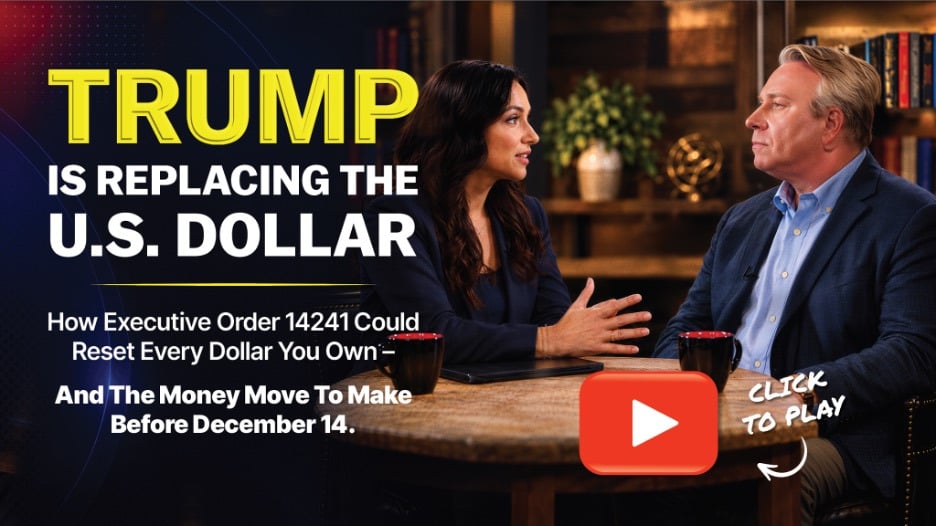
President Trump is replacing the U.S. dollar.
Not with crypto. Not with a digital currency. Something far bigger than that – and it's already been signed and sealed in the back rooms of D.C., ready to be issued by the U.S. Treasury.
Bypassing every legal and political channel under the guise of "national security," Trump has enacted this total money reset using a landmark executive order (14241).
Whether you’re a Democrat or Republican, whether you support this new money or not, it doesn't matter.
Soon, every U.S. citizen will be forced to use Trump's New Dollar to fill their gas tank, buy groceries, and pay medical bills.
Which is why I've produced a critical new documentary laying out exactly what Trump's New Dollar means for your savings, your investments, and your family's financial future.
Detailing three important steps you can take today to prepare – including the name of a core band of assets connected to Trump’s initiative that could surge as a result.
As you’ll see in my briefing, the last time America reset its money like this – under Richard Nixon’s presidency in the 1970s – it created one of the greatest wealth divides in the history of our nation.
On one side, it minted an average of 1,300 new millionaires a day for over half a century. And on the other… the folks left behind, drowning in debt, with no idea how to use America’s new money to create wealth.
As Trump rolls out his new dollar, the question is:
Good investing,
Porter Stansberry
PS. If you’re wondering what Trump’s new money will look like, when it will be issued, what it means for your investments and why it could be front-page news on December 14 – all of those questions are answered in my briefing.
3 Stocks Benefiting From AI Demand Just Announced Major Buybacks
Submitted by Leo Miller. Article Posted: 10/5/2026.

Key Points
- NVIDIA expanded its share repurchase authorization by a record $150 billion as strong AI demand continues to drive growth.
- MongoDB disclosed another $1 billion in repurchase capacity shortly after its CEO's departure rattled investors, although the board approved the increase before the sell-off.
- Talen Energy authorized a $1.5 billion accelerated repurchase as part of a $3 billion program while expanding its role in powering AI infrastructure.
- Special Report: Why This Clean Energy Well Escaped the Solar and Wind Cuts.
Key stocks benefiting from AI adoption have just announced significant buyback programs. This includes the world’s leader in AI chips, NVIDIA (NASDAQ: NVDA), which announced a huge $150 billion increase to its authorization.
Meanwhile, an emerging AI software beneficiary expanded its program after the market crushed its shares, while an AI energy winner now has the capacity to buy back 20% of its market capitalization. All three companies are displaying confidence in their outlooks, despite their differing performance in 2026.
NVIDIA’s Record Buyback Highlights Its AI Cash Machine
The chip inside every Tesla (Ad)
Every Tesla built since 2012 pays this small, overlooked supplier a fee for its technology. So does every Starlink dish and AI satellite Elon launches.
When Nvidia tried to buy the company, Elon reportedly fought the deal. Now his filing for 1,000,000 satellites could expand its revenue stream sharply.
Dylan believes the stock could see significant movement starting October 24th.
See which overlooked supplier Elon has quietly paid since 2012NVIDIA’s latest buyback program isn’t just big; it’s record-breaking. After increasing its buyback program by $150 billion, its total remaining authorization stands at $235 billion, which NVIDIA says is the largest buyback authorization in corporate history.
For perspective, $235 billion is greater than the market capitalization of huge firms like Verizon Communications (NYSE: VZ), International Business Machines (NYSE: IBM), and Citigroup (NYSE: C). However, for NVIDIA, it represents around 4.2% of its market capitalization, demonstrating the incredible amount of value the firm has created. The sizable buyback program could allow the company to continue reducing its share count over time.
Another reason NVIDIA may be choosing to buy back shares is the stock’s relatively meek performance in 2026, at least by NVIDIA’s standards. Shares are up approximately 25% this year, compared with gains of 39% in 2025, 171% in 2024, and 239% in 2023. Additionally, this 2026 return came only after a recent rally. Two months ago, NVIDIA stock was essentially flat for the year. Despite NVIDIA’s massive size, Wall Street analysts continue to see additional upside.
This performance comes despite the company posting its fastest growth in two years last quarter, with revenue increasing by 106% year-over-year (YOY). The firm’s buyback program is a clear sign of confidence as it continues to rake in cash from hyperscaler customers.
One factor worth watching is AI supply constraints. NVIDIA has said customer forecasts point to demand that could support substantially higher sales, but supply limitations are constraining how quickly the company can meet that demand. The faster those constraints ease, the more room NVIDIA may have to convert demand into revenue.
MongoDB Adds Buyback Capacity as Leadership Uncertainty Hits Shares
Software company MongoDB (NASDAQ: MDB) has rallied significantly in recent months, posting a return of around 40% over the last six months. Although the overall impact of AI on its revenue growth remains small, this portion of MongoDB’s business is expanding rapidly. Last quarter, its Atlas revenue from AI-native customers increased 165% YOY.
Additionally, its Enterprise Advanced segment posted growth of 36% year-over-year (YOY) last quarter, with interest in AI features such as Search and Vector Search contributing to the increase. This helped the company achieve year-over-year growth of 30%, its fastest increase in more than two years.
However, as MongoDB works to expand its AI business, it is facing a serious disruption: the firm’s CEO, Chirantan Desai, is departing to join Meta Platforms (NASDAQ: META). This news sent shares plummeting 18.5%. Notably, the very next day, MongoDB announced a $1 billion increase to its buyback authorization. This brought the company’s total buyback capacity to $1.35 billion, equal to approximately 4.8% of its market capitalization.
The timing of this move strongly suggests that the company believes investors are overreacting to the CEO’s departure and sees an opportunity to repurchase shares. While certainly a significant loss, whether one individual’s absence justifies MongoDB losing nearly a fifth of its value in one day is at least questionable.
Talen Leans Into Buybacks as Data Center Demand Expands
Last up is Talen Energy (NASDAQ: TLN), which has a significant power-generation footprint that includes nuclear, fossil fuel, and natural gas facilities. Talen shares have not performed well in 2026, down more than 10%. This follows the stock’s massive gains of 86% in 2025 and 214% in 2024.
The company’s AI-driven growth comes from its Susquehanna nuclear power plant, which supplies energy to Amazon.com’s (NASDAQ: AMZN) data centers. In 2025, the two firms signed a 1.92 GW power purchase agreement. Notably, the project continues to ramp up, with the full contract ramp expected to take place by 2030.
Talen just announced a CEO switch, appointing Terry Nutt, and announced a $3.0 billion buyback program at the same time. Of that amount, $1.5 billion will go toward an accelerated share repurchase (ASR) program, equal to approximately 10% of its market capitalization. The firm expects to complete the ASR by the end of the first quarter of 2027. This leaves another $1.5 billion in repurchase capacity through 2028, equating to roughly another 10% of its market capitalization.
The ASR indicates that the firm sees an opportunity to repurchase a large number of shares very quickly. The additional $1.5 billion authorization through 2028 also implies a fast repurchase pace should the firm exhaust its initial capacity.
3 Buybacks, 3 Different Signals
The scale of these buyback programs is notable, but the message behind each one is different. NVIDIA is using its enormous cash-generating capacity to return capital while AI demand remains strong. MongoDB is adding flexibility to repurchase shares during a period of leadership uncertainty and heightened volatility. Talen, meanwhile, is committing a significant portion of its market value to buybacks as it expands its exposure to power demand from AI infrastructure.
In each case, management is signaling confidence that repurchasing shares is an attractive use of capital. But investors should not view the announcements in isolation. NVIDIA still faces supply constraints, MongoDB must navigate a CEO transition, and Talen’s outlook depends heavily on execution and continued growth in data center power demand.
The buybacks strengthen the bullish case for all three companies, but the bigger question is whether their underlying businesses can deliver enough growth to justify that confidence.
Only 20 Stocks Are Holding Up the Market: 3 Bargains Outside AI
Author: Bridget Bennett. Published: 10/8/2026.

Key Points
- Whitney Tilson argues record index highs mask a broad bear market, since 19 of the top 20 S&P 500 contributors are AI-related while most stocks lag.
- Tilson favors three non-AI value picks: speculative Joby Aviation, undervalued Casey's General Stores, and underappreciated Eli Lilly, each hit by sentiment rather than fundamentals.
- Each stock has a specific catalyst to watch: Joby's first commercial flight, Casey's in-store same-store sales, and Eli Lilly's retatrutide FDA filing.
- Special Report: Why This Clean Energy Well Escaped the Solar and Wind Cuts.
The market has hit a record high, but almost none of that gain belongs to the average stock.
That gap is where Whitney Tilson of Stansberry Research is doing his shopping. His case is that the index is masking a broad bear market underneath and that the clearest values currently sit outside artificial intelligence. Three names carry the argument: a speculation, an off-the-radar mid-cap and the world's largest drugmaker.
A Record-High Index Is Masking a Market-Wide Bear Market
Elon Musk: “This will be Bigger than the Iphone” (Ad)
Elon Musk says a new industry could grow 190,597% by 2040, calling it potentially the biggest industry ever.
James Altucher argues the smartest play isn't Tesla or SpaceX, already giant companies with limited upside. Instead, he points to a little-known Musk-linked company more than 150 times smaller than Tesla.
Click here to see the full details on this opportunityBy Tilson's count, 19 of the 20 largest contributors to the S&P 500 this year are AI-related, and those names account for essentially the entire 13% index return. The other 480 stocks are collectively flat. Roughly 59% of S&P 500 components trade at least 20% below their all-time highs, and about one in six is down 50% or more.
That is what a bifurcated market looks like, which is why a value investor staring at a 99th-percentile Shiller multiple can still have a long shopping list.
Tilson follows the old Buffett-Munger approach: estimate what a private buyer would pay for the entire business, then buy at a steep discount. The strategy depends on the market making mistakes, and a market this narrow makes plenty. ServiceNow (NYSE: NOW) was a recent example. Investors priced in the possibility that agentic AI would gut enterprise software subscriptions, but large corporations declined to rip out systems that worked, and the stock recovered sharply.
Joby Aviation Is a Speculation With a Second Buyer Attached
Joby Aviation (NYSE: JOBY) builds an electric aircraft that takes off vertically before rotating its motors forward to fly. It behaves like a helicopter but runs roughly 99% quieter, which is the foundation of its commercial argument: Most helicopters are not welcome over cities.
Tilson first recommended the stock near $7 three years ago. It tripled before round-tripping back to about $7 and a $6 billion market cap. The caveats are significant: no revenue, no FAA approval and no commercial flights. This is a position to size carefully, not a core holding.
The market is pricing in a delay. Commercial service in the United Arab Emirates—a 30-minute trip between Abu Dhabi and Dubai—was pushed back when regional conflict disrupted the timeline, and investors who saw no near-term catalyst sold. U.S. approval is realistically one to two years away, although Joby is further along than any competitor.
What could change sentiment is the first paying flight. What limits the downside is everything else the company owns: electric motor and battery technology, an experienced engineering team and aircraft already delivered to the U.S. Air Force, where a silent airframe has obvious value. If air taxis never become a viable business, Tilson expects electric vehicle makers and defense primes to enter a bidding war.
Casey's General Stores Looks Like Walmart Did in 1988
Casey's General Stores (NASDAQ: CASY) operates roughly 3,000 convenience stores across 19 states from its Des Moines headquarters, generating about $18 billion in revenue and carrying a $22 billion market cap. It is the third-largest convenience chain in the United States and the fifth-largest seller of pizza. That is the point: The high-margin "inside" business drives the model, and more than half of sales now run through the app.
The stock fell about 34% in two months, taking it from 35 times forward earnings to 26 times. The trigger was a quarter in which fuel margin drove the beat while in-store comps decelerated and management reaffirmed, rather than raised, guidance. At a premium multiple, reaffirming guidance is not enough.
Nothing about the company's competitive position changed. Walmart (NYSE: WMT) generated the same $18.6 billion in trailing sales in mid-1988, with nearly identical profitability and almost the same forward multiple, and has since become close to a 100-bagger. The comparison is not a forecast. It is a reminder that 26 times earnings can be cheap for a business capable of compounding earnings at a double-digit rate for a decade. Casey's targets towns of 500 to 20,000 people, and Texas alone has roughly 2,000 such towns.
Eli Lilly's Next Obesity Drug Is the Part the Market Is Discounting
Eli Lilly (NYSE: LLY) carries a trillion-dollar market cap and trades near 40 times trailing earnings, making it look like a story investors have already missed. Tilson believes the company is only in the middle innings at most.
Two factors support that view. The first is retatrutide, Lilly's next-generation weight-loss candidate and the first to target three hormone receptors at once, compared with the two targeted by tirzepatide in Zepbound and Mounjaro. Average weight loss in trials has been closer to 29%, versus roughly 20% with Zepbound, with less muscle loss. Lilly plans to file with the FDA in early 2027, putting a launch in late 2027 at the earliest.
The second factor is the potential size of the market. Studies continue to identify benefits beyond weight loss, including effects on fatty liver disease, sleep apnea, inflammation, cholesterol and addictive behavior. The argument is that demand could eventually extend beyond people who need to lose weight, with low-dose use becoming common among people who do not.
Based on estimates Tilson believes are too conservative, Lilly trades near 28 times forward earnings—below where it has traded for most of the past few years.
Where the Risk and the Upside Sit
The risks are uneven. Joby can drift for quarters without a catalyst and lose investor goodwill along the way. Casey's needs in-store comps to stabilize, because a fuel-led beat leaves guidance looking fragile. Lilly faces real pricing pressure across the category and a long regulatory runway before retatrutide sells a single dose.
The upside shares one trait: All three sold off on sentiment rather than broken fundamentals, which is the only condition under which a value approach works at all.
Watch the catalysts instead of the quotes: Joby's first commercial flights, Casey's inside same-store sales and Lilly's retatrutide filing. Those are the events most likely to move these three stocks.
For investors looking for more of Tilson's insights, visit here.
This email is a sponsored message sent on behalf of Porter & Company, a third-party advertiser of The Early Bird and MarketBeat.
If you have questions or concerns about your newsletter, feel free to contact our U.S. based support team at contact@marketbeat.com.
If you no longer wish to receive email from The Early Bird, you can unsubscribe.
© 2006-2026 MarketBeat Media, LLC.
345 North Reid Place #620, Sioux Falls, S.D. 57103. United States..
