|

Fellow Investor,
A lot of small AI drug-discovery companies get paid one project at a time.
The work gets delivered, the project wraps up, and they go hunting for the next one.
That makes it hard for investors to know what next year looks like.
But one tiny AI stock just signed a multi-year deal with Teva (NYSE: TEVA), a drugmaker almost 900 times its size.
And management describes it as a recurring-revenue platform relationship. And the relationship isn’t new: MindWalk has worked with Teva Australia since 2018.
Recurring revenue gives tiny companies visibility, and visibility is what gets them taken seriously.
The pharma giant isn’t the only big player in its corner, either. Over the years, this company has worked with 19 of the world’s top 20 drug companies.
It’s also in active discussions with other big pharmaceutical names.
So the question you should ask yourself is...
If one drugmaker just signed on, could others follow?
Get the full story.
To your wealth,
WSI News
CONTINUE READING
This message is a paid advertisement for MindWalk Holdings Corp. (HYFT) from i2i Marketing Group, LLC and Summit Publishing. MarketBeat Media, LLC receives a fixed fee for each subscriber that clicks on a link in this email, totaling up to $12,500. Other than the compensation received for this advertisement sent to subscribers, MarketBeat and its principals are not affiliated with either i2i Marketing Group, LLC or Summit Publishing. MarketBeat and its principals do not own any of the stocks mentioned in this email or in the article that this email links to. Neither MarketBeat nor its principals are FINRA-registered broker-dealers or investment advisers. The content of this email should not be taken as advice, an endorsement, or a recommendation from MarketBeat to buy or sell any security. MarketBeat has not evaluated the accuracy of any claims made in this advertisement. MarketBeat recommends that investors do their own independent research and consult with a qualified investment professional before buying or selling any security. Investing is inherently risky. Past-performance is not indicative of future results. Please see the disclaimer regarding MindWalk Holdings Corp. (HYFT) on Summit Publishing' website for additional information about the relationship between Summit Publishing and MindWalk Holdings Corp. (HYFT).
This Month's Exclusive Content
Bloom Energy Just Reported—Its Biggest Order Is Still Waiting on a Pipeline
Submitted by Thomas Hughes. Article Posted: 10/24/2026.
Key Points
- Bloom Energy's Q3 results show that Oracle's force majeure notice on its Jupiter project has minimal impact, since it represents only about 10% of a growing 25GW backlog.
- Bloom Energy raised guidance for the third consecutive quarter after reporting $1.24 billion in revenue, up 138.9% year over year, with expanding margins and earnings beats.
- Analysts remain bullish with a Moderate Buy rating and significant upside potential, even as share dilution and broader market corrections weigh on recent stock performance.
- Special Report: Elon’s AI Masterkey — Get In Before December 8th

Bloom Energy’s (NYSE: BE) Q3 earnings report shows strong growth despite uncertainty surrounding Oracle’s (NASDAQ: ORCL) force majeure notice. While this is a headwind, numerous tailwinds offset it. Investors must not get this wrong: Bloom's broader growth outlook does not depend solely on Oracle's Project Jupiter, although any significant delay or cancellation would still carry risks.
The project represents roughly 2.4 GW, or about 10% of the 25 GW of potential deployments Bloom has identified. It is not part of the company’s contracted backlog, which is growing and diversifying across industrial applications. Bloom has other clients to sell to.
Warren Buffett told CNBC's Becky Quick it's tough to find values when everybody is preferring gambling, a blunt line aimed at the broader market, not just meme stocks.
Weiss Ratings runs 1.2 billion calculations a day across all 15,000 publicly traded U.S. stocks, plus crypto and ETFs. The system flagged Nvidia as a Buy back in 2011, before its nearly 30,000% run, and warned on banks ahead of the 2008 crisis.
Three bonus reports now name stocks to buy, stocks to avoid, and crypto picks worth watching.
Click here to see the three bonus reports now
Oracle’s lean into Bloom Energy fuel cells did what it needed to do for the business: validate the technology and put it in the spotlight. In Q2, Bloom reported visibility into about 25 GW of potential deployments, underpinned by a growing number of clients. The critical detail is that Bloom's fuel cells, while not mobile, are modular, portable and easy to install, and production capacity is highly divertible. Oracle’s headwind could become a tailwind for another project, which may now receive its fuel cells sooner than expected.
What is the status of Oracle’s Jupiter New Mexico project? The pipeline intended to supply the center is now expected to enter service in February 2027, nearly six months later than originally planned. Oracle and Bloom have since confirmed that the deal remains in place, but risks remain. The challenges include land and air quality, with New Mexico regulators pushing back against pipeline routes and their environmental impact. The issues are under review, but the project faces numerous legal challenges, not just those impeding gas and power infrastructure. The biggest risk is to Oracle, which took on billions in debt to fund its AI ambitions. While Jupiter is not directly tied to the debt increase, monetizing the asset is critical to Oracle’s outlook.
Bloom Energy's Q3 Revenue Surges as Guidance Climbs Again
Bloom Energy had a very strong quarter, reporting $1.24 billion in net revenue, up 138.1% year over year (YOY) and nearly 16% above expectations. Product sales drove the strength, rising 179.4%, while services and other segments also grew. More importantly, volume leverage is evident in margins: gross margin expanded by more than 400 basis points, adjusted operating margin more than doubled from 8.9% to over 20%, and adjusted earnings per share rose to 94 cents—up 79 cents and 25 cents above forecast.
The catalyst, however, is the guidance. Strong quarterly results and production trends led management to raise guidance for the third consecutive quarter. Revenue is now expected to reach $4.5 billion at the midpoint this year, a 122% increase from last year and about 9% above the consensus target. The earnings forecast is equally strong: earnings are expected to reach $3.25 per share at the midpoint, more than four times the 2025 adjusted result, and could exceed that forecast.
One reason future results may exceed expectations is a new deal with American Electric Power Company (NASDAQ: AEP). Headquartered in Ohio, the company serves 11 states, but the new 702-megawatt project is planned near Cheyenne, Wyoming, to serve Google, a subsidiary of Alphabet (NASDAQ: GOOGL). The deal combines Bloom Energy's natural gas-fueled, noncombustion fuel cells with planned carbon capture to provide near-zero-emission power for Google data centers. While not immediately accretive, it reflects broader acceptance of Bloom Energy's technology and its growing importance in the distributed, colocated, lower-emissions energy ecosystem.
Wall Street Sees Upside, But Bloom Energy's Risks Remain
Analyst trends have been bullish all year, with coverage increasing, sentiment firming and price targets rising, though post-earnings price-target changes have been mixed. Analysts maintain a consensus Moderate Buy rating on Bloom Energy, with price targets suggesting about 20% upside on average and more than 60% at the high end, despite the stock's recent decline.
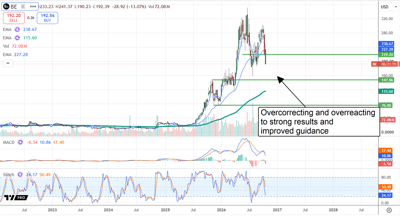
Forces beyond analyst sentiment are also at play, including the recent addition to the S&P 500 Index. That move triggered an accumulation wave in an already-correcting market. After rising about 2,000% over two years to its high, the stock was already pricing in future strength and needed a correction. The narrative today is that the company is still outperforming, driving a bullish outlook and setting up for another upswing in its share price. The catalysts are numerous, but the most powerful would be advancing the Jupiter project or securing a deal to offset it.
The biggest risk to investors is dilution, which has also affected the stock’s price action. The company’s capacity ramp costs money and is being funded, at least in part, through share sales. The bad news is that outstanding shares increased by about 5.5% from year-end 2025 through Q3 2026. However, the balance sheet reflects a robustly growing, solvent business whose biggest challenge is execution. Balance sheet details include a flat cash position, increased receivables, contract assets that quadrupled and higher inventory. Asset growth outpaced liability gains, leaving equity up 2.5x. The likely outcome is that Bloom Energy’s backlog continues to grow, the company converts contracts into capital and fuels its flywheel, which is building momentum.
|